Skoura: On the lip of the Desert

The Dust Storm, the Lost Road, the Oasis and the Richest Man in the World.

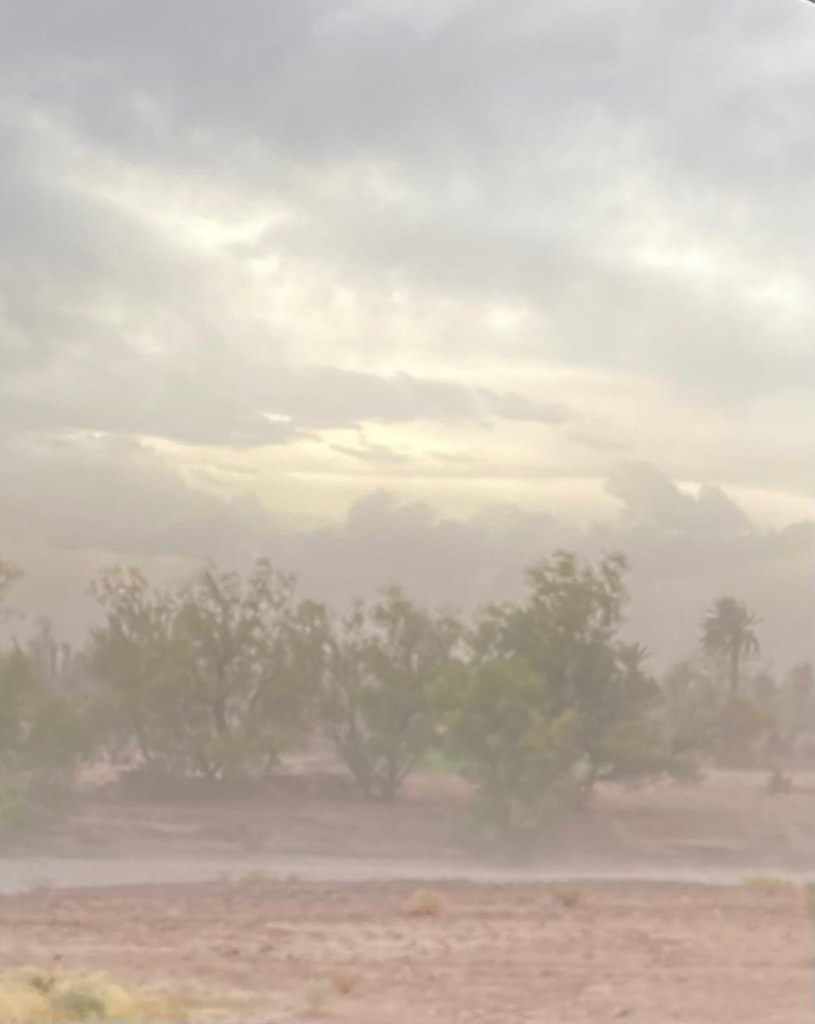
After an entire day driving through the winding roads of the majestic High Atlas Mountains, we were greeted by the sudden burst of hot, dry, desert wind. Its dramatic breath briefly foreshadowed by flying debris and dust, it swept across the green oasis and turned the air to sand, drew a curtain of ochre haze across the sky until the sun was merely a pale suggestion, before dissolving into nothing. The dry riverbed which in other seasons carried the life-giving waters of the Atlas Mountains bellowed clouds of dust into the sky.

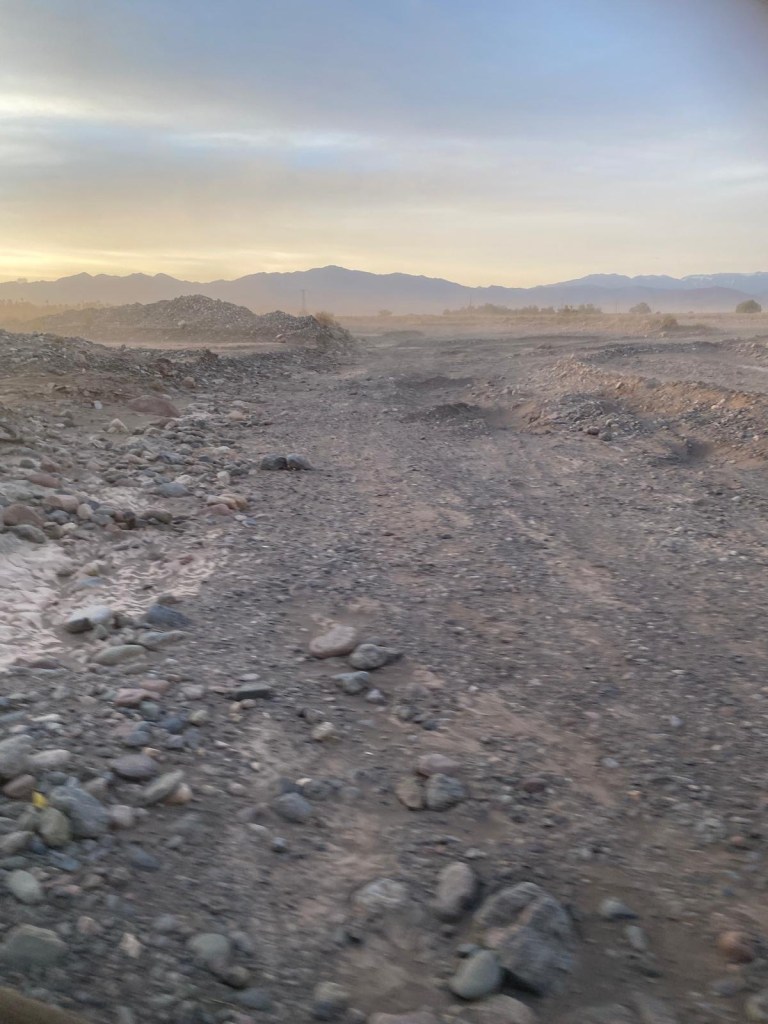
 The palm groves vanished in the haze. We turned off the main road onto a dirt track, chasing GPS directions toward The Sawadi Ecolodge (Thai translation of Sanskrit word for ‘well being’) in the bosom of the palms. The track narrowed. The gravel deepened. The road stopped being a road and became a gravel pit threading between trees we could no longer see. We were lost! As the sand blew the sun sank somewhere behind the dust, its descent invisible except for the ochre and amber haze that began to give way to the darkening horizon.

I reversed slowly, feeling for the edge of the track, the rear tyres sliding on loose stone, trying to retrace two kilometres toward the last certain thing I had known: the paved road.

Then through the blowing wall of sand, a man, his white scarf wound so tightly around his face that only his eyes were visible, moved through the dust storm. He seemed at ease navigating the sudden cloud of dust as a man living close to his own element – moving through in his small scooter barely inconvenienced, like a fish in its own bowl.

I called to him then yelled out the name of the ecolodge over the blowing wind. He raised his arm and gestured into the wall of nothing. I looked. There was only more sand, more shifting shadow, more swirling ambiguity.

Sudden sand storm on the Oasis

Hastily, I assembled a few words of French, Arabic, a set of arm gestures and a smattering of English to ask if he might lead us there. He waved in the opposite direction as if to say his village was the other way. I tried again — the same broken multilingual theatre, the same inventory of gestures — and he looked at me for a long moment with the patience of a man who has seen stranger things than a lost foreigner pleading in three languages at once. His eyes smiled. And then he led the way.

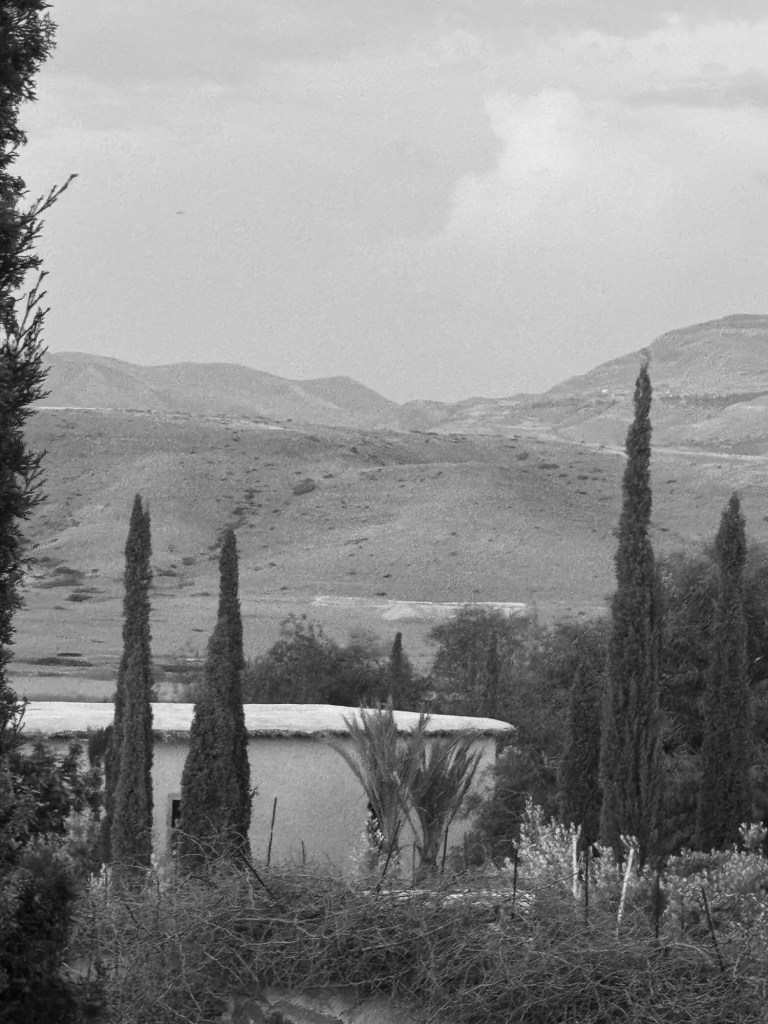
Moon landscape on the edge of Desert

We crept behind him through the storm. He turned often to confirm we were within sight, and then at a sharp bend the narrow kasbah gates of the ecolodge materialized from the dust. In that exact moment, a loud thud went through the chassis of the brand-new rental SUV (that the Avis agent assured us had only one driver before us) and shook us. The rear passenger wheel hung directly over a deep cement gutter running beside the gate and turned aimlessly.

A villager appeared on a bicycle and stared nonplussed at the offending wheel and consulted the motorcyclist in Berber. I joined them. The three of us stood in the blowing sand and studied the problem with the seriousness it deserved. Hand gestures alone were enough for us to fetch large stones and jam them against the bottom of the hanging wheel. (All the while I was congratulating myself for having bought the entire insurance package from the agency – protection from my privilege Visa card be damned!).

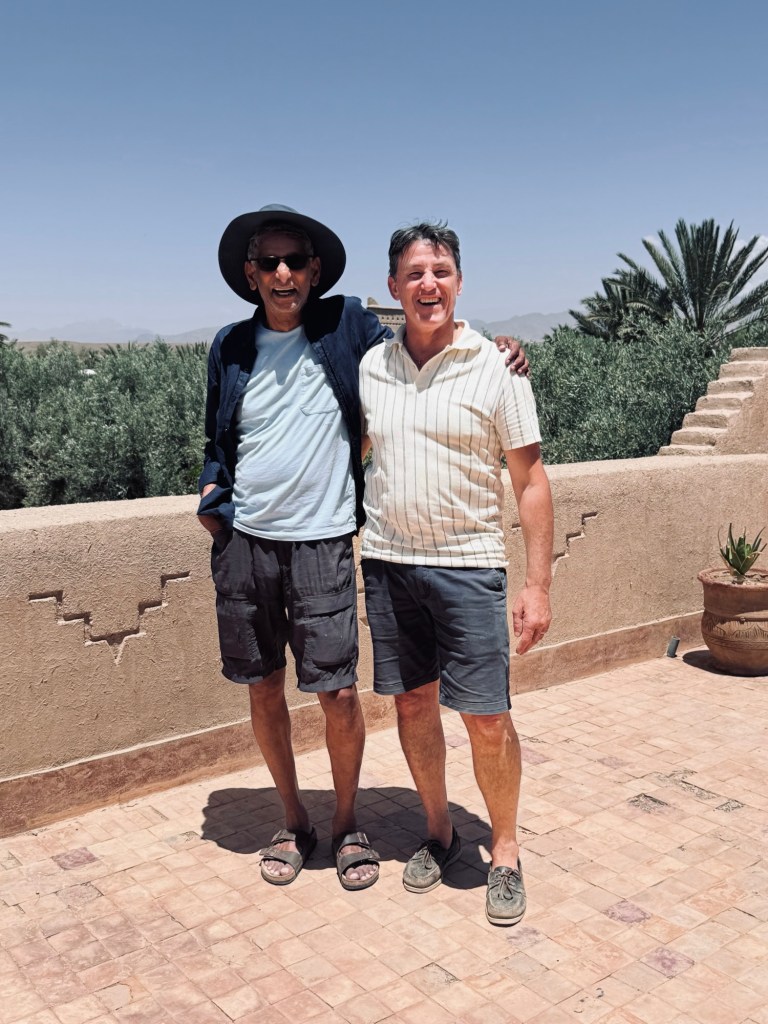
We pushed and rocked. We pushed again. And finally, with a screech the car came free and miraculously unscathed! Our newfound village friends directed us carefully through the narrow gates. Finally unable to suppress their curiosity, they asked if I was from India. Taking this as a cue for camaraderie, I declared, ‘Shah Rukh Khan!’ and they smiled broadly in recognition of the Indian Bollywood star’s name which is a household name in Morocco! It would henceforth be amongst the opening words of any conversation with local villagers.

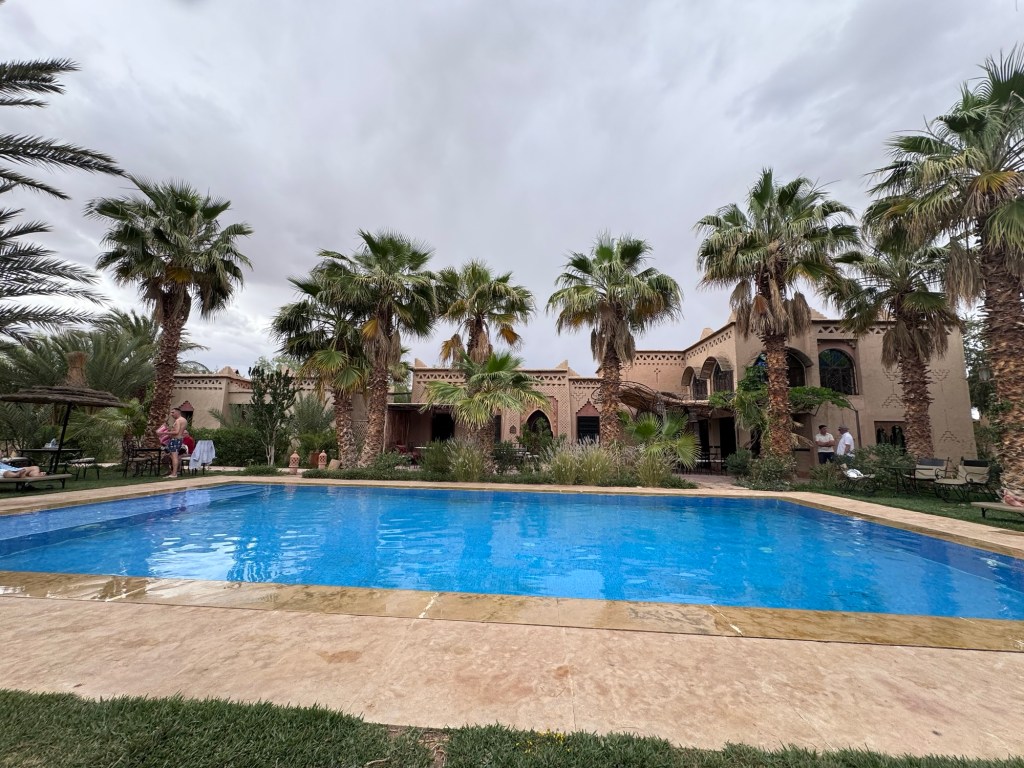
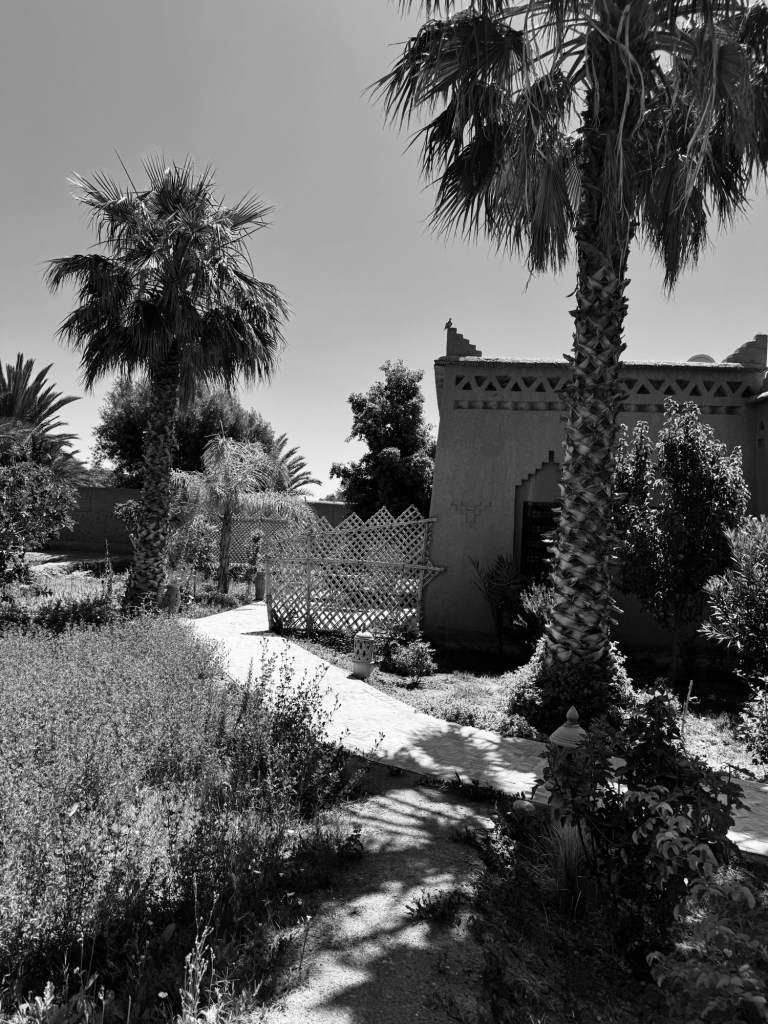
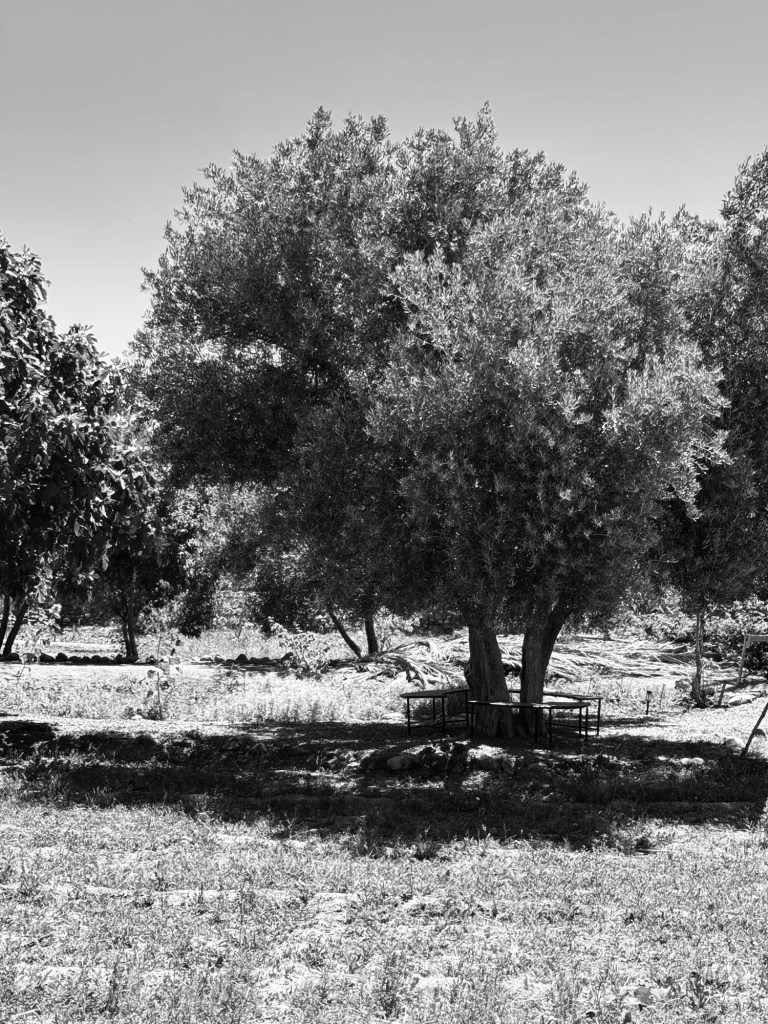
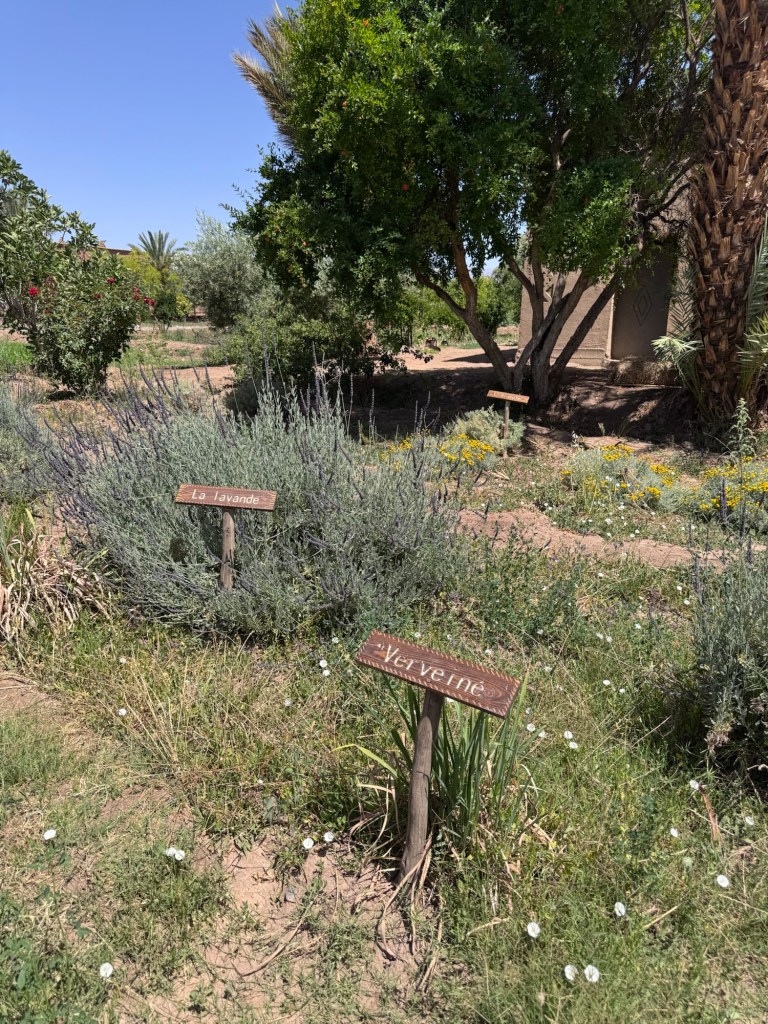
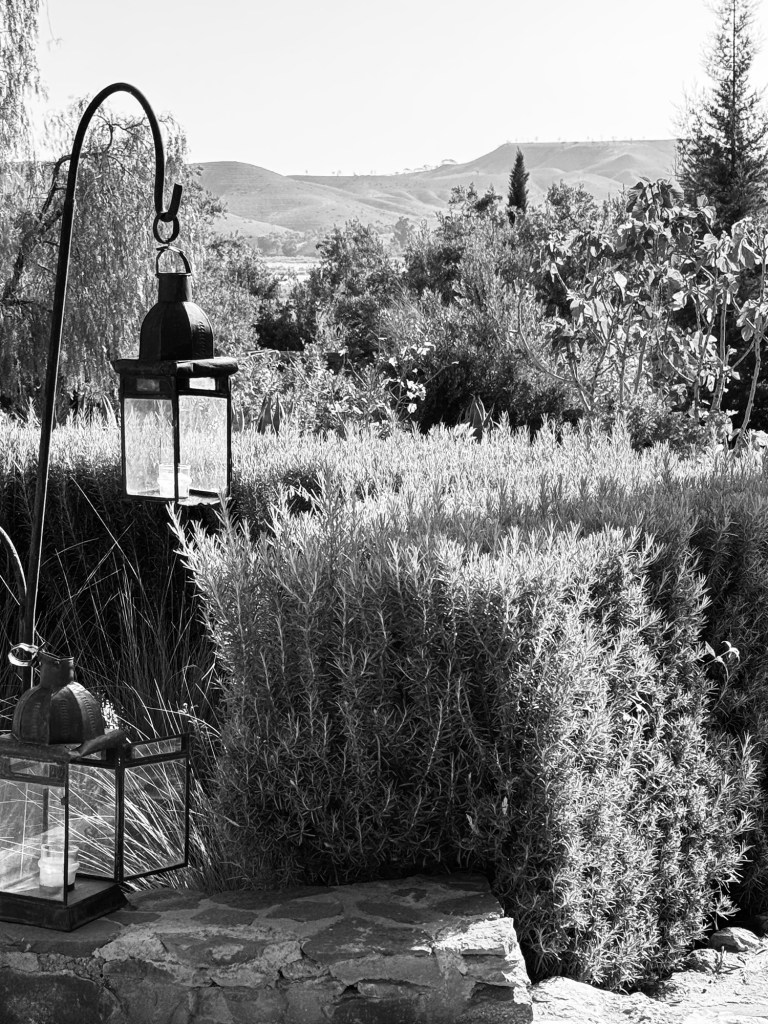
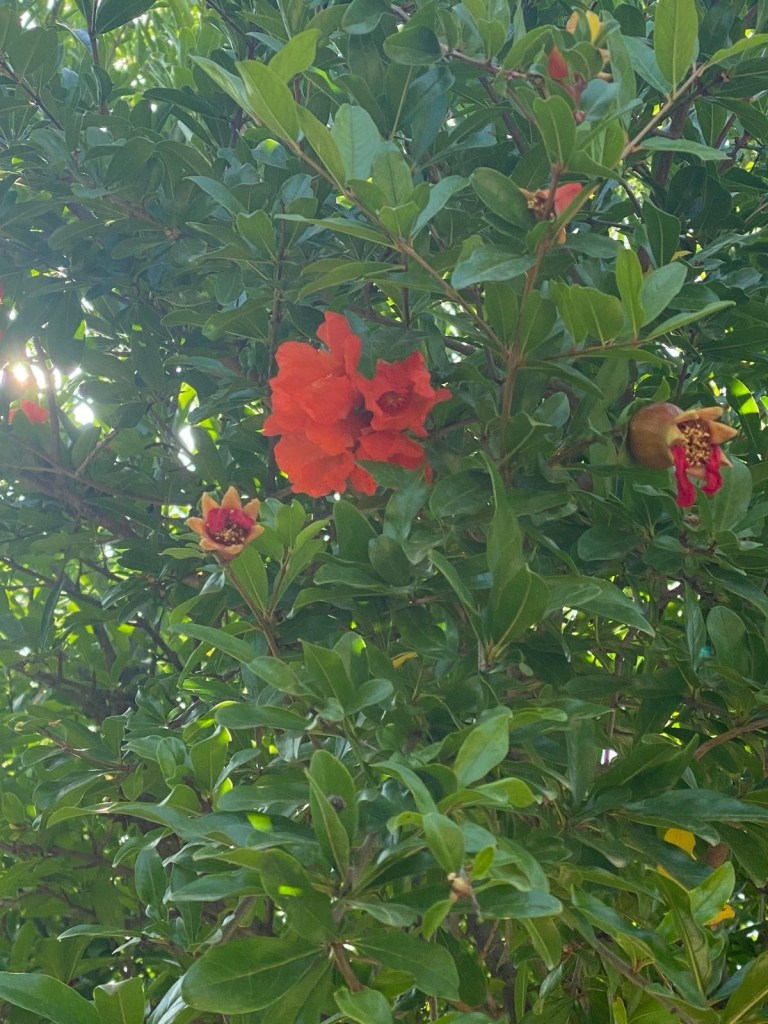
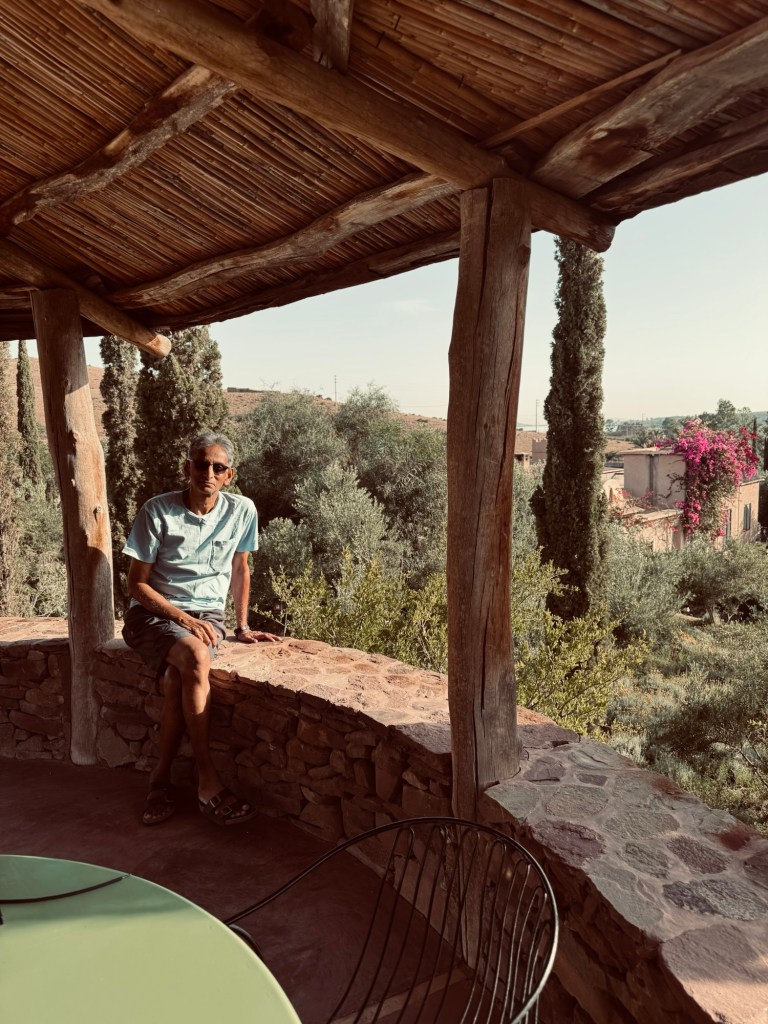
The storm fell away as quickly as it had come. Inside the Sawadi Ecolodge was another world entirely – French guests – almost all of them working for French companies in Casablanca – feasting on organic Moroccan dishes and fine Moroccan wines made by French vineyards, children laughing and jumping in a heated pool, and a remarkable canopy of trees – fig, olive, pomegranate, apricot, grape vines, orange, pear and palms. Mature trees pressed close along the paths that ran beside rows of herbs – coriander, lavender, rosemary, and vegetables – tomatoes, kale, cabbage.

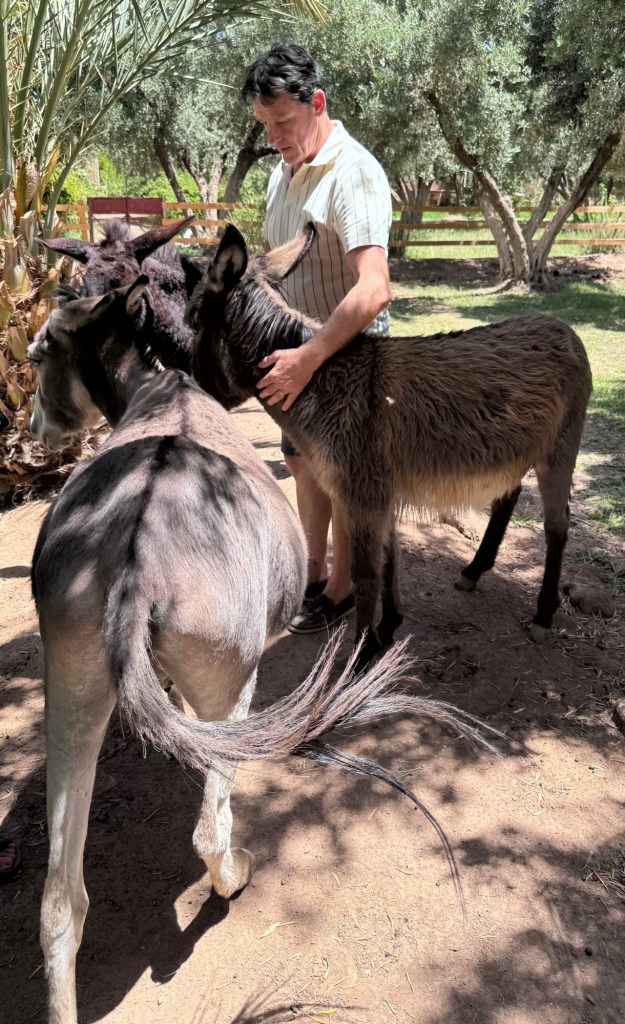
An organic farm every corner of which articulated the two decades of loving labour of Nicola – a Frenchman from Bordeaux – and his family. Nicola greeted us with the unhurried warmth of a man who made exactly the choices he meant to make and had time to grow comfortable with them. Donkeys gathered around him competing for his affection as he whispered warmly into their ears. Chickens, turkeys, horses wandered freely.

The ancient Persian irrigation system, Nicola explained – ran through the entire 4500 hectares of the Skoura oasis through a network of underground canals (khettaras) and above ground channels (sequias) for over three thousand years! The subterranean Atlas Mountain waters were mined into underground wells and carried through interconnected tunnels to gently feed the soil.

“I am the richest of men,” he said, as though reporting a simple fact, when I asked about his life.

“People told me, how do you dare build something here, in a remote part of a country that we colonized?” And he paused before adding dramatically, “They may despise you for what your history did to theirs?” He had listened to every version of the warning. Then his face broke into its wide, uninhibited smile.

“C’est la vie,” he said as only a Frenchman could shrug “Everyone who lives in fear will find the object of their fear. N’est-ce pas?” He laughed, easily, and generously. “I have a wife and four children. That is all the wealth I need. This place is all the ambition I ever had”

Outside the walls, the oasis of Skoura continued its ancient work — sustaining, yielding, receiving — as it had for millennia. The oasis is not merely land made fertile. It is a living argument, three thousand years long, that ingenuity, water, and patience, given enough time, can make even the desert generous.

It refreshes the body and restores the soul. And occasionally, if you arrive in a sandstorm and fall into a gutter to be led out through the dark by a man with kind eyes and a white scarf, it will also make you feel, however briefly, like the richest of travellers. 

Ode to the Atlas Mountains

The light arrives unseen like a whispered rumour.

slow suffusion through the Atlas foothills

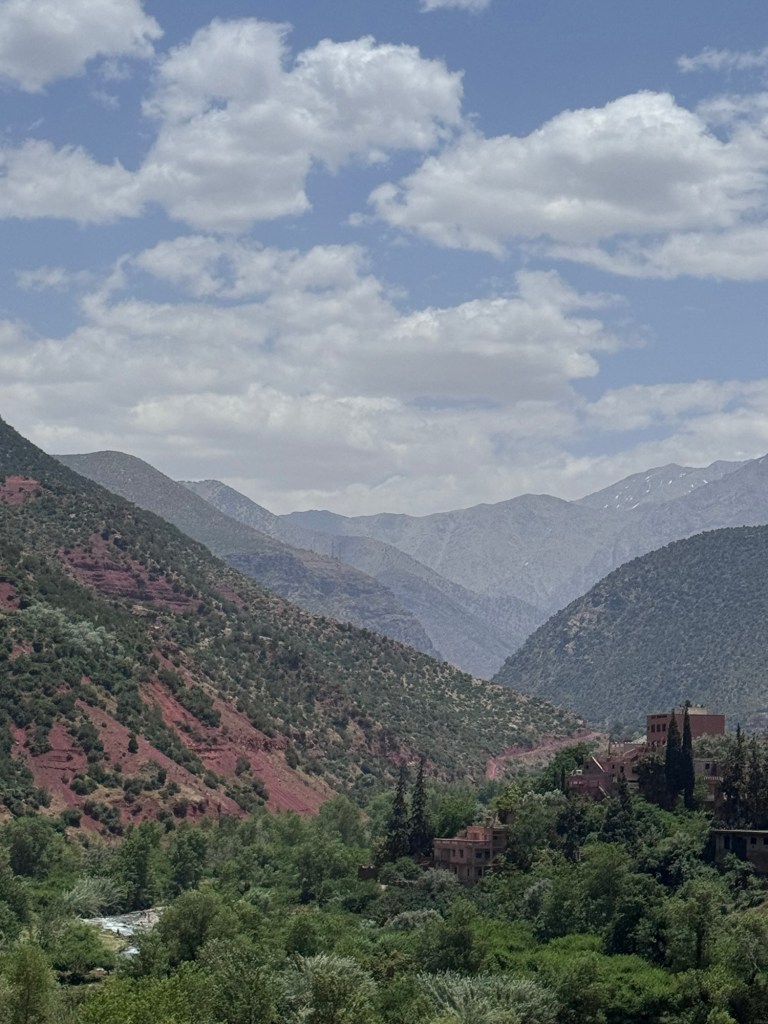
Deeply embracing orchards of pomegranate, orange, fig, olive, and proud cypress.

The mountain breaths between inaudible intimations,

Its sound moves through the foothill grasses

Which lean and prostrate in the way of believers

toward something they cannot name.

And the sound of the mourning dove becomes a prayer echoing through the hills.
Far from the spotless roads of tourist convoys,

The dusty trails through dusty forgotten villages remember their origin

the slow press of caravans out of Africa

out of Mali through the heart of the Sahara,

gold counted before watchful eyes, salt weighed against it,

moving northward toward the colossus of Marrakech.

Solemnly passing the Kasbah of Ait Benhaddou, ten centuries settled

into its hillside like words lodged in the throat of time,

its kasbah is smeared with dark earth: black dirt, black clay carved into a black fortress.
A lone sentinel watching the trade route etched into the very sand.
Along which empires emerged and crumbled

Hesiod saw a god here first.

Ovid agreed.

They pressed a name onto these peaks

that were nameless well before antiquity.

Atlas, the Titan at the rim of the known world,

sentenced to carry the sky on his shoulders

so that the rest of life might live.

The truths of geological causation cannot capture the wonder

That Perseus, son of Zeus, lifted Medusa’s severed head

those petrifying eyes turned toward

a face already made of stone?

Or had these mountains always been

that myth’s conclusion, the skull

made into summit, the anguish

folded into limestone over eons

until it became something beautiful

and indifferent and permanent?

No one answered.

The gods grew quiet, the way gods do

when a more insistent voice arrives.


The shrill cry of the muezzin’s call.

On the morning of Eid El Adha,

A call that unspools across the dusty villages,

  •  light draped like linen
  • every hill and minaret and crumbling wall,

and it does not ask — it announces:

  • that sacrifice is the oldest grammar,
  •  Abraham raised his knife
  • The ram is in the thicket
  • The only witness, the high Atlas.
  • grasses bend again
  • orange trees do not move.
  • The light, still arriving, says nothing
  • And means even less by its silences

The Medinas of Marrakech -A Living History in Cobblestone

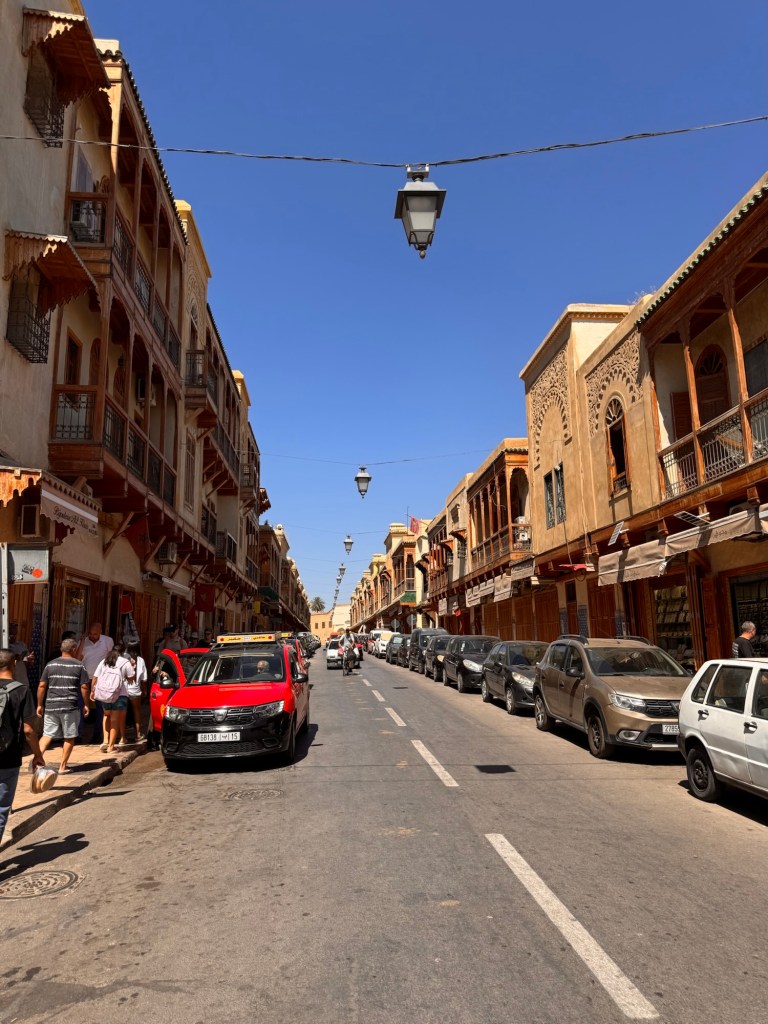
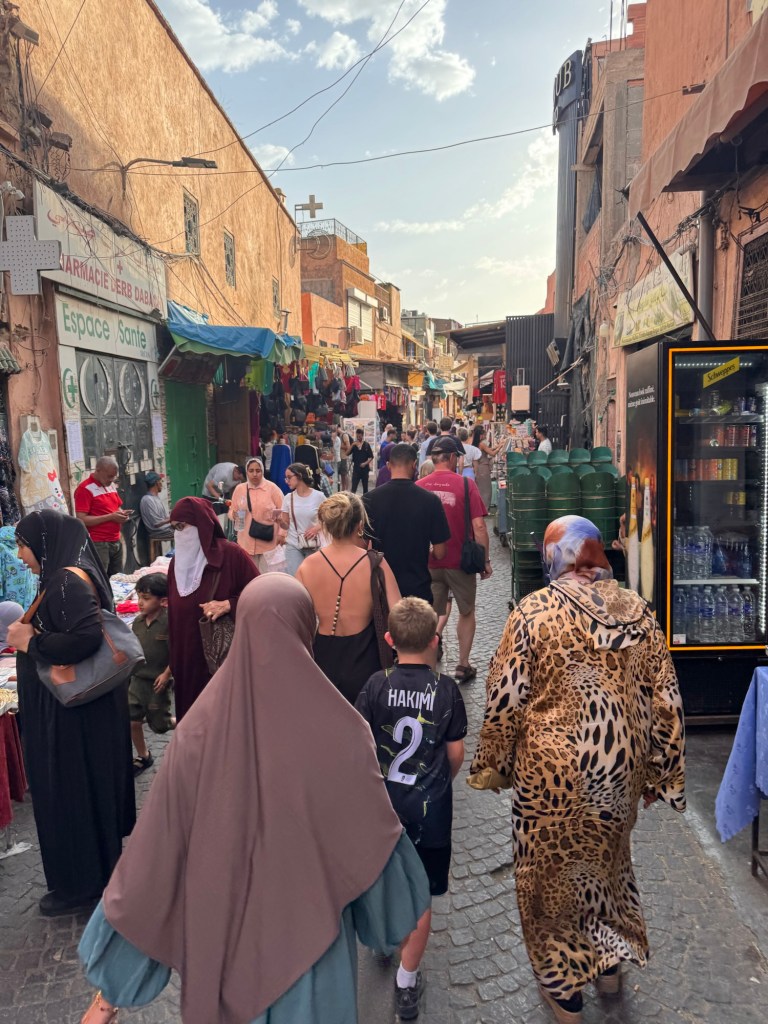
The chaos of Marrakech begins the moment you enter the Medina, that ancient, enchanted part of the city packed with narrow alleys, tiny shops (souks), restaurants, mysterious doorways, and people who all seem to know exactly where you should go, even when they do not.

In truth, the adventure begins even earlier, the moment you take a taxi towards the Medina. Your first encounter with Marrakech will certainly be a short but educational haggling session with the taxi driver, a contest that you will leave you with a slight loss of dignity, a little confusion, and certainly deprived of a  larger banknote than you ought. The driver will then assure you, with magnificent confidence, that he can take you directly to your riad, one of those traditional Moroccan houses now transformed into small, opulent hotels.

This is, of course, impossible.

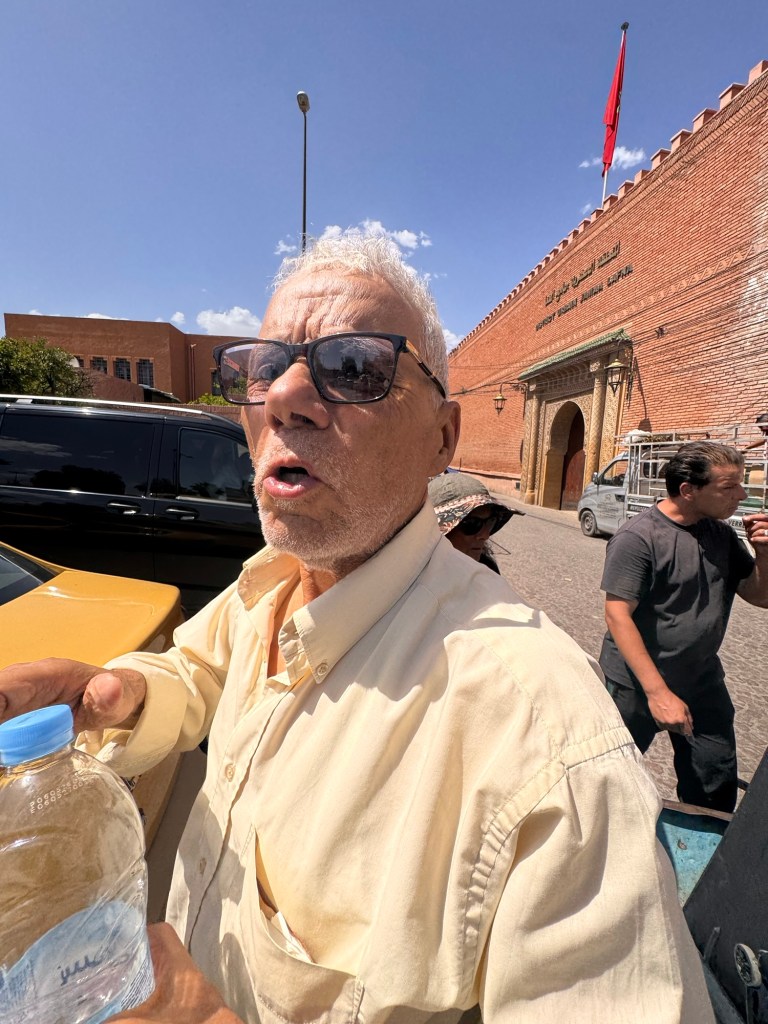
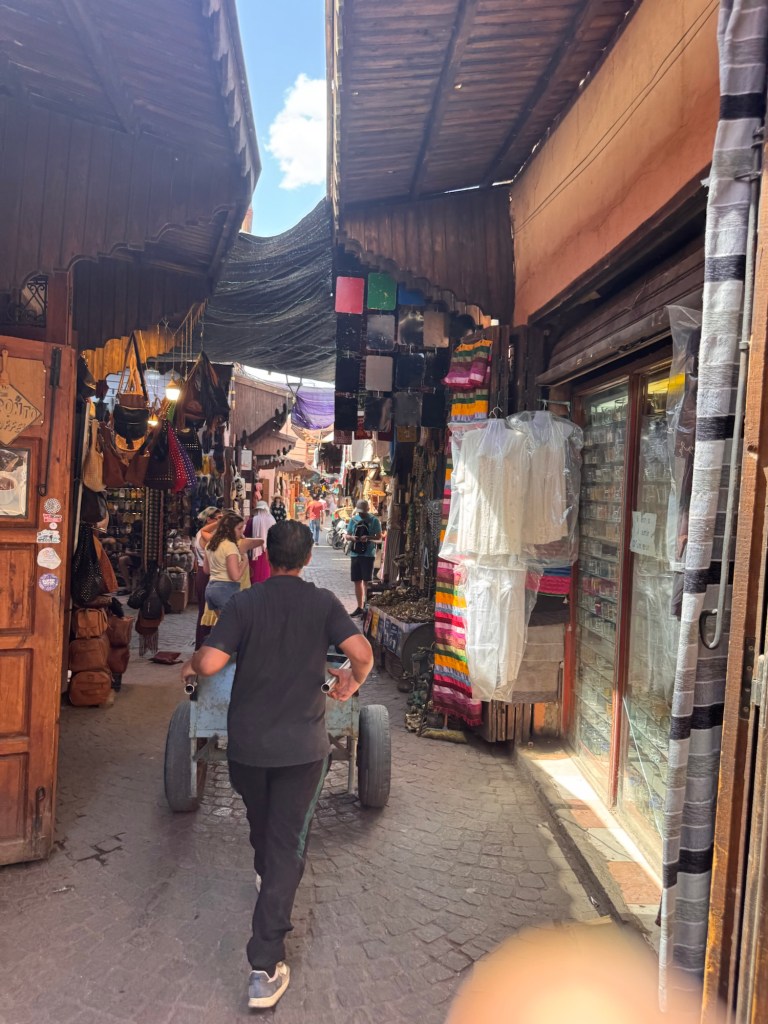
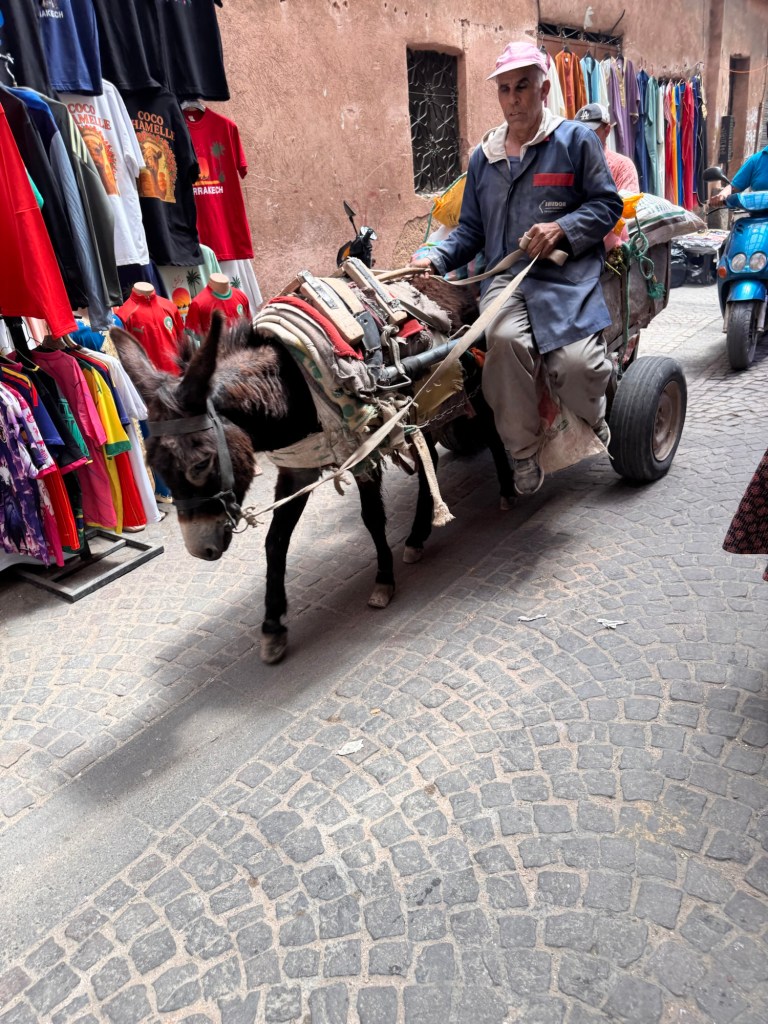
Taxis cannot enter most of the Medina. The true art lies in discovering how close the driver can get you, which may or may not be the same as how close he finds convenient. There will follow a lively discussion with several strangers in a mix of languages, some not fully shared by both parties. At this point, the helpful onlookers will appear and kindly recommend a man with a hand-drawn cart, who will transport your bags through the alleys and, naturally, guarantee that he knows the way to your riad.

He may even know it.

Then begins the next stage of the expedition: consultations with strangers, shopkeepers, boys on bicycles, elderly men seated in doorways, and passers-by who wave their arms with great authority. Directions will arrive in a cheerful mixture of Arabic, Berber, French, and occasional English, all accompanied by sweeping gestures that show a direction with some authority. You will follow the man with the cart through alleys that narrow, twist, vanish, and reappear. There will be children kicking soccer balls, women in hijab whispering to each other as you pass, and old men smoking meditatively in the shade.

Eventually, and sometimes quite suddenly, you will arrive at your riad.

For travellers who dislike uncertainty, unlike those of us who nobly insist that uncertainty is the very soul of travel, it is wiser to contact the riad well before arrival. They can arrange a pre-negotiated taxi and a pre-negotiated man with a pre-negotiated cart. This will save you several unknowns, a few unnecessary alleys, thirty minutes of wandering, and a great many arm gesture and most certainly with more money.

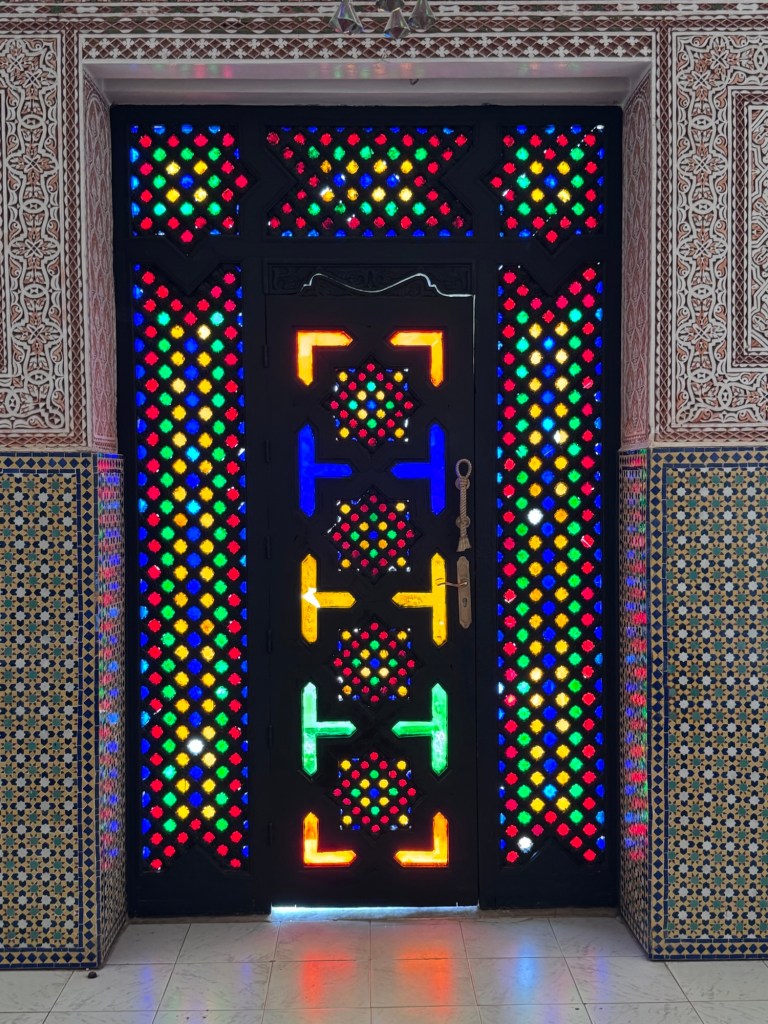
But if you do arrive by the more traditional method, slightly dazed and gently cooked by the heat, you begin to understand something essential about Marrakech. The history and culture of Morocco are built into the thousand-year-old cobbled lanes, the rhythm of life in narrow alleys, the weathered wooden doors, the ornate ironwork, the hidden courtyards, and the cool, serene riads concealed behind plain walls.

The ancient Medina was, in its own way, a natural fortress. Invaders would have had to pass through narrow alleys two or three at a time, vulnerable from both sides and from the rooftops above. Today, the same alleys defend the city against a different enemy: the overconfident tourist with a wheeled suitcase.

The preservation of Morocco’s medinas also owes much to French colonial history. In the early twentieth century, Marshal Lyautey, the French Resident-General, and his urban planner Henri Prost developed a policy that preserved the old medinas as living heritage while building modern districts around them. Whatever the contradictions of colonial rule, this decision helped protect the ancient urban fabric that gives cities like Marrakech their enduring character- the source of one of Morocco’s biggest industries, tourism.

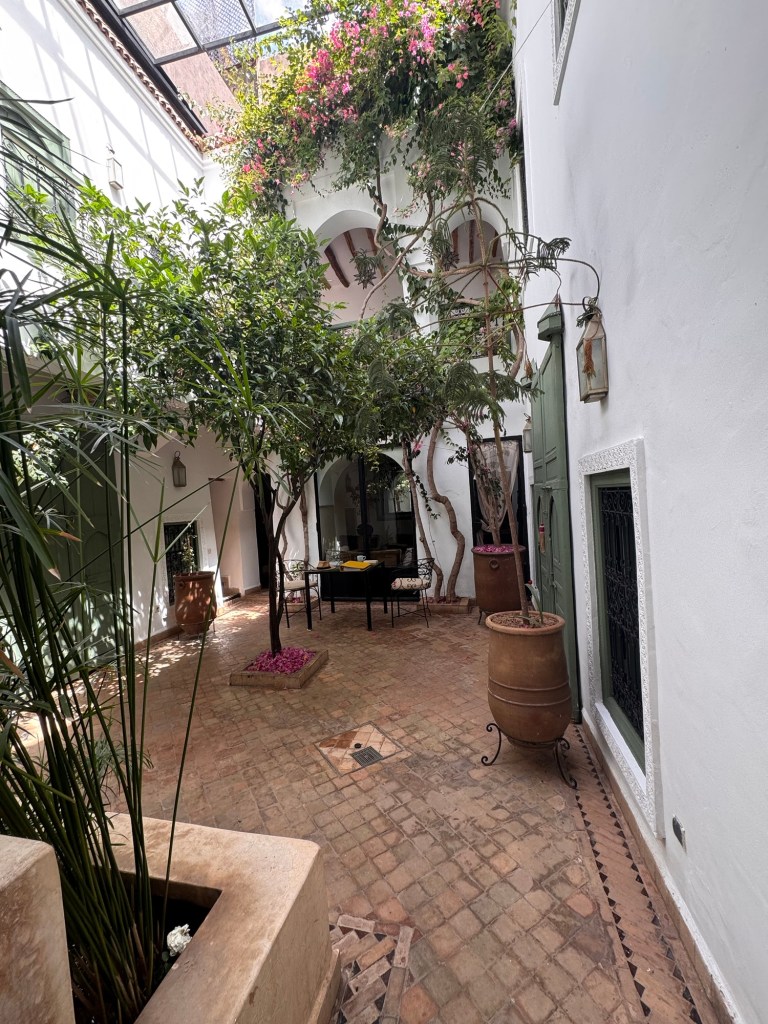
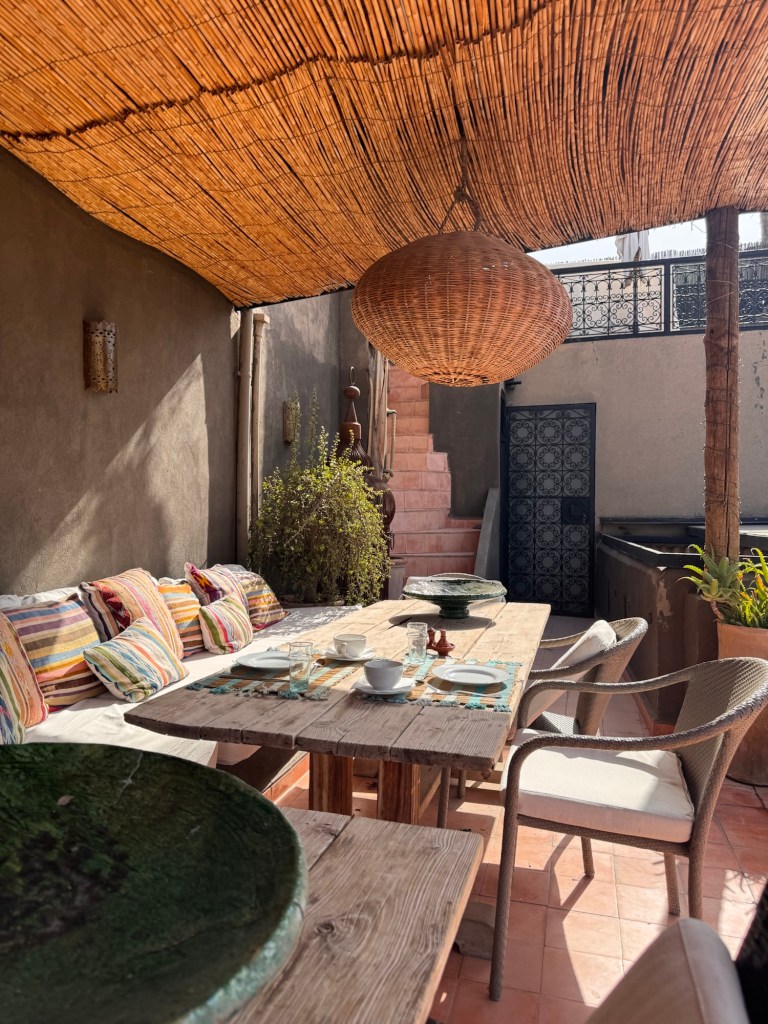
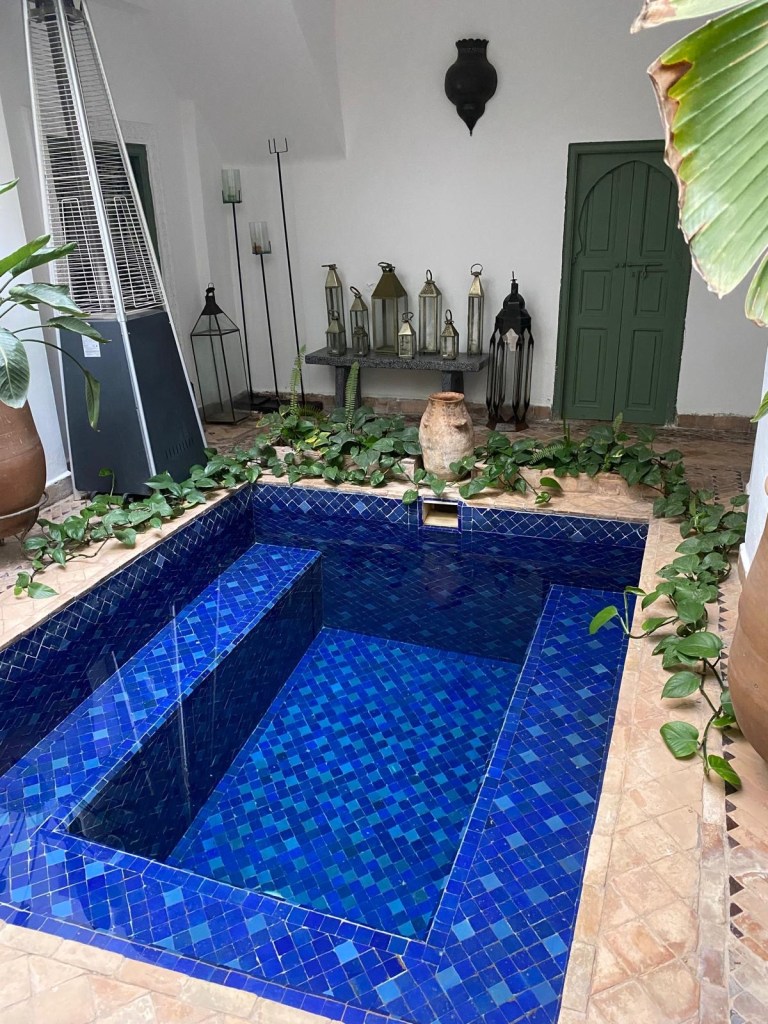
The riads themselves are marvels of discreet beauty. From the outside, many appear almost secretive, with high walls, few windows, and heavy doors. But step inside and the world changes. There are open-roofed courtyards, tiled pools, shaded gardens, carved plaster, polished wood, and rooms arranged around silence and cool air. Many offer generous breakfasts, extravagant rooftop dinners, and midday refuge from the forty-degree heat.

After wandering through the Medina’s magnificent confusion, that first glass of mint tea in the shade feels less like hospitality and more like rescue. As evening descends the snake charmers, street musicians and hawkers emerge, and life bustles in the retreating light- restaurants serving traditional Marrakech tajines – meats slow cooked in clay – and a host of other cuisines. In the face of the retreating sun, the loud thumping beats of the flying, somersaulting circus youth give way to the late afternoon prayers flowing out of mosque into the marketplace turning noise temporarily into silent whispers before erupting again as the muezzins cry fades into narrow alleys.

Sunrise in the Kruger

A poem only because kruger is otherwise ineffable

Profound silences abide in the savannah 

Even as robin, dove, and whistling lark sing

their notes rise—an allegro to the light— 

While dawn spills a golden gown on the plain.


There is no cruelty here—only truth,

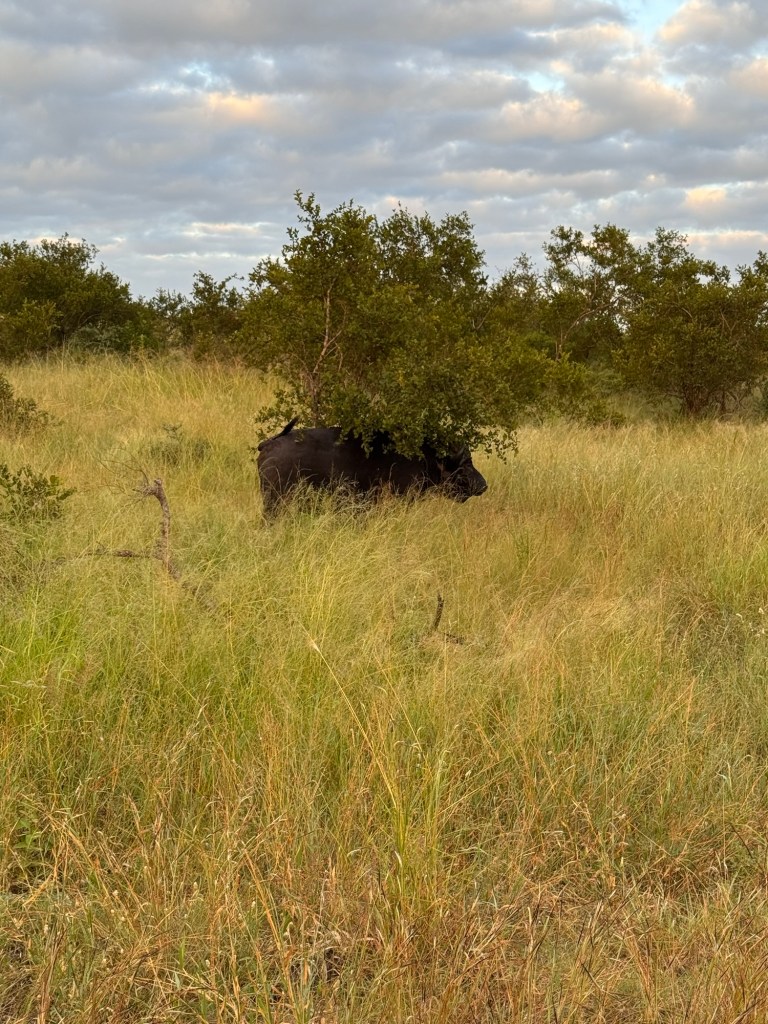
The buffalo combs its back on the brush   

Impalas graze wary of movement and sound

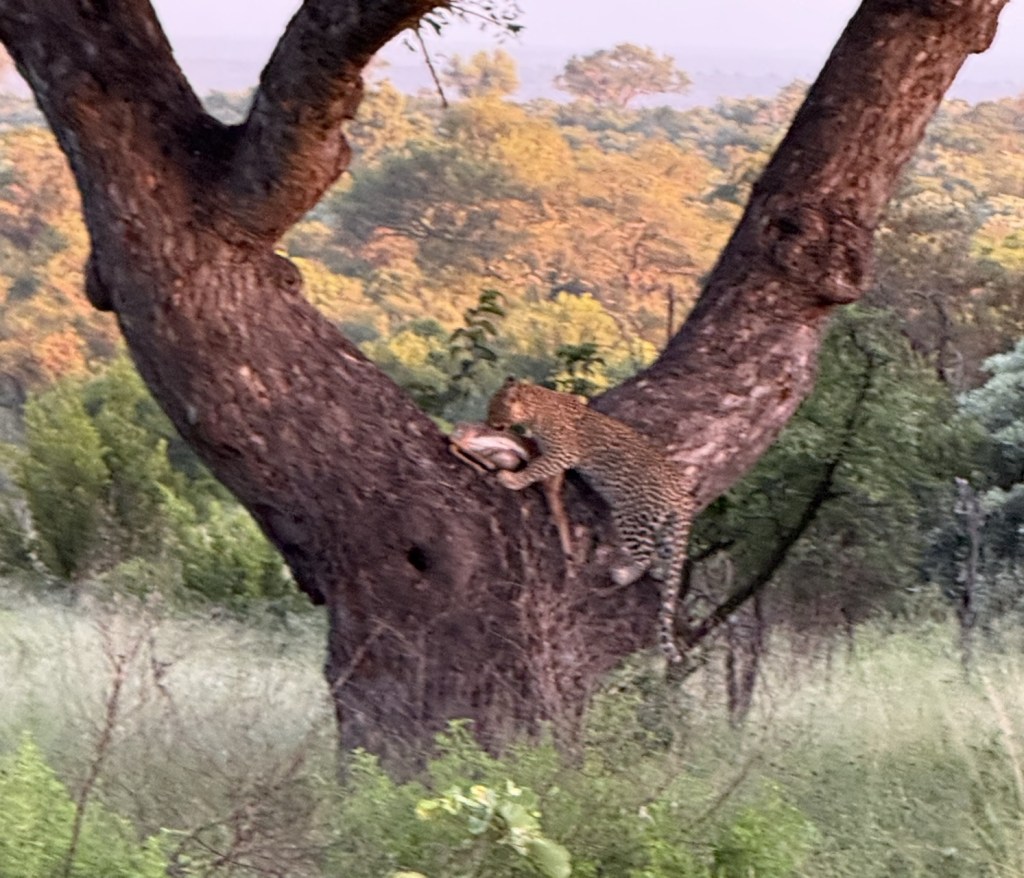
A leopard stares into the sun with its lifeless prey

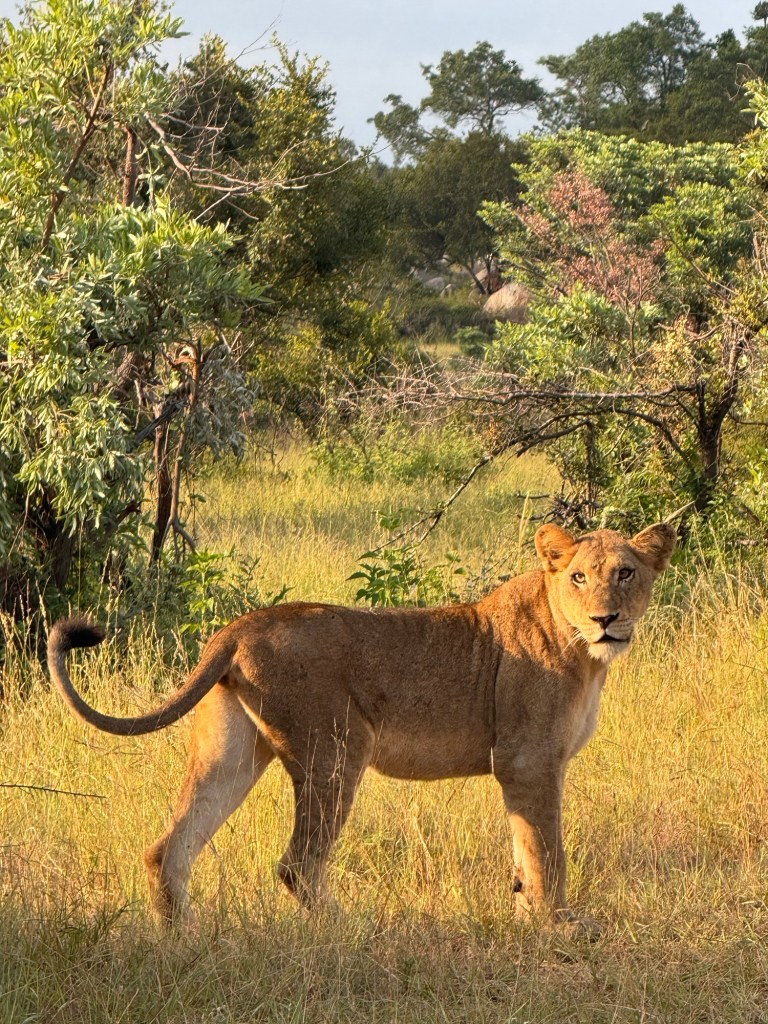
Kruger is South Africa’s gift to the world

her voices many but in jarring rhythm

her wilderness a mirror for man’s forgotten soul

Both bear savagery and awe in every breath

A Day in a Xhosa Village

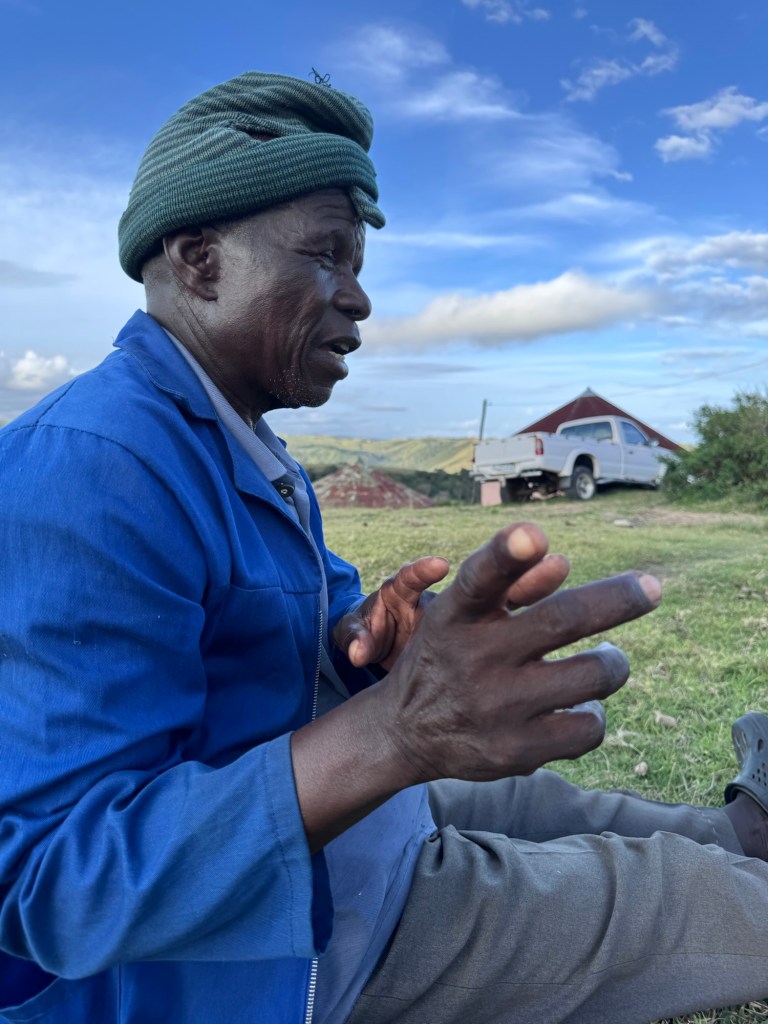
It was better for us then,” he said when I asked him about life during apartheid. The afternoon heat drifted into dusk as Team, the seventy-four-year-old man sat uphill from his mud-and-clay house, gazing toward the Indian Ocean. In these hills of the former Transkei—once a homeland carved by South Africa’s apartheid planners for Xhosa-speaking people—Team is known as the village’s oldest man, a keeper of stories that straddle two eras.

“Back then,” he continues, his hands tracing invisible circles in the air, “white people didn’t come here. We had no money, so we made everything ourselves. We grew food, built our homes, traded with our neighbours. Now things come from everywhere, and we have money—but it’s worth nothing because everything is so expensive. We’ve forgotten how to make our own things.”

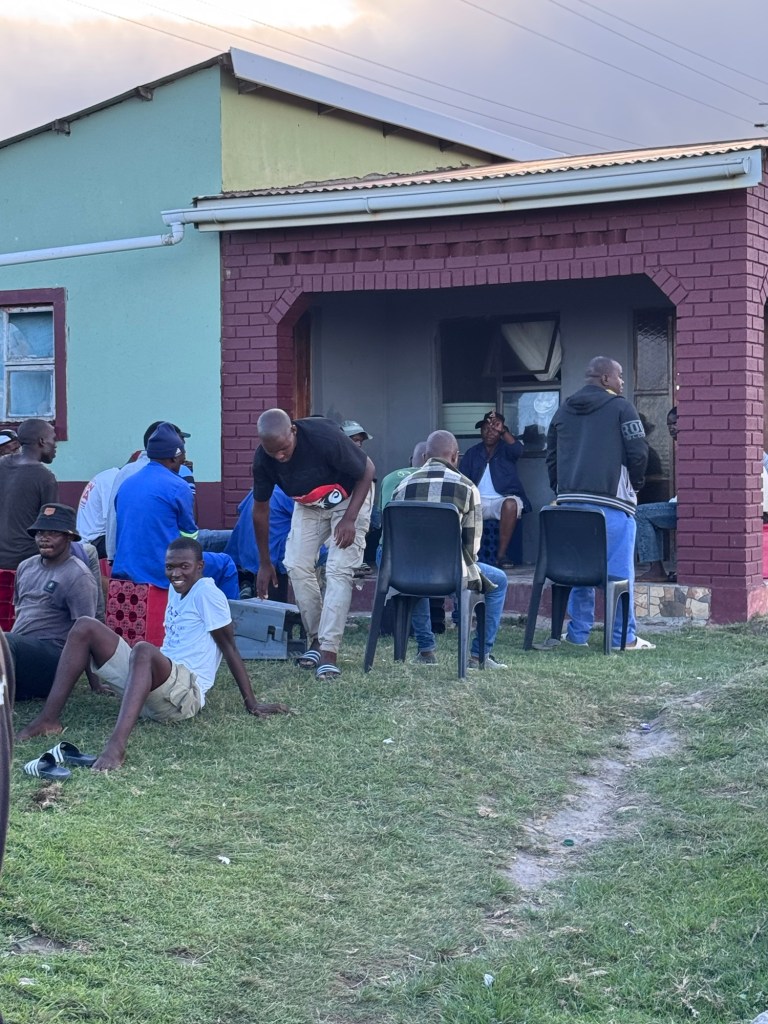
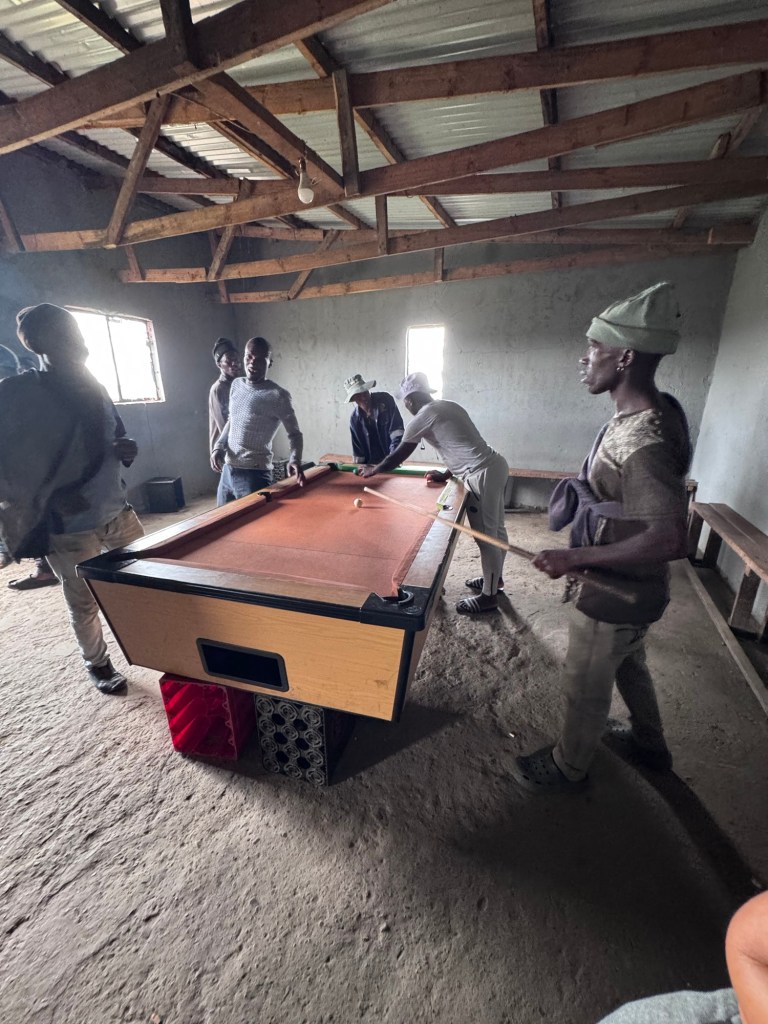
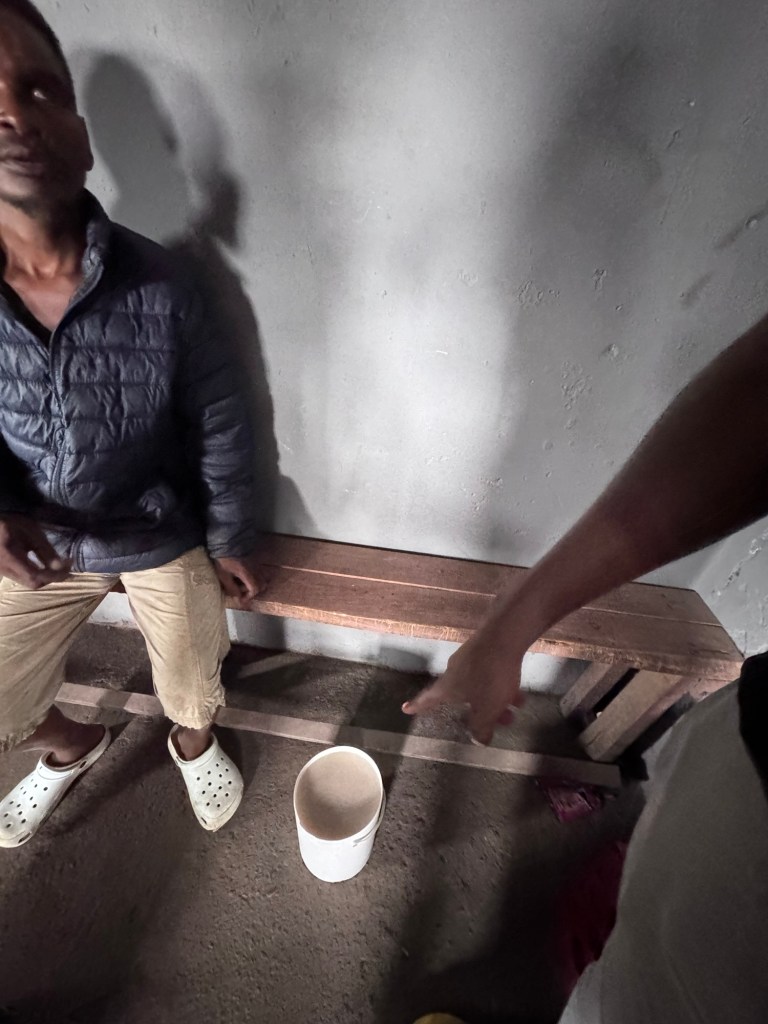
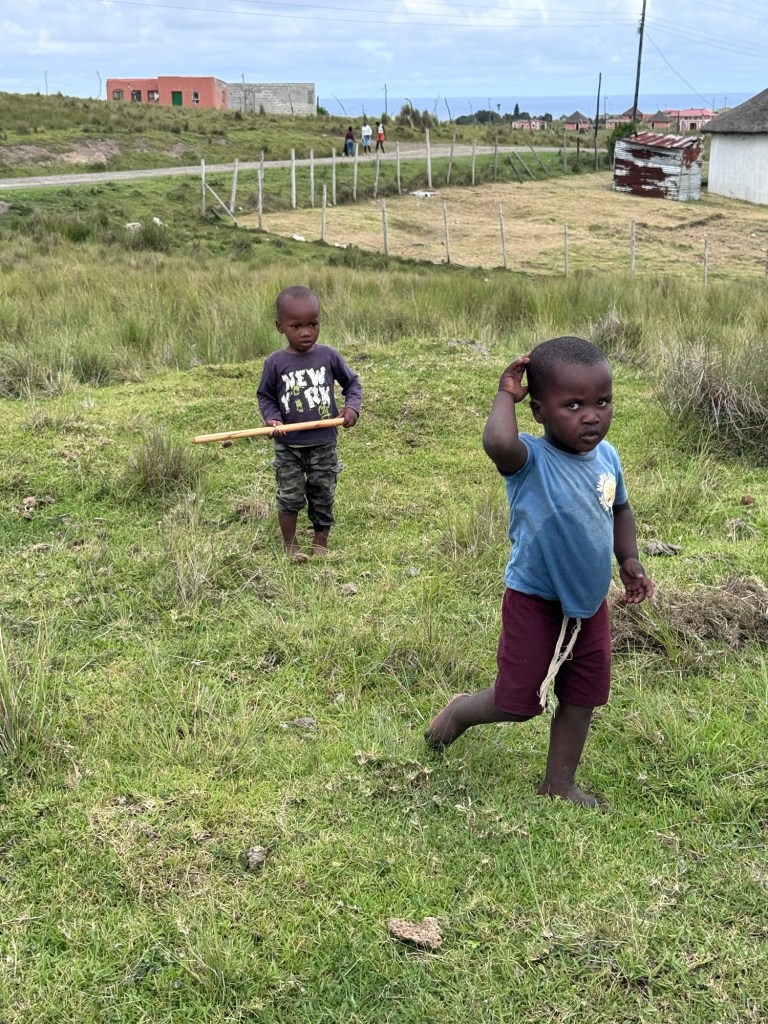
Below the ridge, a knot of men debate animatedly, voices rising and falling over a dispute between two villagers. The traditional council mediates quarrels here, calling the police only when talk fails. Around them, the rhythm of village life continues: cattle move lazily through the grass, sheep float like clouds in the expansive landscape, chickens dart between stones, children chase a tattered, deflated soccer ball. On top of the hill, a group of young men laugh aloud at the bar while playing on a dilapidated pool table, dipping their mugs into a bucket of home-made beer. Far off, the waves fall silently toward an empty beach.

“At least now we can go anywhere,” Team said, his eyes brightening. “The young can travel for work and send money home.” He speaks in Xhosa, each sentence adorned with the unique, crisp clicks of the tongue. When I asked if they truly lived without money, he stops and grimaces. “No. When we needed it, I went to the mines.” He gestures northward. “I took the bus to Mthatha. There they gave me an identity card, then sent us by train to the coal mines. I worked six, seven months at a time. Then I came back and bought some cows.

As my guide, S’Bo, translates, Team’s hand sweeps across the distant horizon beyond the Mngazi River—ten miles away—then his arm plunged straight down to the earth. “The mines were that deep,” he says. “No protection. No masks. Many men died of tuberculosis. If you were hurt or sick, they sent you home with a little money. There were no doctors.”

His words hang heavy in the air. My mind raced to find language for this strange feeling: a kind of affection for a harsh regime. I’ve read memoirs of prisoners who recall confinement with strange tenderness, of hostages who sympathize with their captors—but nostalgia for apartheid feels like something else entirely: an ache for the small tenderness of a simple life now transformed into the chaos of freedom and choice.

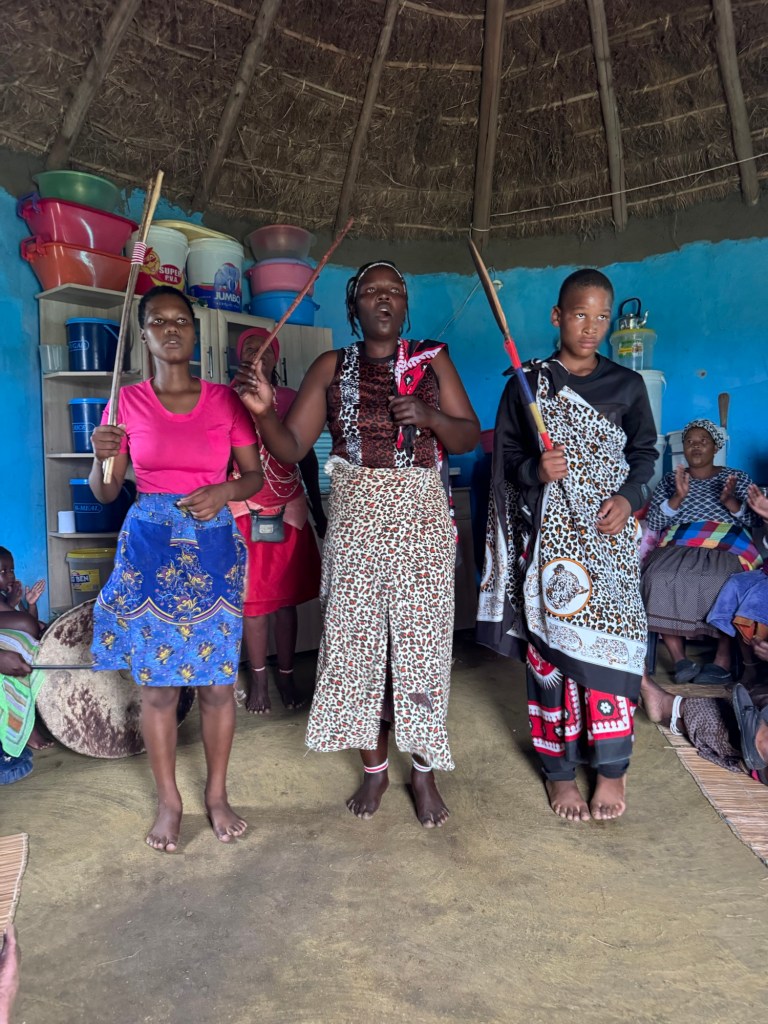
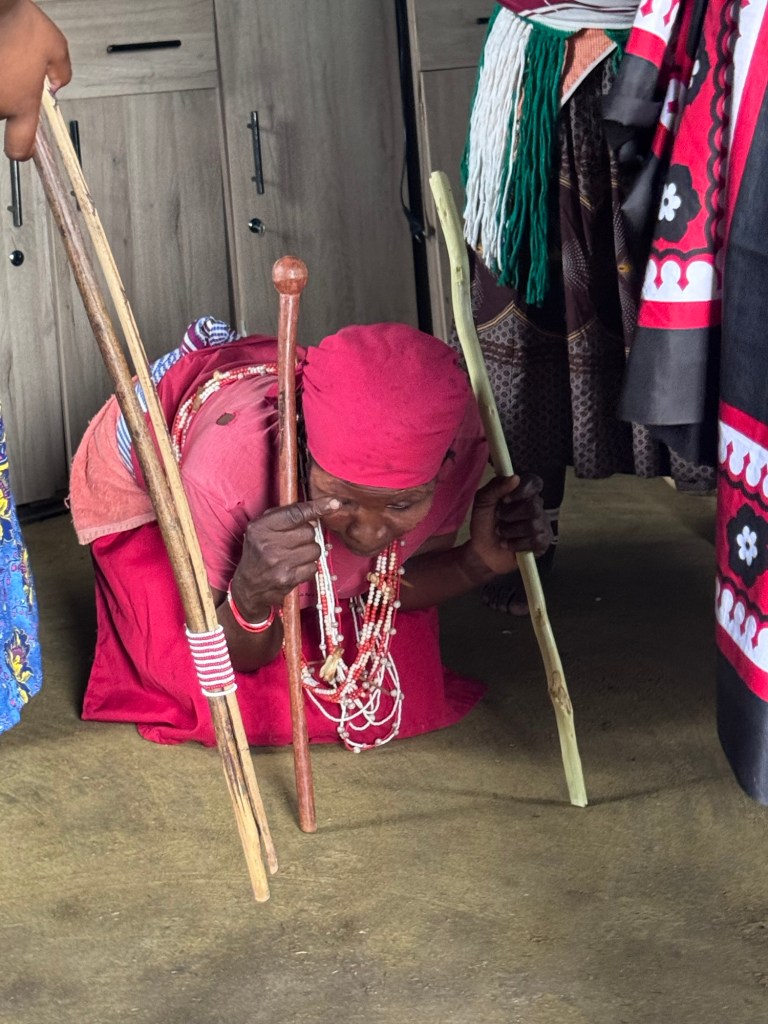
Earlier that day, S’Bo had taken us to a healing ceremony in a traditional circular rondavel home. Women and children crowded the earthen floor, clapping in rhythm as three dancers—bodies upright, feet stamping with fierce grace—circled a small fire kindled with sage. When the drumming ceased, two healers knelt, whispering prayers through a haze of aromatic smoke, careful not to sever the fragile link to the ancestors.

Outside, the Transkei hills burned gold in the last light, and the voices from the bar up the slope drifted down—laughter, the clack of pool balls, music rising and falling on a popular Zulu pop song. Somewhere between old constraints and new freedoms, the spirit of this land endures, wrapped in both sorrow and resilience.

Transkei: a living tragedy of apartheid with unseen joys

The mountains of the Transkei darkened under a swift-moving mist, swallowing horizon and hill with unnerving speed. This was once a semi-autonomous homeland—an apartheid creation roughly the size of Denmark—where Xhosa-speaking people were exiled in 1959 – many stripped of their South African citizenship anywhere in the country. It is the longest and most thorough suppression of human spirit which finally ended with Nelson Mandela’s release in 1990.


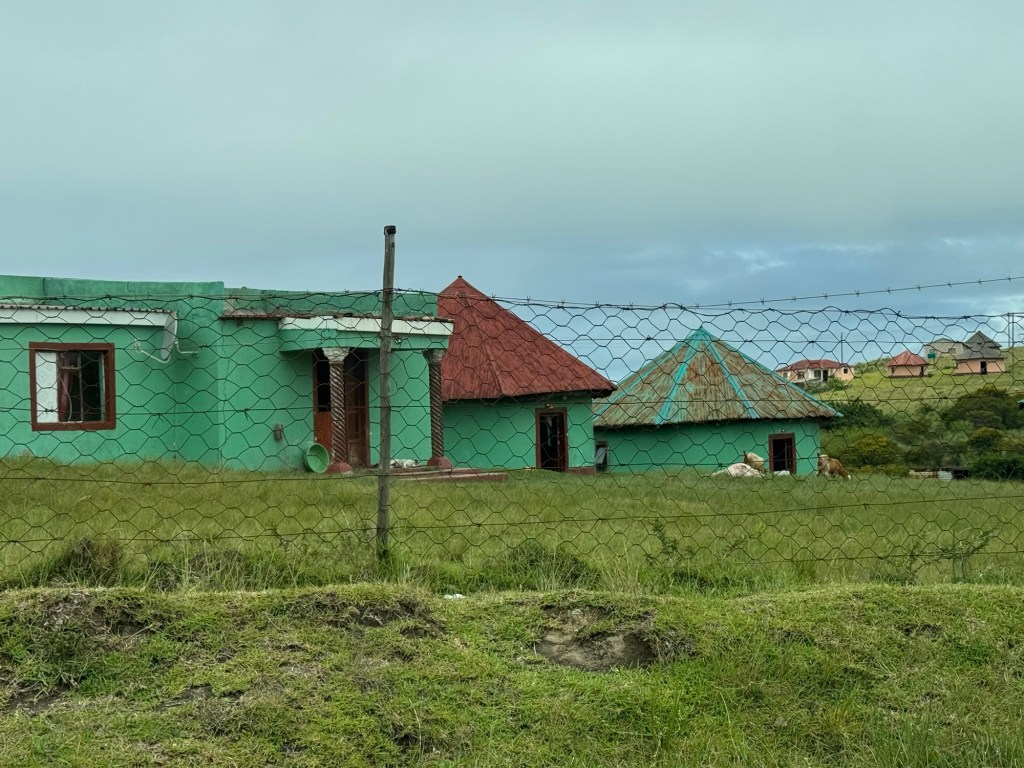
Traditional Rondavel style homes

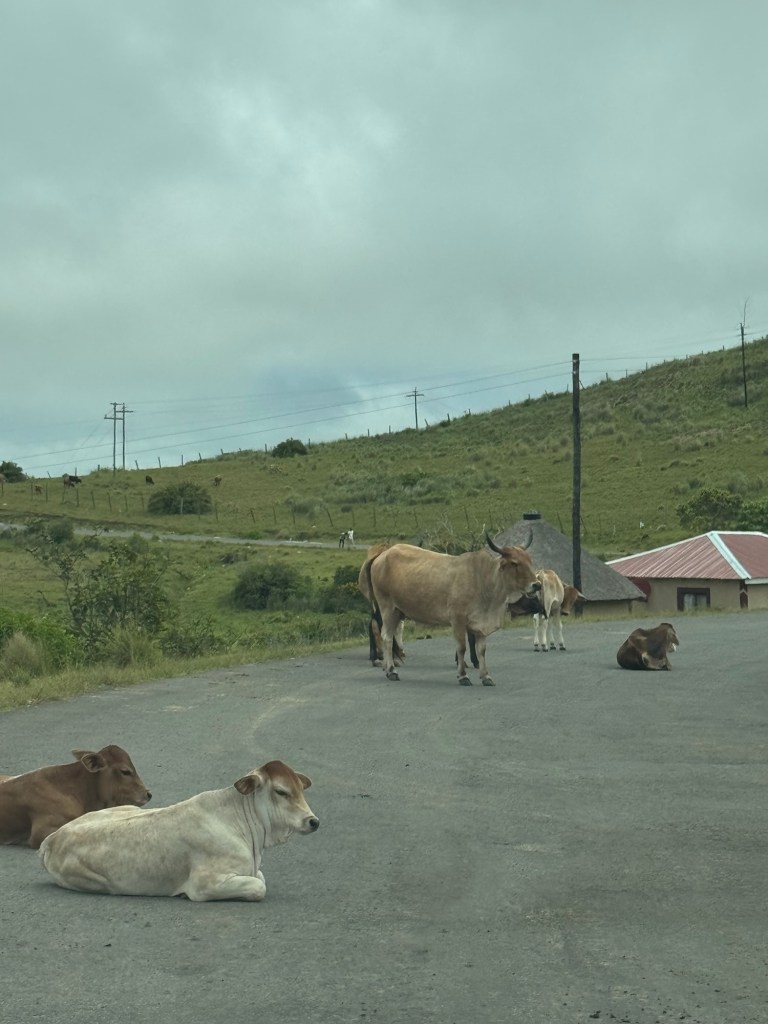
 By half past five, the narrow, potholed road merged into the evening sky, dissolving the line between earth and cloud. Shapes emerged like ghosts through vapour—children on their way home, goats, cattle, dogs, horses. Animals stood adrift in the grey, drawn to the tarmac as the rain softened and cooled the porous soil on the sides of the road. The drive to the village of Coffee Bay is worse than I had been forewarned. The village is so remote that reputable travel guides don’t even mention it. Yet, it is the home of the crown jewel of the Wild Coast: Hole in the Wall.

Cows idling on the road the day after the rain and fog

Villages pressed close to the road.  What little traffic there was had disappeared, leaving us the lone car for miles at a time. Speed bumps erupted from the surface without warning—some marked by reflectors, some not. In many stretches, the white lines simply vanished, and the only guide was the faint grass edging the road.

By seven-thirty, the fog had devoured the landscape entirely. All past cautions—friends, guidebooks, roadside warnings—echoed through my mind: Never drive through the Transkei after dark. Yet here I was, pulse quickening, breath deepening in a vain attempt to be calm.

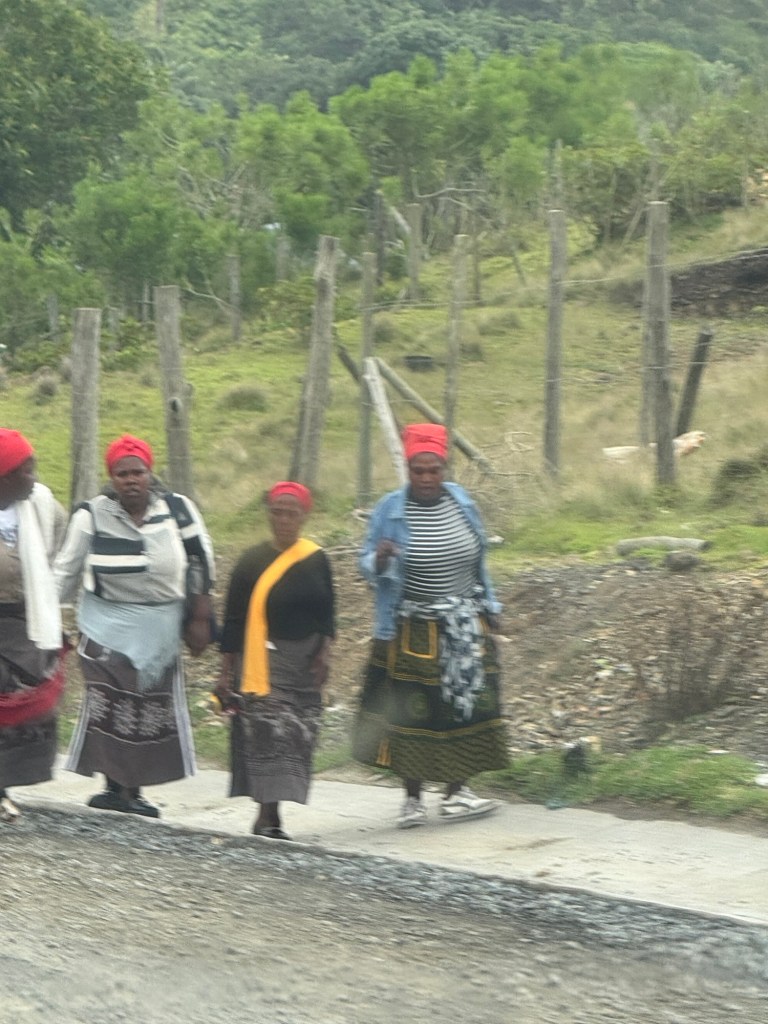
Pedestrians on the road in Coffee Bay on a clear day

The Transkei remains one of South Africa’s poorest regions. Decades of dispossession, unemployment, and marginal development have left deep wounds—addiction to welfare funds, alcohol abuse, narcotics made from crude meth precursors, petty crime and violence. The convenience stores are run by Somalis, Ethiopians and South African Indians charging high prices for tiny increments of goods, and the few rudimentary ‘resorts’ catering to backpackers and surfers are largely run by whites.  Scattered among the impoverished valley is a minority of a white underclass from East London—the beginning of the Wild Coast—people who, as locals wryly note, “never prospered even in the days of white privilege.”

The fog grew thicker as the night turned black when Melanie, the proprietor of the self serve rental called and said emphatically, “Send me your location so I can track you. Don’t stop anywhere.” We inched forward at less than ten kilometres an hour till we arrived at her door, where her neighbour, Lindie – who owned a nearby restaurant- let us in. “I’ll have dinner in a few minutes. Melanie told me you haven’t eaten.” and disappeared into the row of hedges.

Lindie’s restaurant

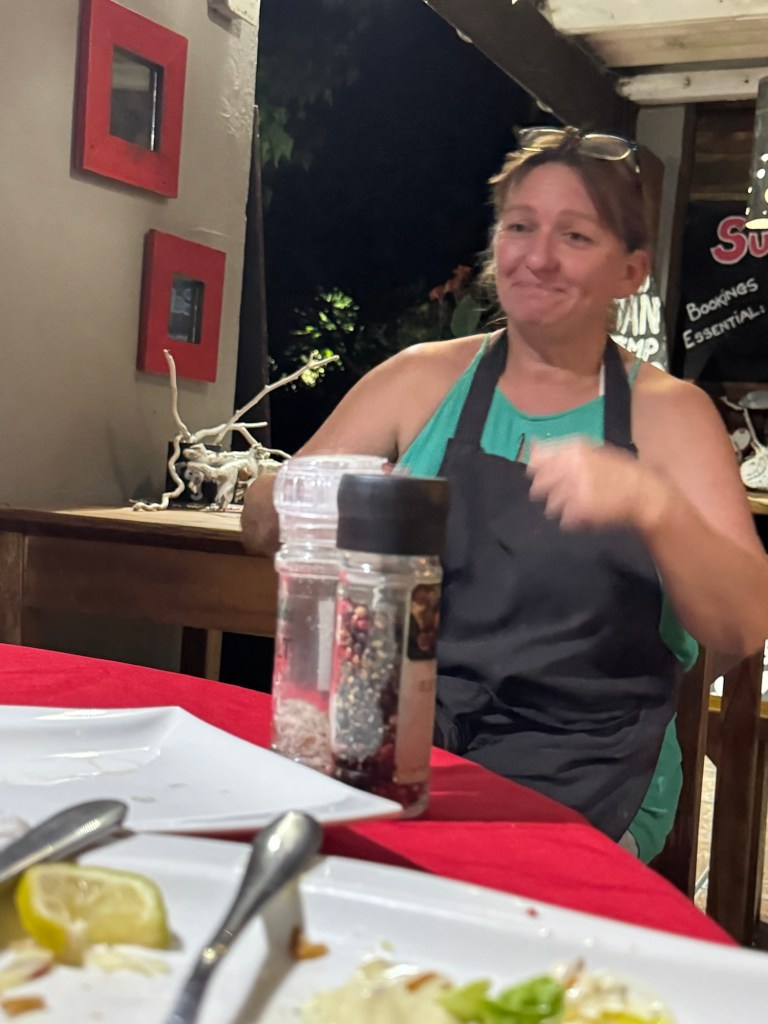
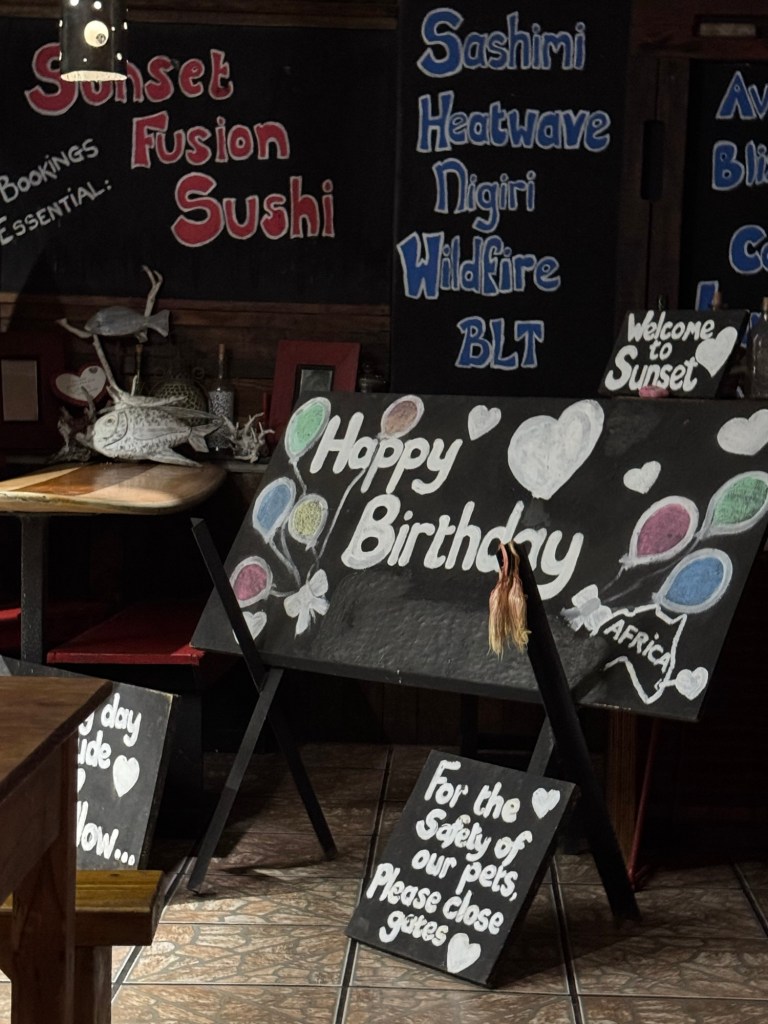
Lindie runs the restaurant almost entirely on her own; her last partner, she notes with a wry half-smile, absconded with a local, black prostitute. She presides over an improbably extensive menu—sushi to hamburgers, curries to grilled fish—all made painstakingly by hand. Her companions are a tail-less parrot that occasionally offers a “hello” and mimics an alarm, five dogs (only one of them friendly), four cats, a 130-kilogram pig called Pipsqueak that she raised from a runt, and a shy son who lives nearby. Her warmth and delight in cooking are matched only by her passion to tell her story: a childhood sketched in dysfunction, steadied by a stern grandfather who drilled survival into her bones, softened by remarkable moments of grace.

Lindie’s menu

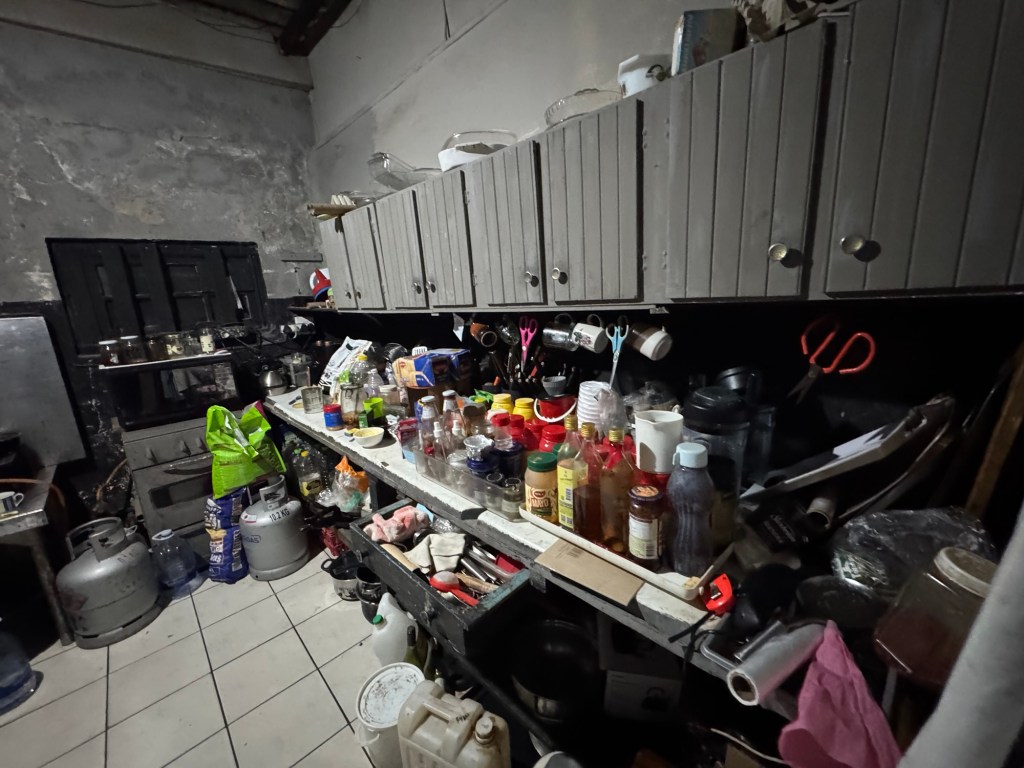
It would be easy, at first glance, to dismiss the menu after a look at her chaotic kitchen. Yet the few clients who find their way here are rewarded with food of startling finesse: chicken seared in a wok with garlic and fresh curry leaves, rice lightly fried with mushrooms, lentils and vegetables, fish dusted in maize meal and fried just to the point of crispness without a trace of oil.

Lindie’s kitchen

Outside, Coffee Bay sleeps, save for the closed-door bars and the darker rooms where meth, cheap spirits and cash still move. Traditional rondavels, their round forms capped with tin or thatch, stud the steep hillsides, amidst small brick houses fronted by grandiose Roman columns. Free-ranging dogs, cattle, donkeys, goats, and pigs largely quiet. The roads are a patchwork—here gravel, there a sudden slice of concrete. The lodges catering to the youthful backpack and surfer mimic the rondavel cabins in form only.

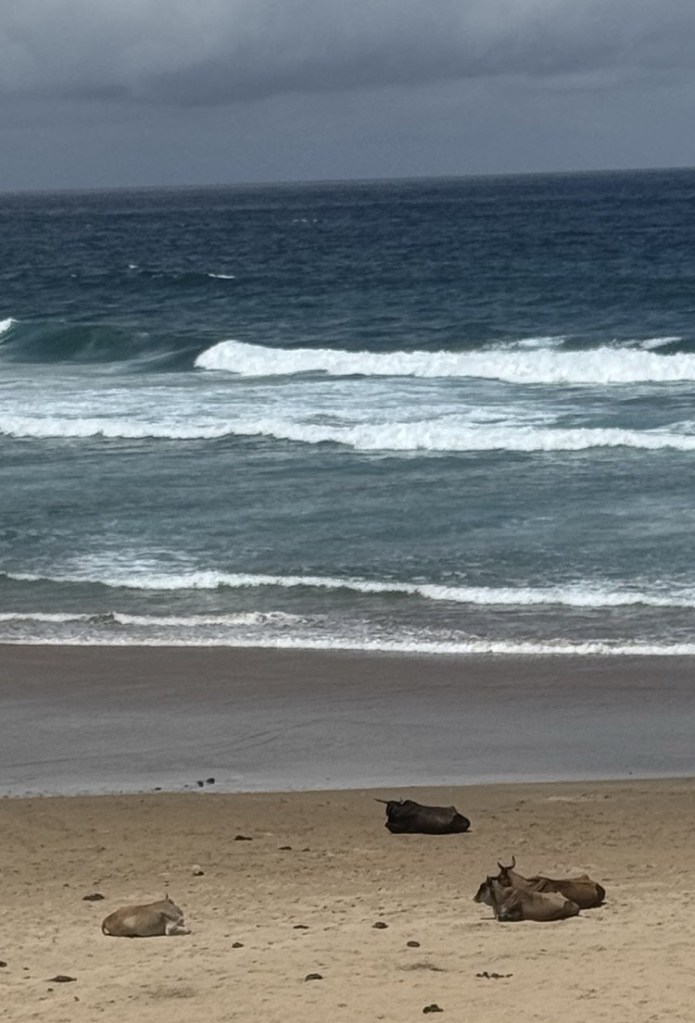
Cows sunning on the beach

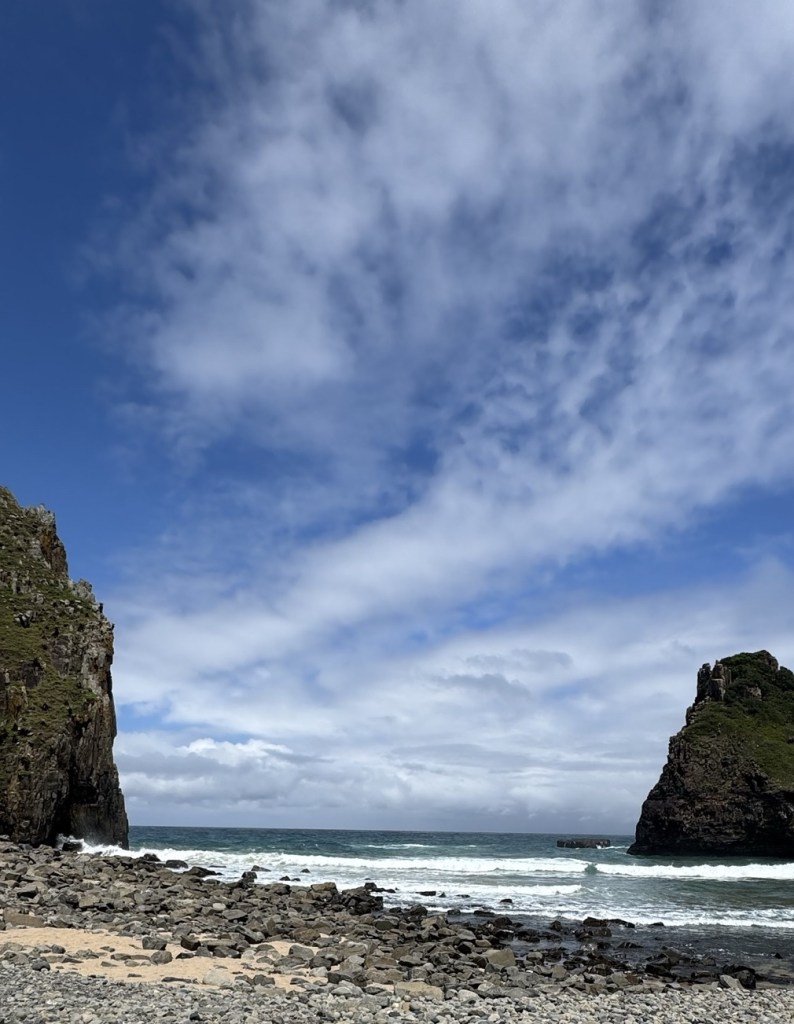
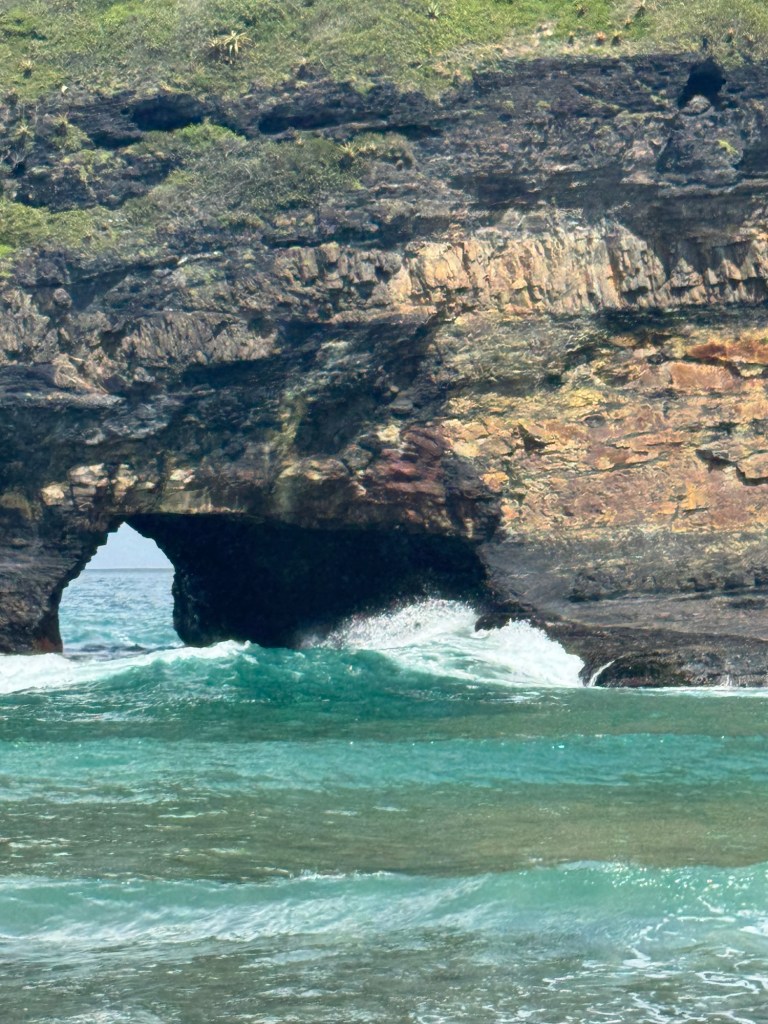
In the morning, idle young men gather near the fence to offer unsolicited guiding services for the one-kilometre walk to Hole in the Wall. If you decline the tour, oysters, crayfish and beadwork are on offer; if those fail to tempt, requests for a few coins follow. The path itself threads into a small, mythic world: a Milkwood forest of twisted trunks and low, listening branches, hills rolling away in layers, and the steady, hollow thump of surf blasting through the ‘Hole in the Wall’ arch. At the Boiling Point, opposing waves collide and rear up in a foaming, shuddering crescendo.

Boiling Point next to Hole In The Wall

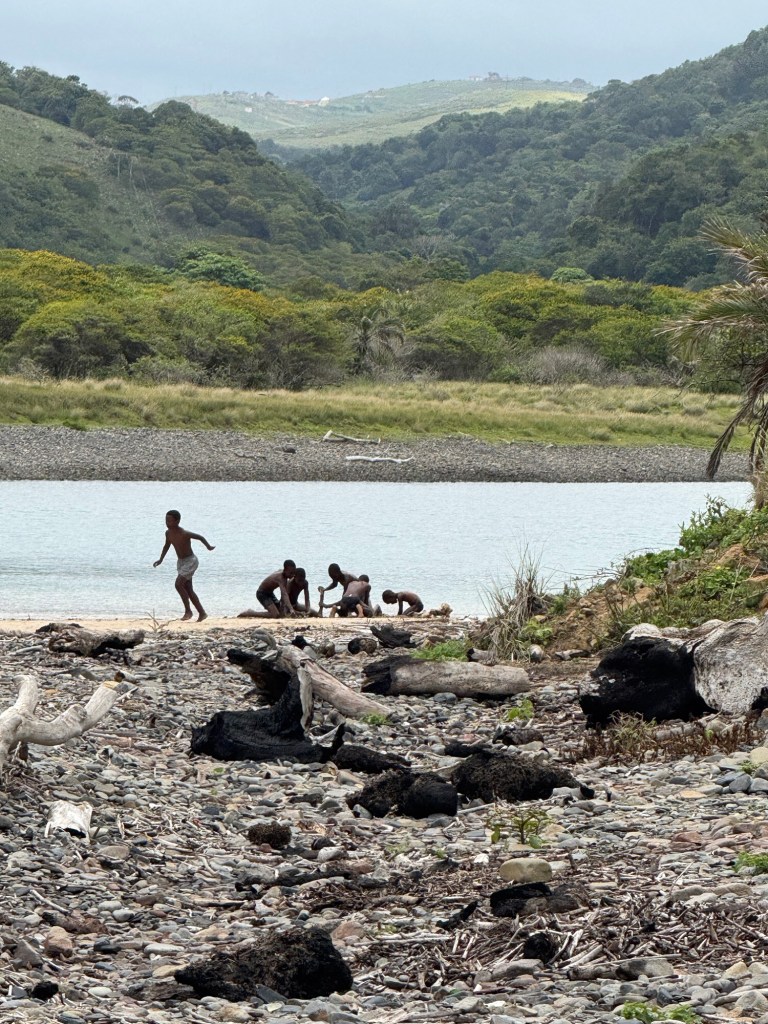
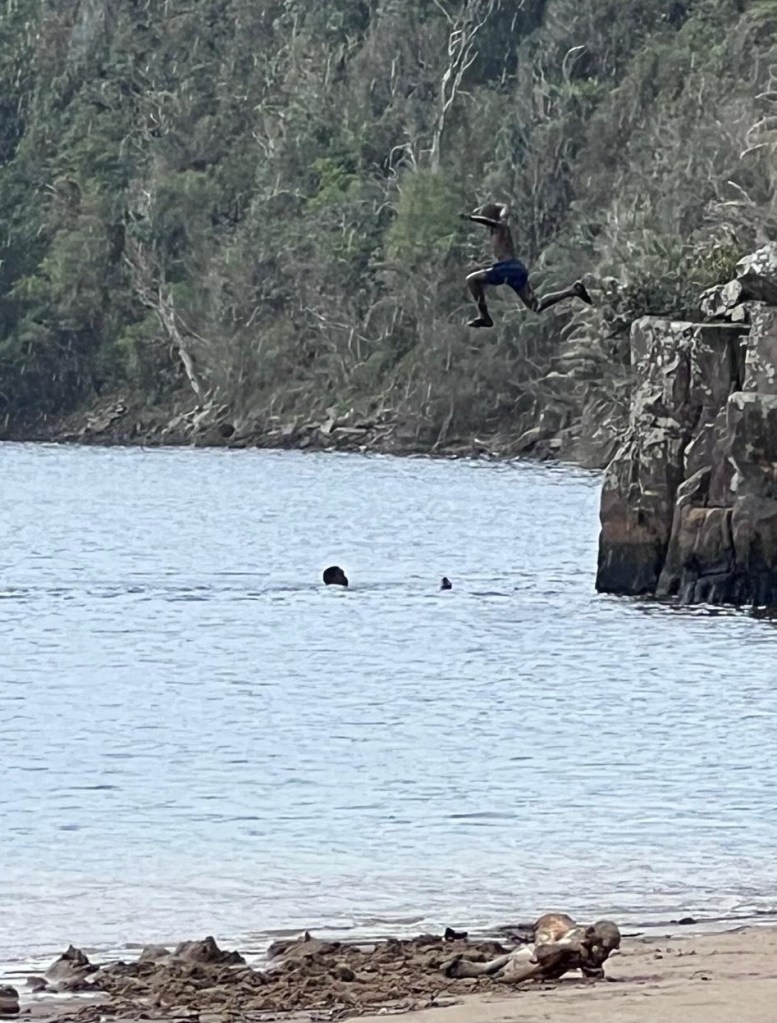
Yet for all the drama of sea and stone, it is the laughter of children that endures, their bodies flying from the banks into the Mpako River as it laps quietly into the sea. Indifferent, two tourists in the distance pause to take photographs of the Hole In The Wall for a moment and leave, sadly oblivious to the greatest gift of nature – the laughter and unbridled joy downriver behind their backs.

Famous Hole In The Wall

In a region still marked by the most ruthless social engineering of the twentieth century, Transkei’s black citizens live with barriers to economic success that remain almost impossible to scale. Yet the unselfconscious joy of children in a clean river, unbothered by markets, forecasts or strategic plans, complicates the usual calculus of wealth and progress. As powerful nations sketch new blueprints for the movement of capital, manpower, and markets, the sound of those peals of laughter over clear water will unlikely enter into anyone’s analysis—yet it may be the one thing here that is wealth beyond measure.

Children playing in the Mpako River


Addo Elephant Reserve and revival.

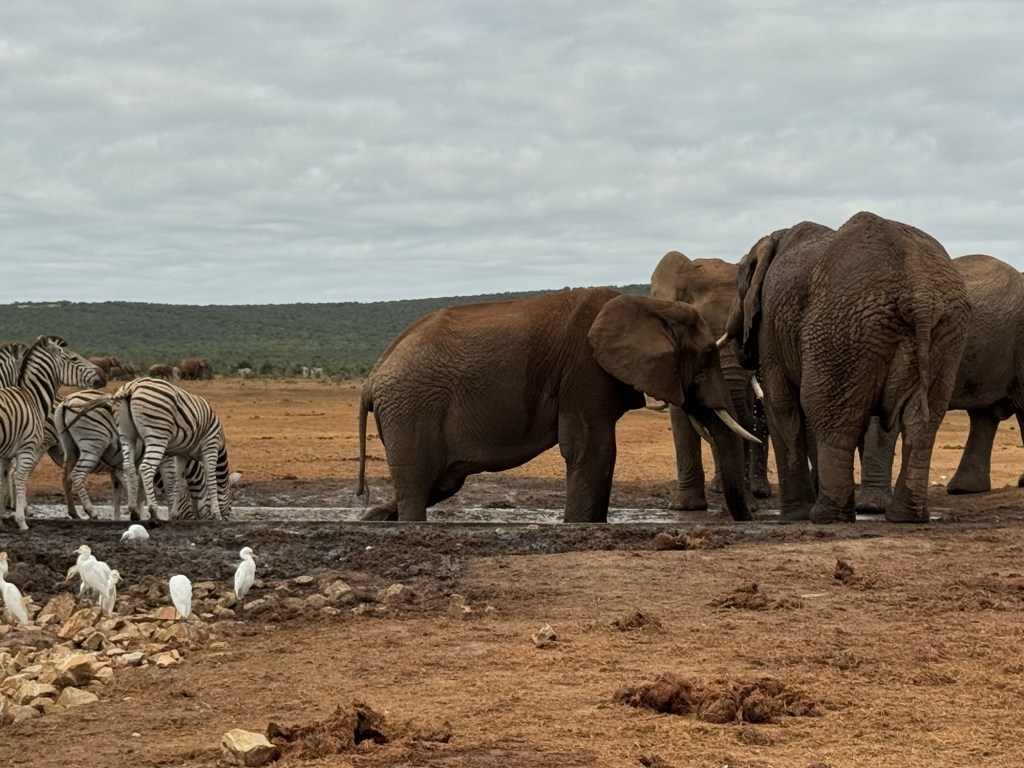
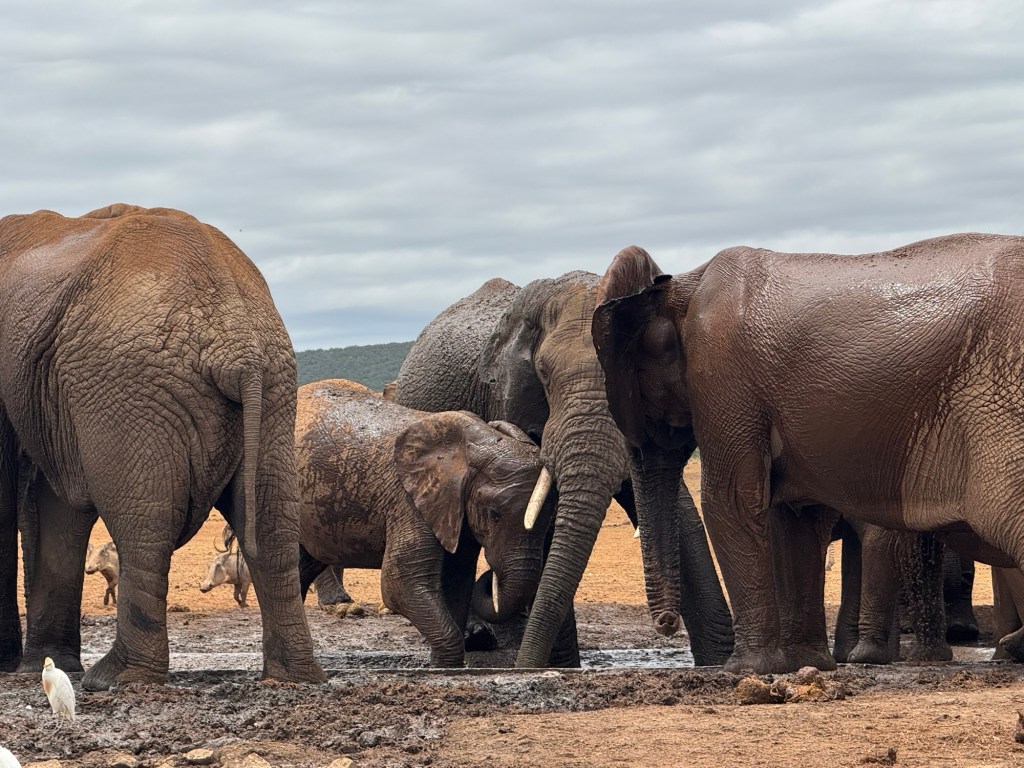
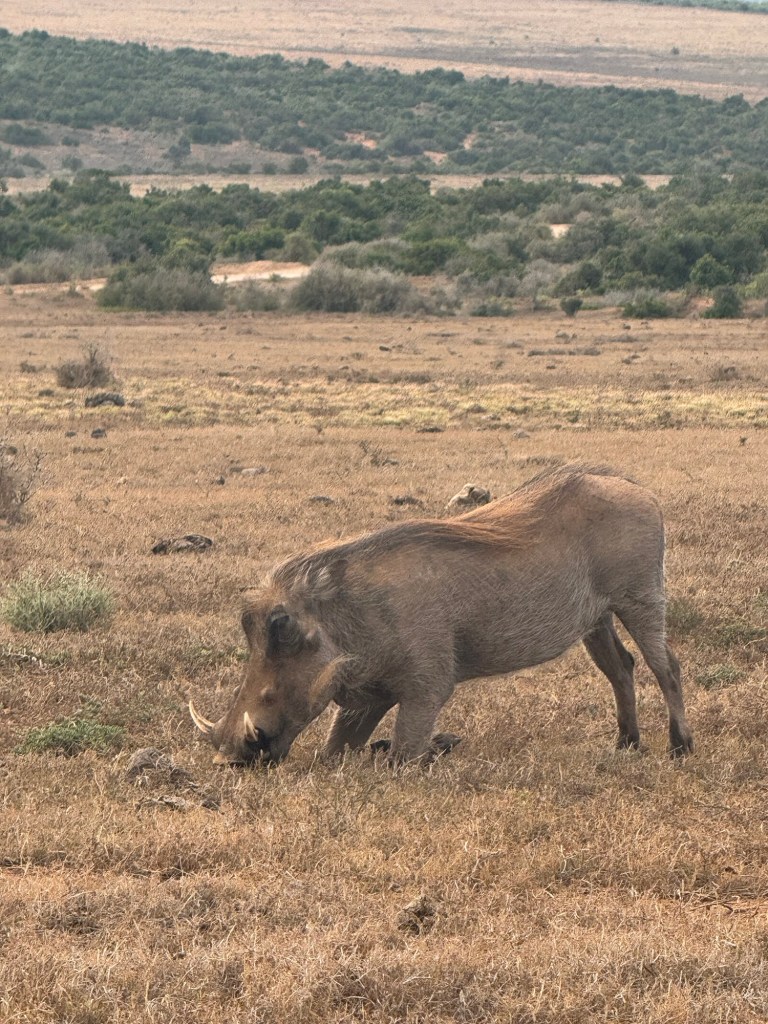
The silence of the savanna is deep. It is not the absence of sound, but a presence—something that thickens the air and slows the breath. The elephants move through it like keepers of the stillness itself, their padded feet pressing into the earth without a whisper. The herd advances as if in quiet conspiracy with the land, preserving the sanctity of morning. Then, a low rumble trembles through the herd—part command, part reassurance—and the tension fractures. Zebras wheel away from the water’s edge, warthogs back into the scrub, and white egrets scatter upward like drifting ash, their wings ghosting above the mirrored pool.

Addo Elephant National Park spreads over four hundred thousand acres across a mosaic of green-dry earth—dense coastal thicket tangled with coarse grass, fynbos clinging to wind-bitten slopes that lean toward the Karoo – a indigenous word for, ‘land of thirst’. This is elephant country: immense, yet starkly intimate. Along its ochre roads travellers trace the outlines of herds as they emerge from the bush—sometimes thirty strong, sometimes one great bull alone, immense in its quiet presence. Their only enemy is now their saviour- the one that drove them to near extinction.

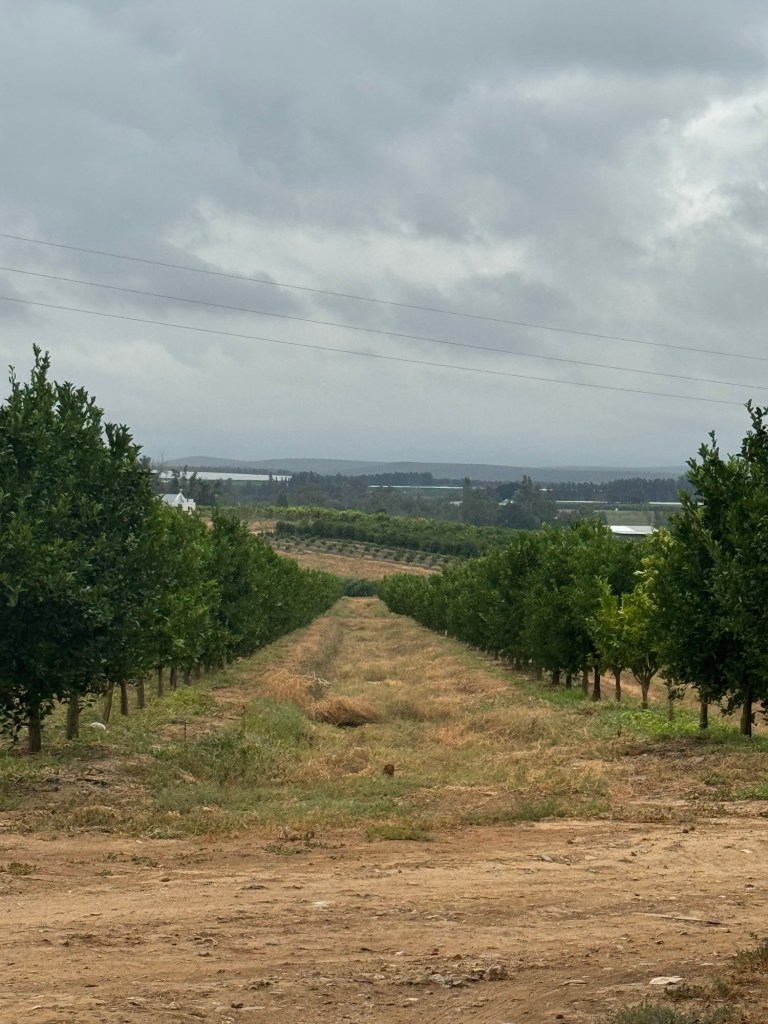
A century ago, these plains—now serene—were their abattoir when European settlers discovered the fertile Sundays River Valley and the elephants became obstacles to progress. Citrus—lemons, oranges, grapefruit, clementines—rewrote the landscape and by 1920 only eleven elephants survived, the last of a persecuted lineage.

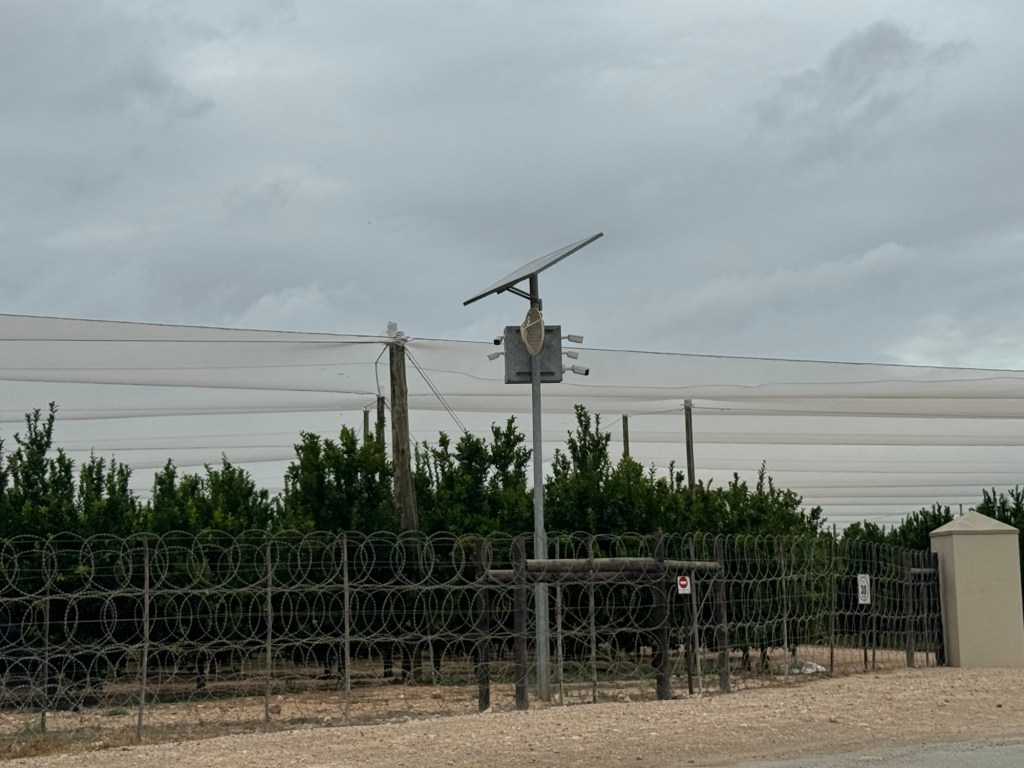
Today, their descendants roam again—joined by Kruger bulls to enrich the bloodline—while, beyond the park’s fences, citrus estates stretch to the horizon. Rows of white shade screens shimmer in the heat, guarding delicate fruit from the fierce Eastern Cape sun. The district retains its pastoral

poise: wide verandas, quiet guest houses, social clubs. Yet beneath the calm runs a more uneasy current. Many of the younger generation of ‘whites’ have drifted abroad, unwilling to compete in a government framework built to correct past wrongs. Those who remain—grey-haired stewards of family farms—live behind electrified fences and cameras.

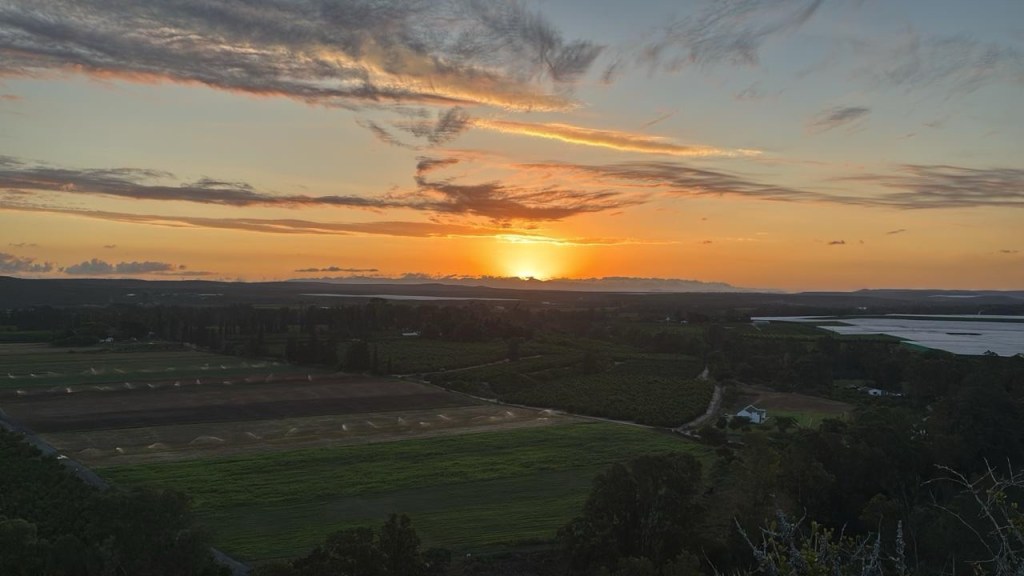
“It’s not easy,” Gregg tells me one evening. A citrus farmer, “the white population is the same but our percentage is shrinking from ten percent of the nation to six since apartheid.” In the nearby townships the population and unemployment amongst the youth accelerates. “We do what we can for security,” he adds quietly, recalling a home invasion in 2021 when one of his relatives was shot but lived. Yet his tone carries more resolve than resignation and resonates a deep love for the land, the country and the stunning sunsets.

“I’m optimistic,” he says, “Some of the new right-wing groups are trying to work with the ANC—bring back some discipline to reduce the corruption.” He said when I asked him for a ten year forecast for South Africa. His words dissolved into the dark night. I find myself wondering what history pages will say about the fiercely proud white enclave that loves this land or will it leave blank pages for its extinction.

Swellendam: a postcard Dutch Town with long memories.

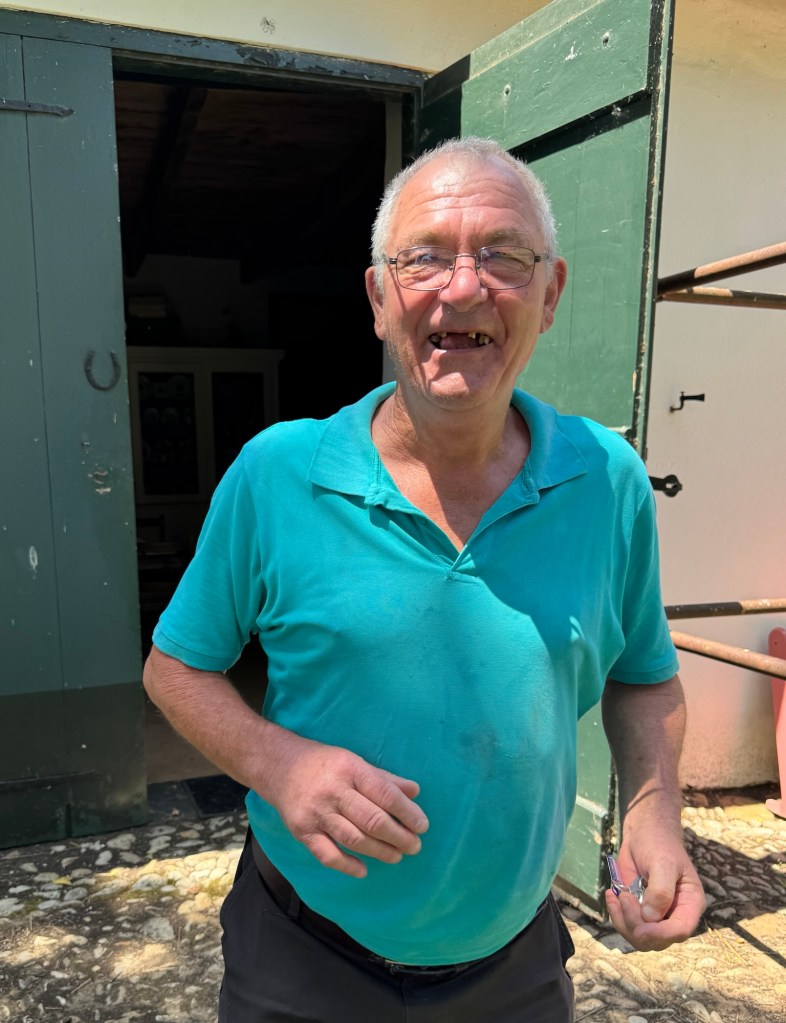
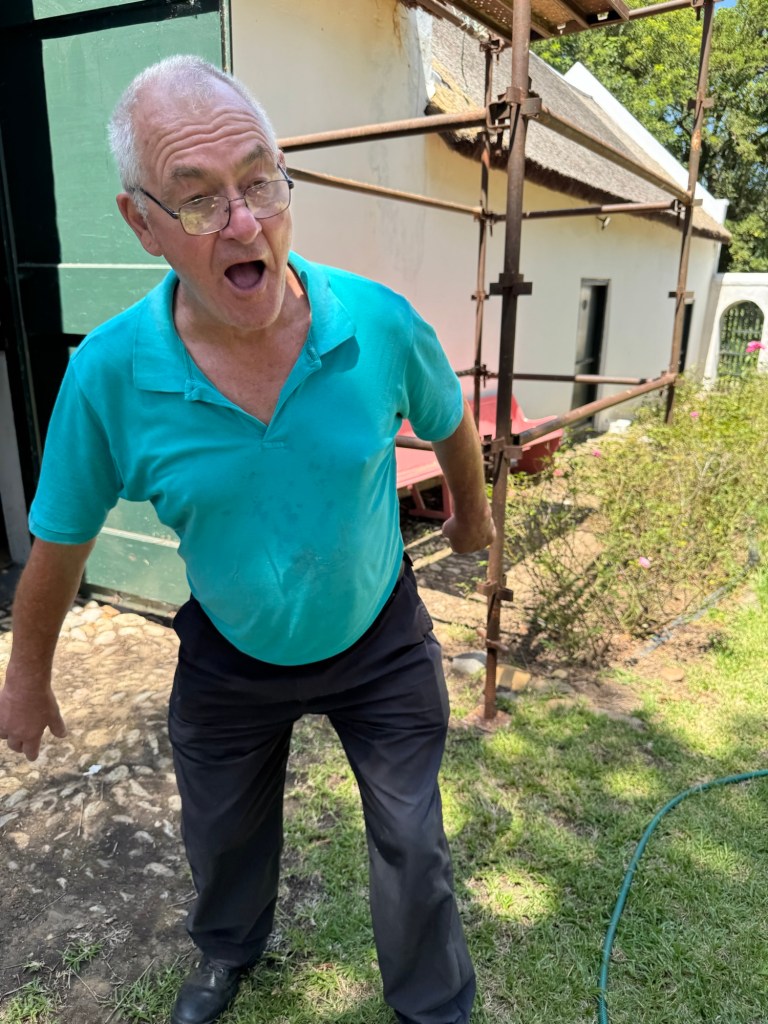
The man stood tall, shoulders squared, his presence cut sharp against the midday light. His gaze at first held both suspicion and restraint, the look of someone guarding old ground. But slowly it gave way to his loud and jolly disposition as if he had longed to talk to someone, anyone.

“I’m not a racist,” Kobus said flatly. The vowels flattened and curled in his thick Afrikaans accent rolling each ‘R’. Then, almost as if reminding himself rather than convincing me, he added, “You’re foreigners, yah? You live somewhere else—only visit.” 

“Yes,” I said. 

He nodded, the gesture small but certain. “This country’s being destroyed,” he went on. “Now only blacks get jobs—some empowerment thing.” As he spoke, his hands carved restless shapes in the air, physicalizing the unease. “Think about it,” he said, spreading his arms wide behind him, “how can a black policewoman, with hips like inner tubes and breasts like melons, chase a criminal?” He laughed—a raw, unguarded sound that startled the still afternoon.

To prove something invisible, he rolled up his pant leg and pointed to a pale scar that crossed his knee like a fault line. “Thirty-five stitches,” he said. “When I worked in Emergency response, Cape Town, fifteen years ago. Still waiting for the police to call.” Pride and grievance seemed woven together, indistinguishable. When he looked back at me, almost searching my eyes for judgment; finding none, he mistook politeness for kinship. 

“I am not a racist,” he said again, quieter now. “We treated the blacks badly. The English treated us badly—concentration camps, women and children dying by the thousands. But we can’t hold on to such things forever. We must move ahead.”

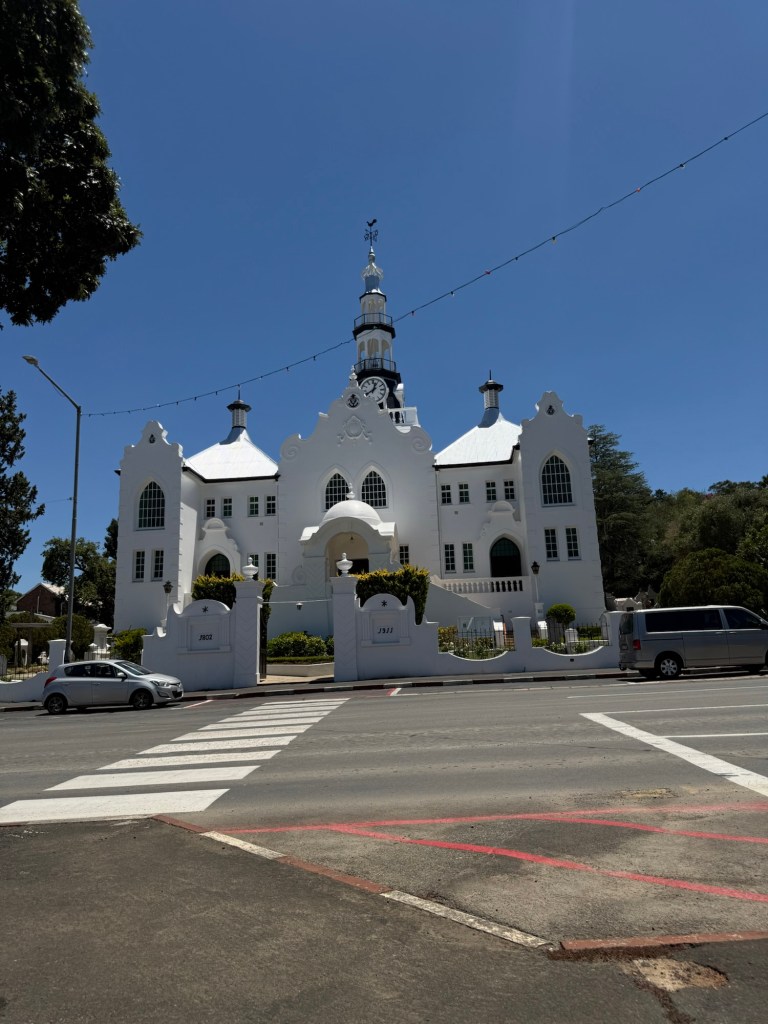
Swellendam rests in a basin beneath the Langeberg Mountains—a town of whitewashed walls and thatched roofs. Once a frontier post to the east, it still harbours an echo of settler enterprise, the architecture preserved as though time itself paused.

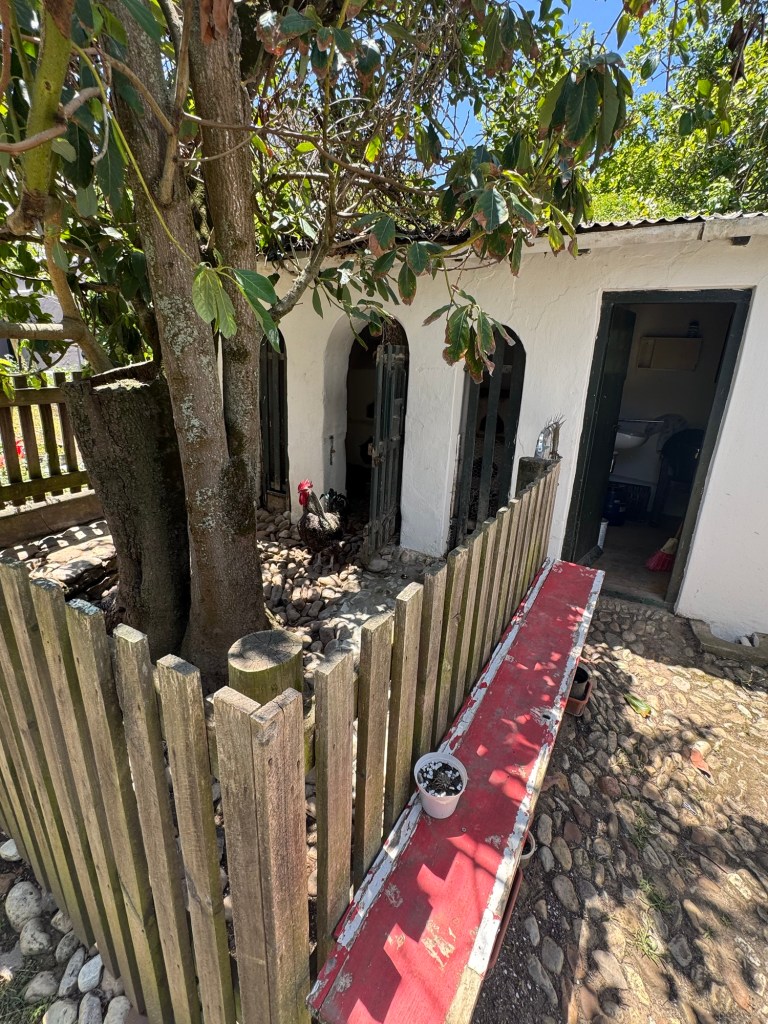
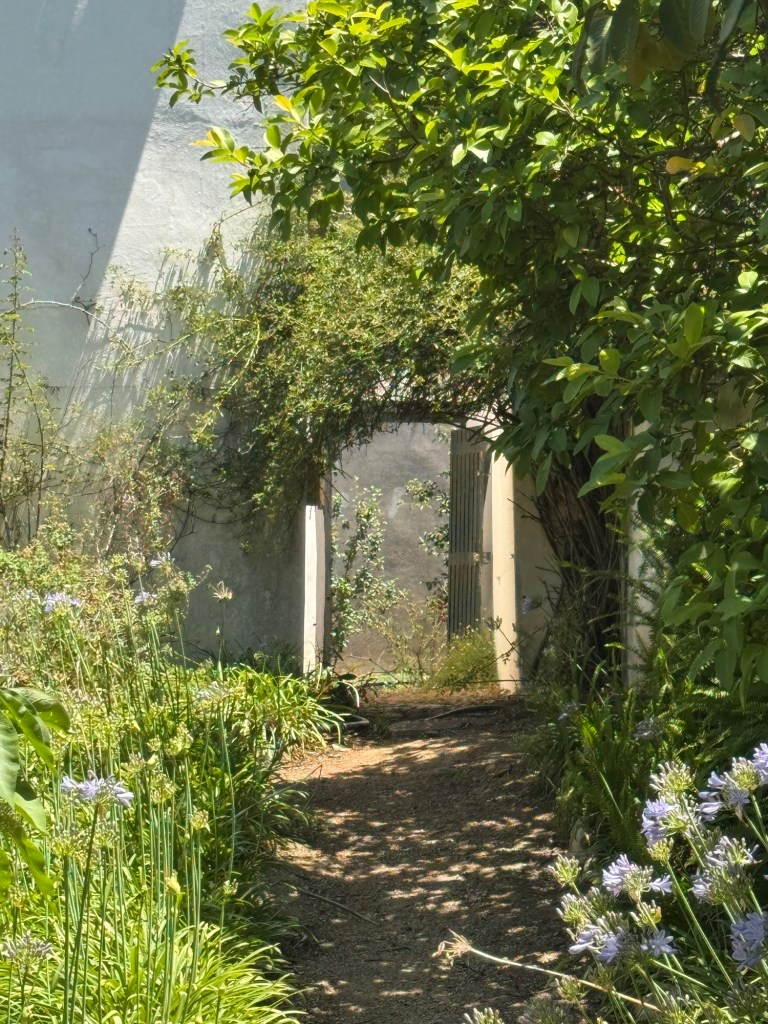
At its center, the Dutch Reformed Church rises, its white plaster blazing in the Overberg sun. Across the square, a tiny hand-painted sign—Anglo-Boer War Museum—leans at the edge of a narrow lane lined with 18th‑century cottages. Following it, I found not a museum, but a large angry rooster, its call splitting the silence. Beyond the low gate stretched a hidden garden—lush, unexpected. Persimmons bowed under their own weight, marigolds burned orange beneath the noon light, and the air pulsed with the scents of damp soil, Jasmin and lavender.

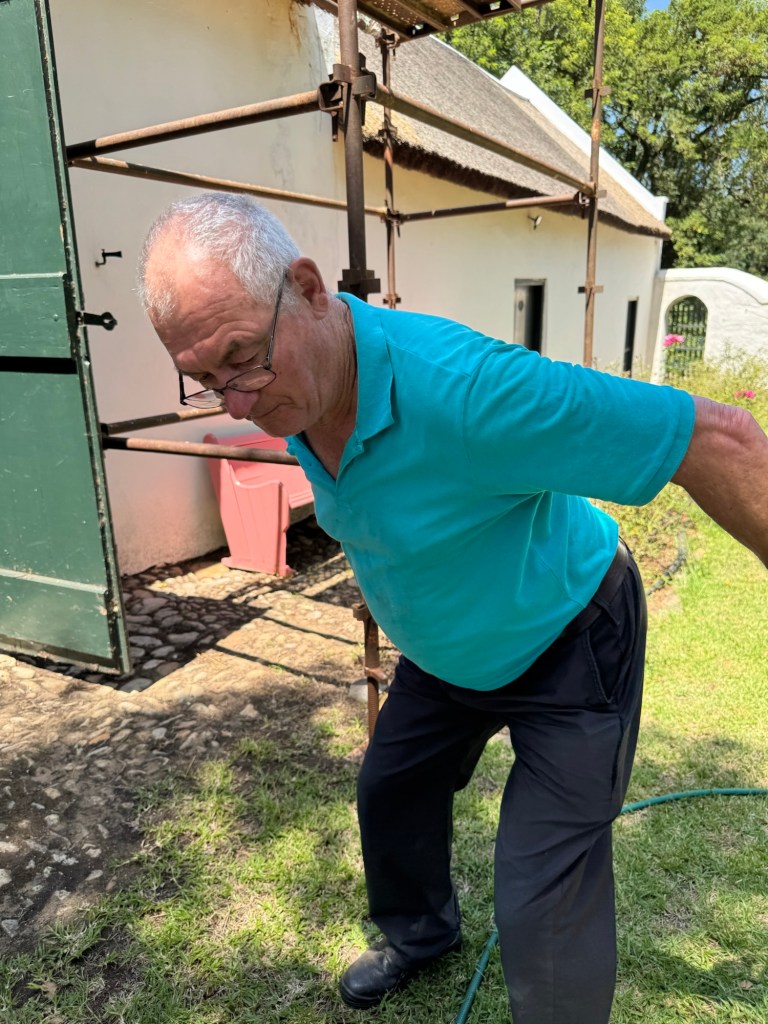
Three coloured gardeners rested on a shaded stoop, speaking softly in the heat, ringed by potted geraniums and poppies. It was from behind a clipped hedge that Kobus had emerged—ruddy, broad, eyes narrowed by the sun yet watchful with cautious pride.

“I am admiring your beautiful garden,” I said. 

He nodded once. 

“I saw the sign for an Anglo-Boer museum.” Almost apologetically.

“I am the gardener,” he replied. “The museum opens on Saturdays—but I can show you.”

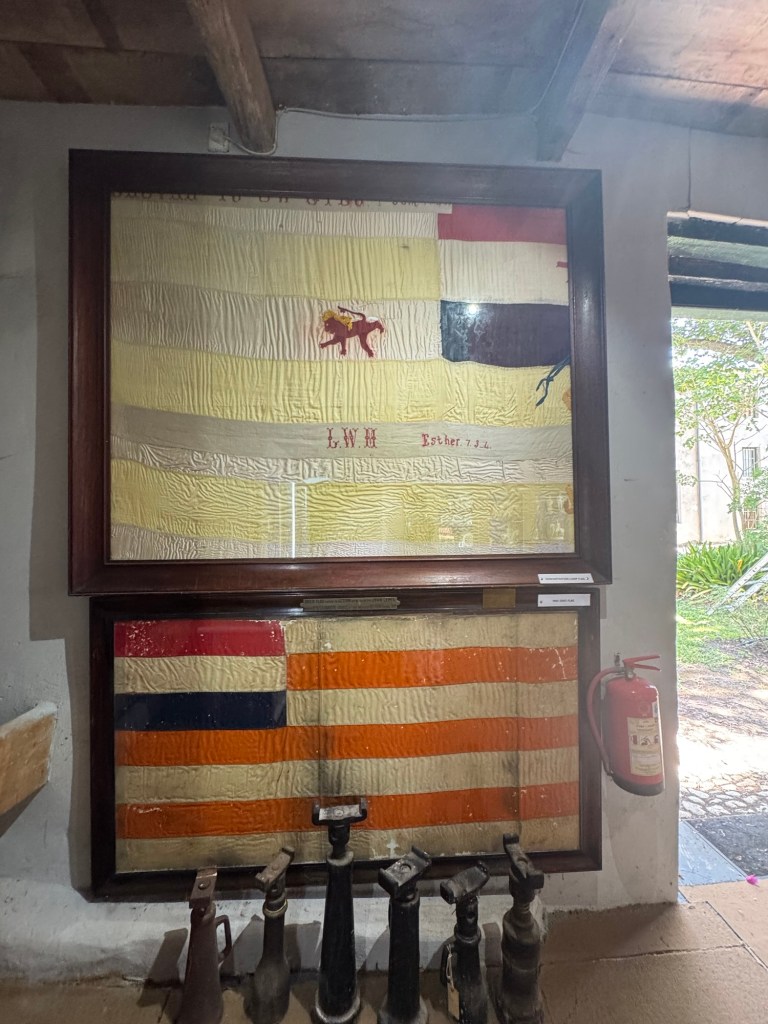
He led me into a small outbuilding, scarcely larger than a garage. Inside, the air was dim and cool. Flags hung from the rafters—the orange-white-blue of the old Transvaal, the golden Free State banner, a weathered emblem from the brief Republic of Swellendam, a rebellion that flickered and died in six months in 1795. On a shelves that lined the walls lay intimate remains of history: a chipped child’s cup, imperial British commanders itched into china, a rusted bayonet, a camp lantern dulled by time.

When I told him Cape Town seemed peaceful, he frowned slightly. “You were in the tourist areas, in daylight,” he said. “I know every inch of that city. In Nyanga, in Philippi East neighbourhood —they slaughter each other like sheep. I worked emergency for thirty years. I have seen everything.” And he says with undisguised contempt, ‘now the ANC wants to make them our bosses.”

Outside, the afternoon was still.  The rooster called again, the sound echoing off old lime-washed walls and was answered immediately by a rooster far away. The streets of Swellendam shimmered in the heat. Beauty persisted at each step through the garden despite the scars men carry.

Franschoek: manicured wine country on unsettling edges

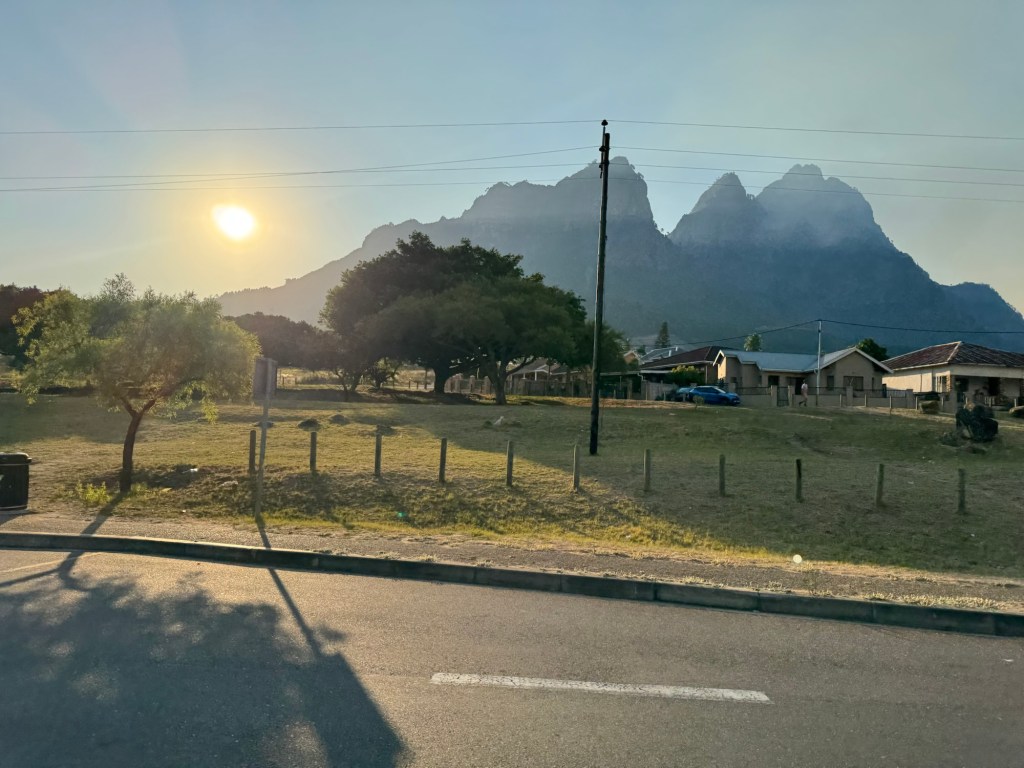
The mountains on the northwest horizon step back in shadowed tiers, their slopes dissolving into a soft, blue-grey haze that blurs the edges.. To the south, sun-struck hills rise in sharp relief, bright and insistent, vineyards combed in clean, deliberate lines into the foothills of Franschoek, the preeminent wine valley of South Africa. It was the work of enterprising French Huguenots – Calvinist refugees who fled France in the 1600s.

Large oaks, eucalyptus, and wild plume trees stand in ordered rows along improbably neat roads, as if the landscape has been brushed and straightened for visitors. As the day wears on and the sun begins its retreat, whatever little moisture the hills have gathered feels ready to slip down into the valley to kiss the grapes.

 Rows of oaks and eucalyptus form a green canopy, interrupted now and then by pockets of the ancient fynbos, low and stubborn. The light that filters through these leaves settles on faces, and the calm it creates is something visitors carry with them for the day. Past the cusp of noon, the haze closes in like silk curtains drawn without a sound, hot wind easing into a gentle breeze.

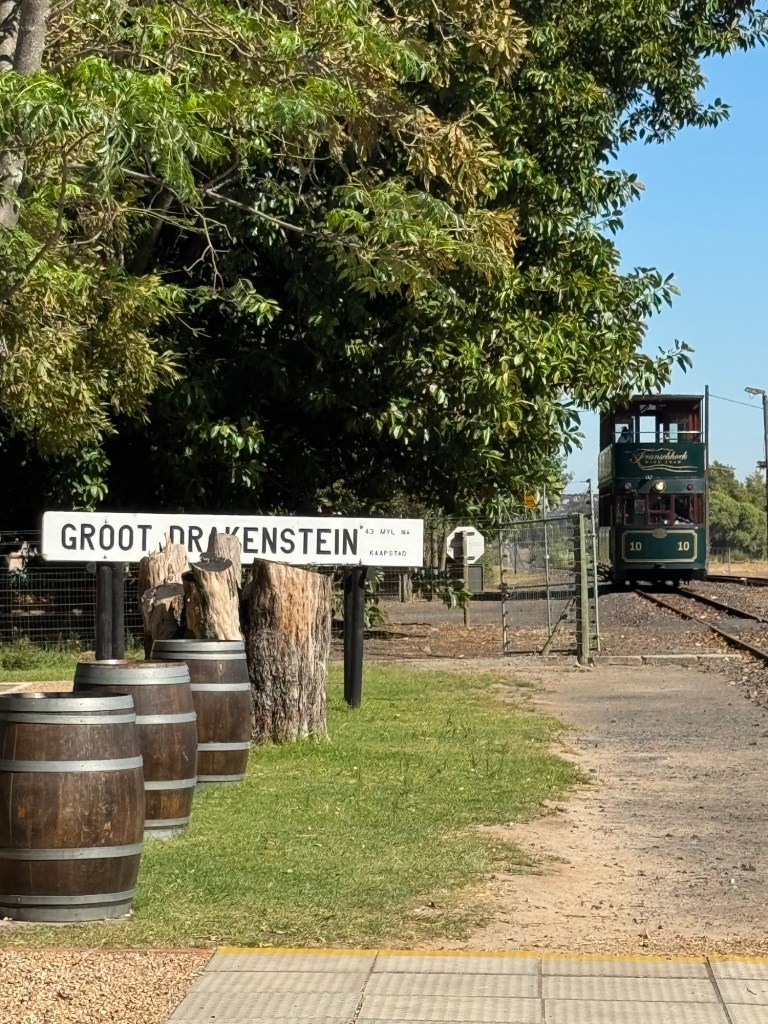
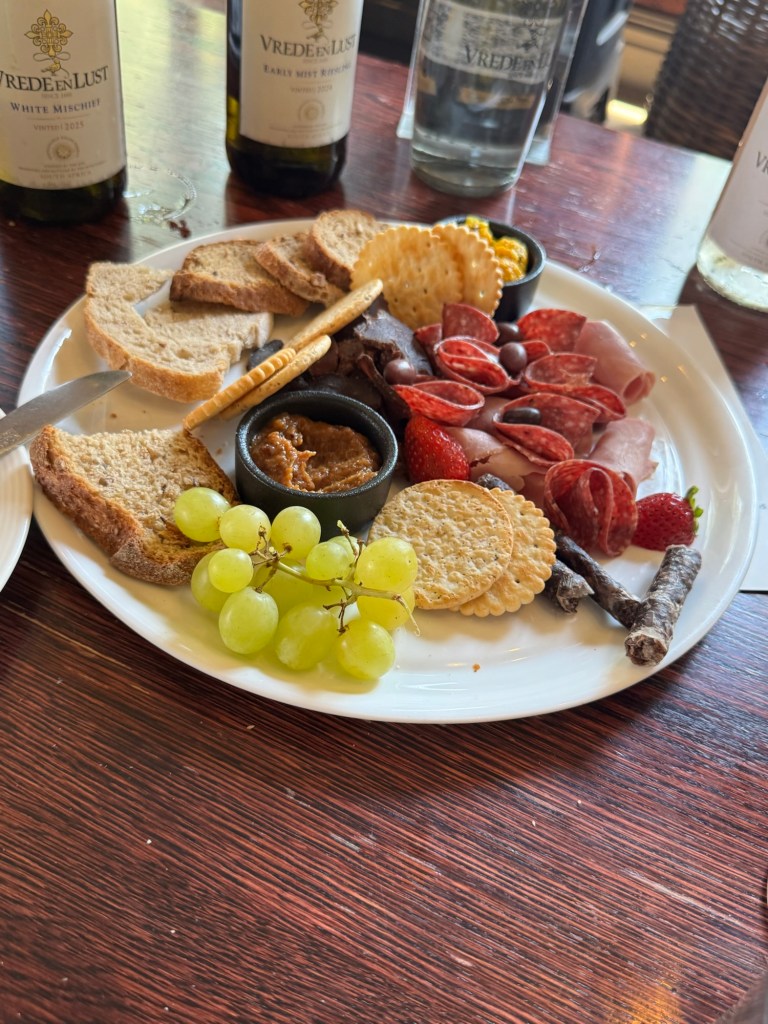
I am on the third vineyard of the Orange line of the Franschhoek tram wine tour – one of five lines. Vrede en Lust (pronounced “Frede and Lust”) – Peace and Passion – has been a farm since 1688, and it wears its age lightly: white gables, disciplined vines. A late-afternoon charcuterie board of dried meats and bread lands on the table just as the reds arrive – some soft-spoken like a Pinot Noir, others full-bodied and unapologetic like South Africa’s own Pinotage. It is a welcome shift after the mid-afternoon whites at the Italian-styled Bacco, where the wines were paired with savoury Cannoli: artichoke, smoked salmon, tuna with capers. Bacco practiced their craft around the Fermintini grape, and even for an inexperienced palate (I am hardly a connoisseur), the order of things felt right – to follow Peace and Passion with Plaisir, the fourth winery, where the wines met chocolate laced with pepper, coffee, and raspberry.

When boarding the tram after the fourth stop, the large contingent of Germans who had been restrained until now suddenly cracked open – howls of laughter, arms flung around strangers, each passenger being hugged as if we had all been traveling together for years, not hours.

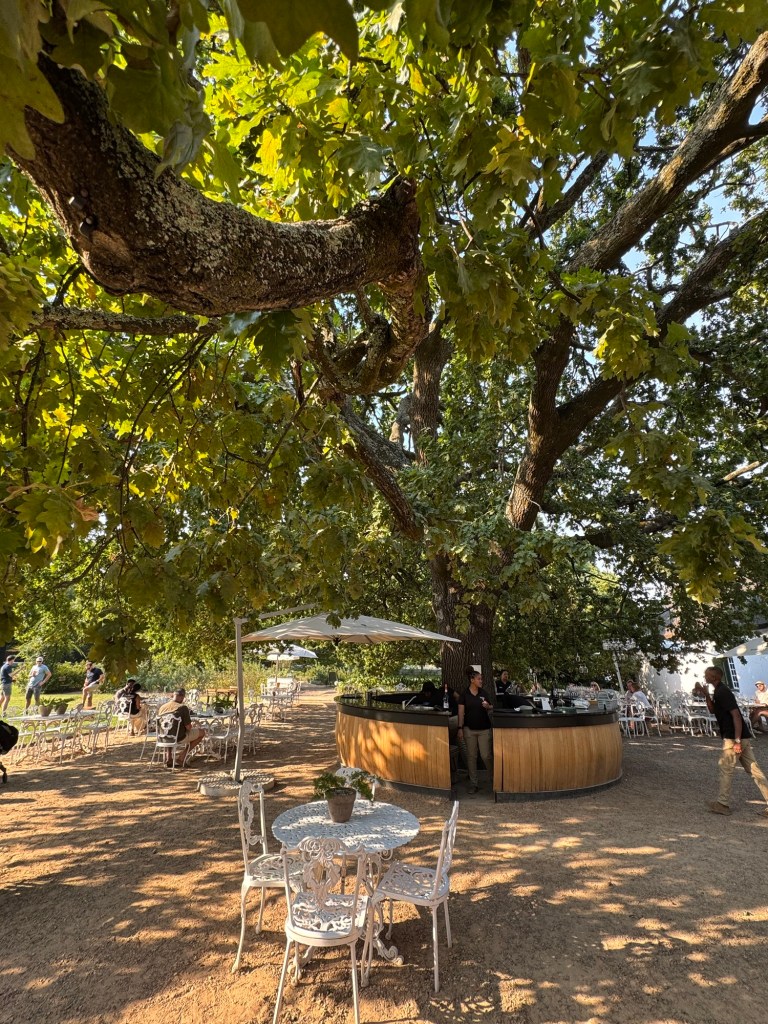
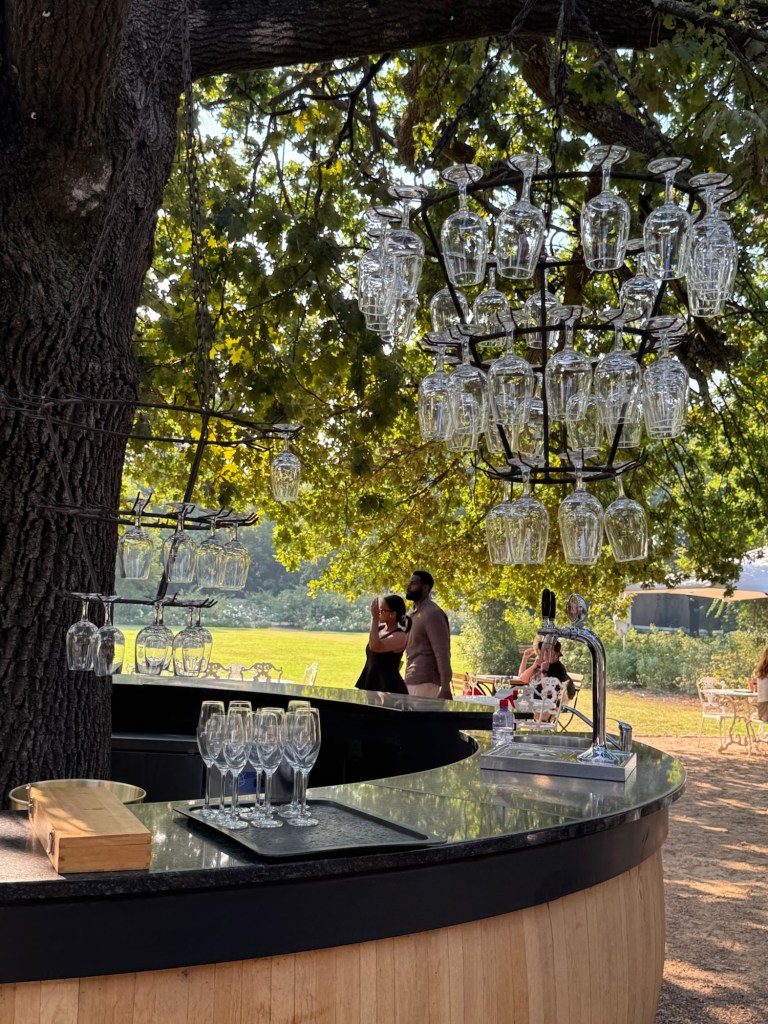
By the time the last stop of the Orange line appeared – the 340-year-old Boschendal – the camaraderie on board had become infectious. Boschendal’s sparkling wines, taken under the spread of a 335-year-old oak tree, gave way to its soulful brandy, the world tilting slightly on unsteady legs as if to underline the point that this, here, was the perfect finishing touch.

And yet, when it was all done and we stood waiting for our Uber driver, Givemore, the spell began to thin. Boschendal’s vast grounds stretched out in the failing light, the winery slowly emptying of visitors. The barks of guard dogs started to carry across the fields, sharp against the quiet. A security guard drove past with his caged dogs. We were about to flag him down when Givemore finally appeared in the parking lot, slightly out of breath, a little apologetic, entirely warm.

The dreamlike state that had carried us through the day – through wines and plates and orchards of apple, plum, guava, pomegranate, past olive bushes and flower gardens, with the ever-present scents of herbs and truffle at the feet of assertive mountains – gave way to an older, less curated story. Givemore is a Zimbabwean economic migrant with a warm smile and lively eyes with dreams of starting a business one day. His mother called to help him keep track of his responsibilities. Some of the workers in these vineyards have been here for generations, held in place by history as much as by employment – descendants of a dark colonial legacy in which slaves and later workers were kept close with cheap wine, tethered to their employers by dependence rather than choice. Gangs roam the townships nearby and security is extremely high. Townships to which blacks and coloureds were banished to from their homes in desirable areas under the apartheid Group Areas Act which was not repealed till 1991. Despite its reversal, the deep division lingers.

In the half-light, the valley showed both faces at once: the beauty that draws visitors in and the turbulence of a social structure that never really went away.

Oh! South Africa: such beauty, such joy, such suffering

The young men surged around the groom, their laughter rising above the beats of the Pentecostal band. They tossed him into the air, and caught him – Rand notes fluttering like paper moths—slipped behind his ear, pressed into the gleaming line of his hair, tucked into his pockets. Moments before, the bride had appeared. An entourage of young women led her along the aisle: some laid sheets of cloth in front of her so her feet would not touch the floor, others trailed behind, holding a plastic umbrella over her head. Her eyes were lowered in ritual humility, her embroidered dress catching the light each time she moved.

Bridegroom carried on stage
Clothes and body covered with Rand notes
Bride walking with her entourage

Inside the church, more than a thousand worshippers swayed and danced, the sound thick and electric in the air. All of them were refugees from Zimbabwe – almost all without legal status and most worked in menial jobs despite being educated. For all the joy and laughter, beyond the sheet-metal walls and barbed wire, violence brooded. Fire licked in the township’s densely packed, poorly built homes —a reminder that joy existed in defiance, of lurking danger. The tiny corner shops are run by enterprising Somalis and Ethiopians, well organized, they dominate the retail economy selling items in such small quantities as the market could bear: sugar by the spoonful, cell access for an hour – further perpetuating poverty.

Saturday market at V&A waterfront district
Patrons on Saturday market

 I had already been bored of Cape Town’s  pristine tourist face – the V&A Waterfront –  polished glass, fine wine, curated beauty, and spotless pavements. In relief, below the majestic Table Mountain, the  city’s postcard Sunday market gleamed with designer boutiques, pastel textiles, artisanal cheeses, and perfectly arranged pastries. Of course as a constant reminder of the traumatic history of this country, the shoppers were white and the servers mostly township blacks and coloureds (racial terms are not derogatory here). It could well have been Manhattan’s Chelsea market on High Line park, minus the frayed edges that lend their uneasy authenticity. Unlike in the V&A district where everything shines, but nothing feels real.

‘Where do you live?’ I asked the waiter after my second glass of wine which accompanied a rich, well prepared, generous seafood platter.

He hesitated at first, wary of his supervisor who entered the room .

When his supervisor turned away, he whispered, ‘in the township by the airport’.

I asked softly, “Will you take me to your township?” 

“No, no, no,” he said and after a pause added. “I could not protect you.”

The word ‘township’ carries the lingering weight of the past—its syllables still holding the geometry of apartheid: separation, distance, survival. Yet what he said next erased abstraction. 

“There is no value in human life there,” he murmured. “Your colour will kill you. Holding an iPhone will kill you. Nice shoes will…” 

The sentence dissolved as quickly as it came, as his supervisor re-emerged. The silence that followed said more than words could.

I shifted the conversation when the supervisor moved to another area. “Is there a church in your township?” I asked, grasping for common ground. 

He nodded. “Many churches. My Uncle, Uncle Joe. His wife leads the choir.”

The next morning, Uncle Joe arrived at my hotel—tall, rotund, composed, eyes alive with chatter. We greeted each other with a sequence of handshakes and smiles,

‘I have arranged everything. The whole congregation is excited. The pastors are expecting you.’ We drove on the pristine N2 highway past well ordered power stations – a legacy of the apartheid regime. But as we turned into the township we were greeted by a raging fire.

Fire raging in township

Fire spreading over township
Uncle Joe and his wife, Tambo

My arrival days earlier had carried its own cargo of warnings. From Dubai’s departure gate to the airplane’s descent over the Atlantic rim, strangers repeated a single refrain: ‘Don’t go out at night’. Their words carrying a note of conspiracy. “I was born in a township,” one man told me, his vowels shaped by the polyphony of South Africa’s history—Indian, Black, coloured, white. His wife drew a small invisible circle with her finger. “Always keep your eyes moving,” she said.

By the time the plane dipped toward Cape Town, unease had calcified from curiosity to fear. I was arriving from a cathartic trip to India, where poverty evokes pity rather than menace. Yet here, on the threshold of another postcolonial democracy, a different truth waited—one that lived in contrasts too sharp for comfort.

On the map, South Africa is a nation poised at the continent’s edge, where the Atlantic and Indian oceans meet in a turbulent seam. In its political imagination, it remains a place of unfinished reckonings—a country that dismantled apartheid’s architecture yet still bears its shadows in land, wealth, and everyday gaze. Modern democracy here was grafted onto the bones of empire, and those bones still show.

For months before arriving, I had studied its stories from afar—films dense with violence, novels weighed with moral ambiguity, the voices of Coetzee and Gordimer dissecting conscience with surgical precision. Yet nothing in print or image could prepare me for the human landscape that awaited, where faith, fear, hope, and survival intertwined like the harmonies of a township choir.

All I learned crumbled in the face of the stark truths of the nation: low economic growth, growth without employment, dramatic population growth in the townships where youth unemployment is said to be eighty percent. Now I wonder, when I witness the deep divisions between its citizens and remarkable disparity of wealth, what Nelson Mandela would say: his ANC’s socialist and communist patrons abandoned for the capitalism of the minuscule minority – the bridge between citizens too wide a chasm to breach.