Kerala: Where Ayurveda Meets the Sacred

Ten days of Ayurvedic therapy ended on Christmas Day, and the beach at Somatheeram came alive beneath a new moon. Music and dance spilled across the sand while the Arabian Sea broke in rhythmic applause. The deep-tissue massages – herb-infused oils, warm milk, and fermented rice – had stripped away the invisible layers of fatigue. I felt newly porous to the world: light sharper, air sweeter, the senses reawakened.
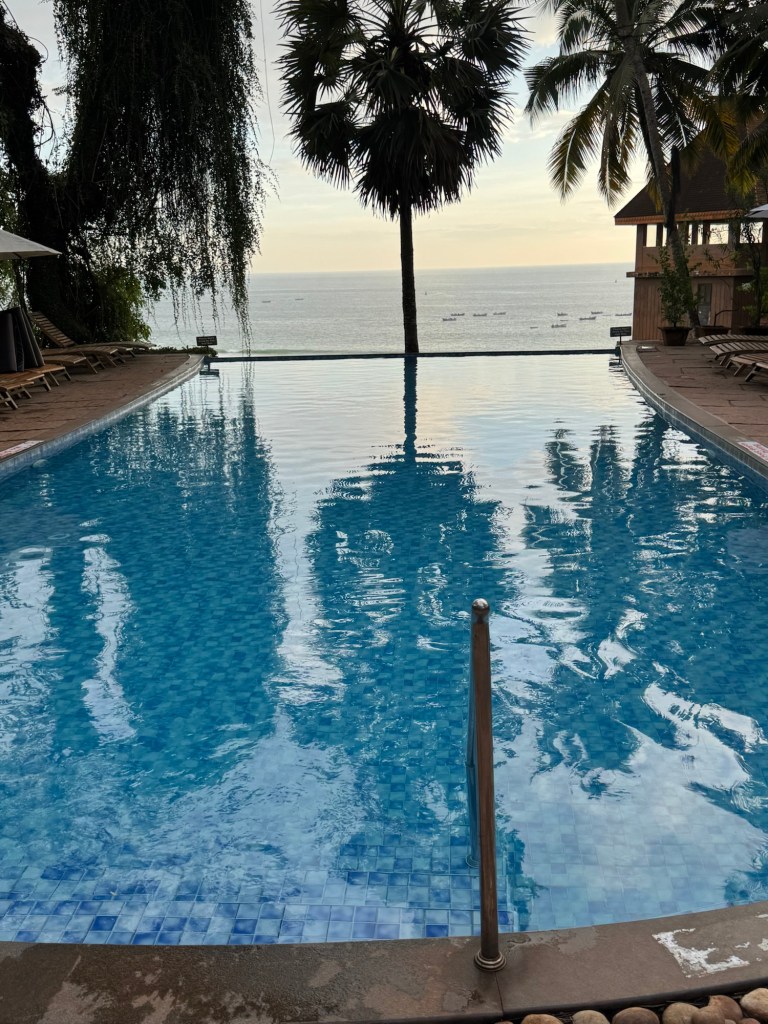
Pool at the resort with fishing boats in the distance


At dawn the next morning, the figure of Christ—arms open, face radiant in the sunrise – watched over the remnants of celebration: footprints, paper plates, and plastic bottles scattered among the waves. Alcohol was absent; Kerala’s stringent controls keep it that way.
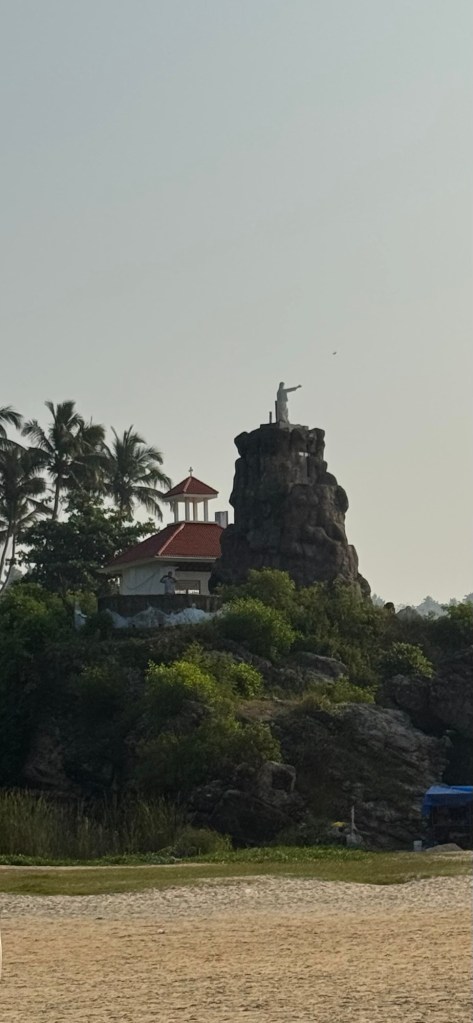
Statue of Christ Facing the Sunrise

Teenagers combed the beach for recyclables while families chased the retreating tide. A newlywed couple posed against the surf as fishermen hauled in their nets. Farther up the shore, Lord Shiva and Parvati stood immense and unmoving, their stone eyes turned inland toward the temple.
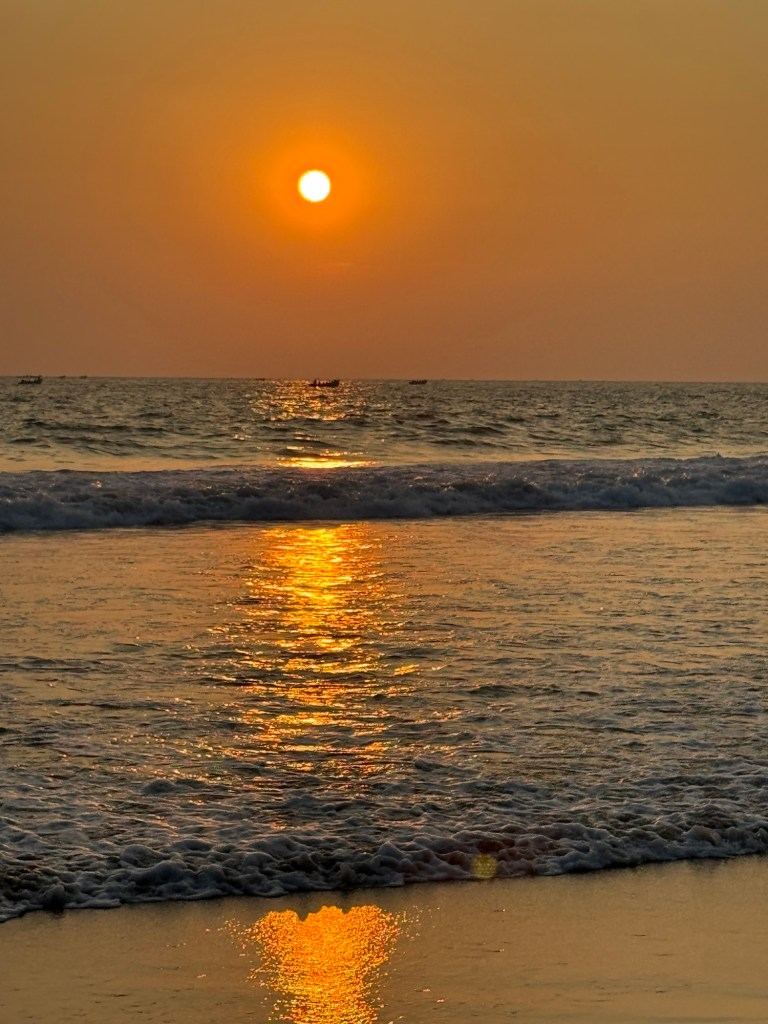

Even in stillness, Kerala feels animated by movement – trade winds, pilgrim footsteps, coconut fronds whispering in the salt breeze. This southwestern edge of India has absorbed the world’s stories for more than two millennia: Arab traders bearing incense and gold, Chinese junks heavy with silk, St. Thomas preaching a new religion, Vasco da Gama’s sails cutting the horizon in search of spice.
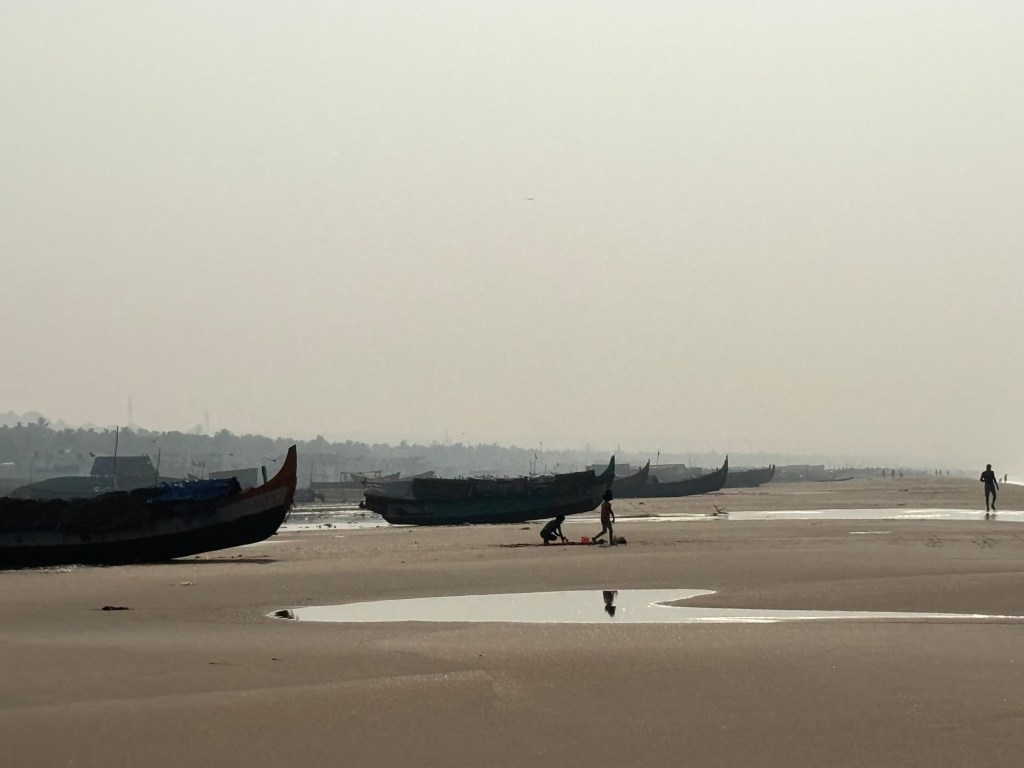

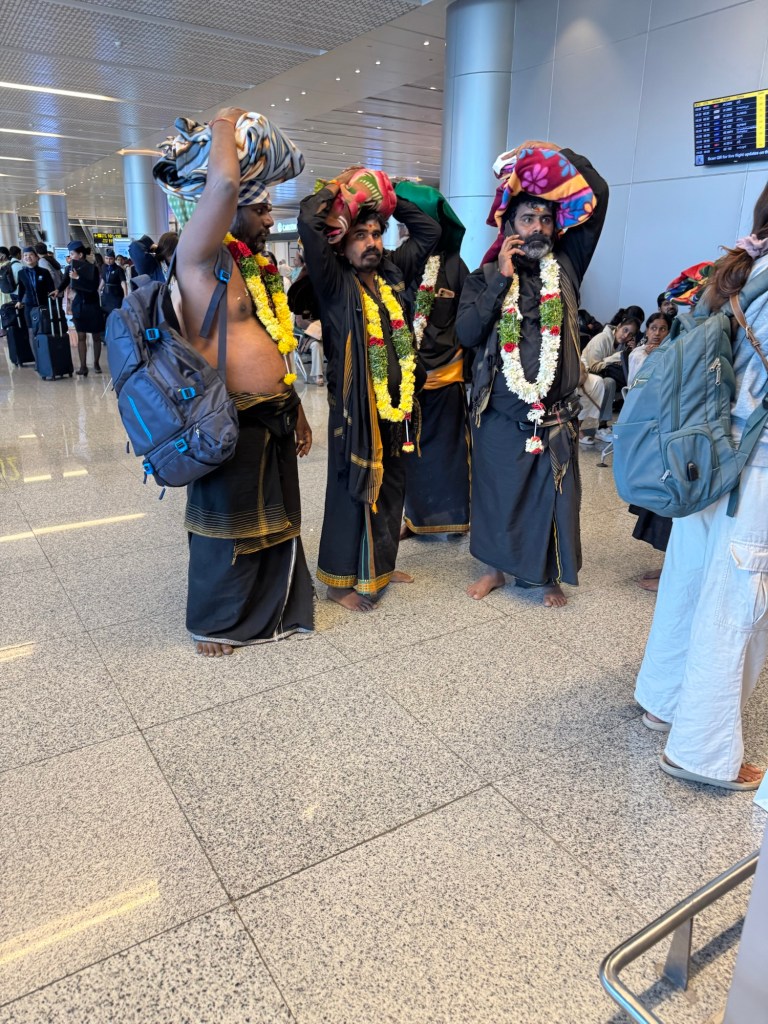
Here, ancient and modern intertwine with ease. Ayurveda’s three-thousand-year-old therapies coexist with a communist government that prizes literacy and social equity. Nearly 99 percent of Keralites can read and write – a figure unmatched elsewhere in India. Early Christianity took root here within a generation of the Crucifixion, even as barefoot pilgrims continue to trek to Sabarimala’s remote shrine. And deep beneath the sanctum of Padmanabhaswamy Temple, the 2011 unsealing of hidden vaults revealed a $20b trove of jewels and idols – glimpses of the region’s layered opulence.
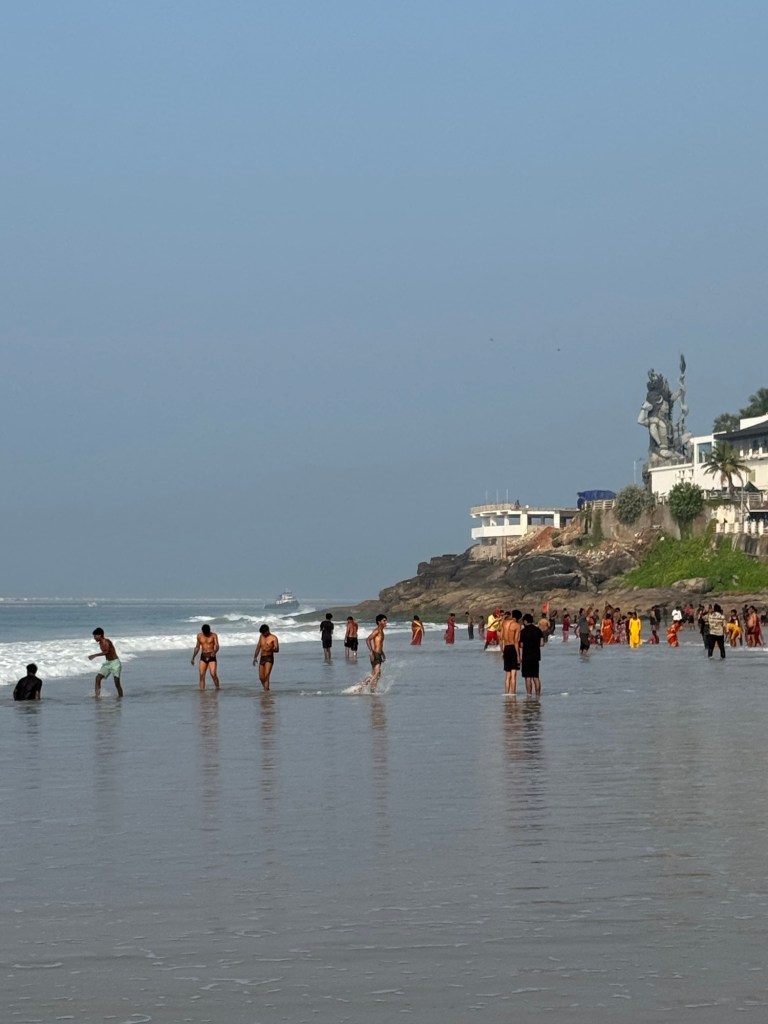
Statue of Shiva and his Consort Parvati


This is my third stay at an Ayurvedic retreat on Trivandrum’s coast. I won’t claim a cure, yet something essential shifts each time. The careful choreography of massage, yoga, and vegetarian fare seems to cleanse more than the body – it quiets the mind, dilutes the noise of elsewhere. At $250 Canadian per day, with comfort wrapped in sea breeze and ritual, it feels an honest price for peace.
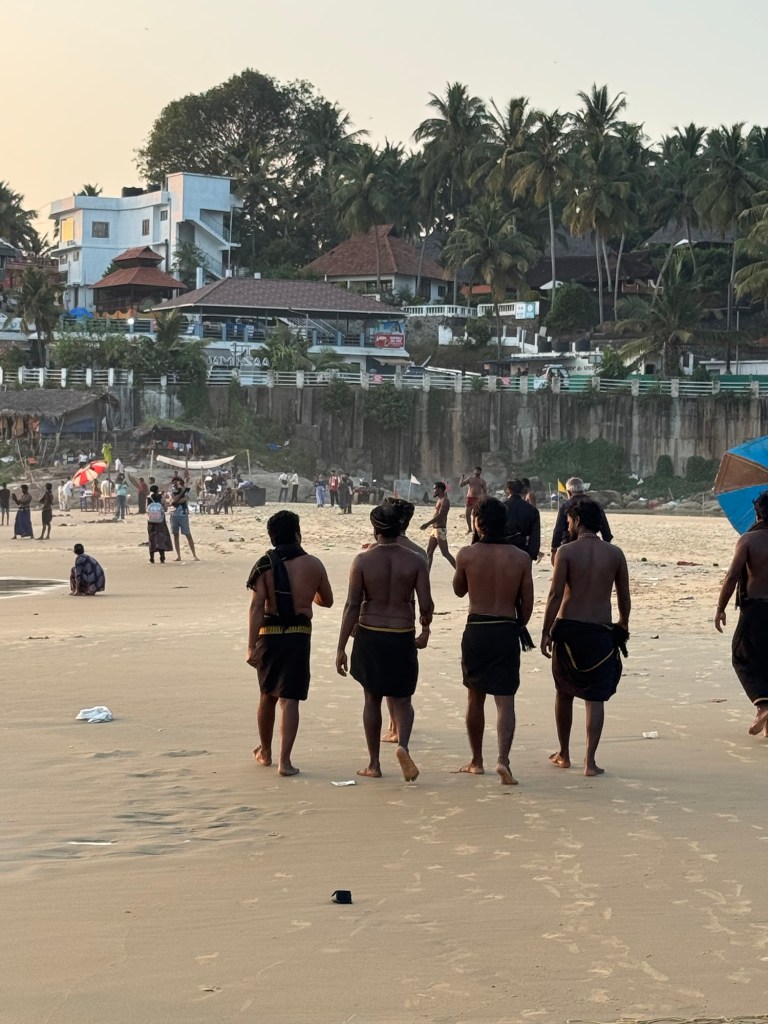
Pilgrims to a Hindu Temple


Later, as I prepare to leave, the scent of sandalwood still clings to my skin. The sea beats its pulse against the shore, a patient rhythm that outlasts empires and travelers alike. Kerala gives as much as it treasures – an ancient land where healing is not an escape from the world, but a clearer way of returning to it.
Lost iPad at an Indian Airport

I am a seasoned traveller. I have the hygienic travel habits of intrepid travellers. Habits to make sure I don’t lose things that matter: passport, cell phone, cash and credit stored in 3 places:wallet, carry on, and personal item. If traveling through Brazilian favellas – safest places in Rio are airbnbs rented from drug lords rather than tourist neighbourhoods which their residents invade – bring expired credit cards to replace active credit cards in my wallet.

Despite planning and precaution, I am doomed to lose something. Each of the moments I lose something have certain traits. Typically it will be lost early on a trip when the travel habits are not established, and when something unaccustomed happens.

I lost my iPad. Brand new, fully appointed to replace my laptop so I may travel lighter on a three month trip through South India and South Africa. The moment I lost it had a few unaccustomed variables courtesy of the new emerging India.

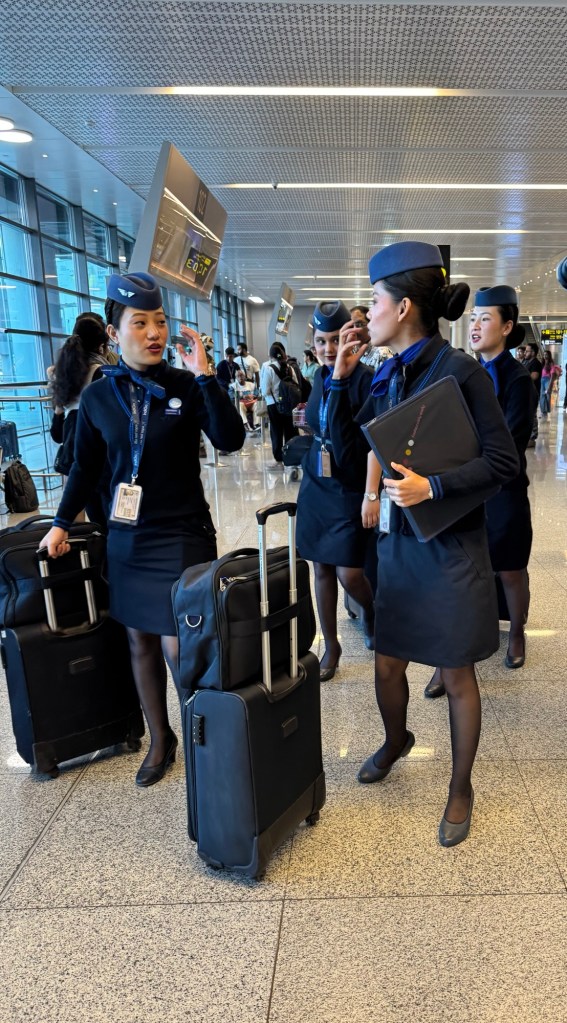
Firstly security in Indian airports is very competent and thorough – in part due to Israeli training – and in this case they stopped to ask me about my paper binder containing my ever-nascent novel, and also my blood glucose testing kit. Their queries absorbed my attention and I noticed the agent took my boarding pass from my security tray and jotted down my details on it – something that’s never happened to me. Lo and behold, I gathered all my things except the brand new fully loaded IPad and left.

Late that evening, in a city hundreds of kilometers away I discovered my loss. I searched frantically for a number to call at my departure airport and was relieved then astounded to have someone answer the phone! Then to speak to me in perfect English in what is a regional airport! He gave me a WhatsApp link and asked me to call in a half hour. I did. He had the iPad in hand and sent a text with an email address and exact instructions on what I need to pick it up and also exact instructions to have someone pick it up on my behalf.

As my mind eased, I reflected on my situation. As an expat – I left India as a child – on numerous trips to the subcontinent, I have seen remarkable changes in the country in the past ten years. A lost iPad suddenly shed light on the changes: a lost item at one time was just that: lost. Or rather, stolen. Baggage handlers once took bribes in concert with the check-in agents, Customs agents turned the other way at the sight of a carefully wrapped wad of cash, security was a casual affair managed by a beetle-nut chewing guard, yet I had just found my iPad with no expectation whatsoever!

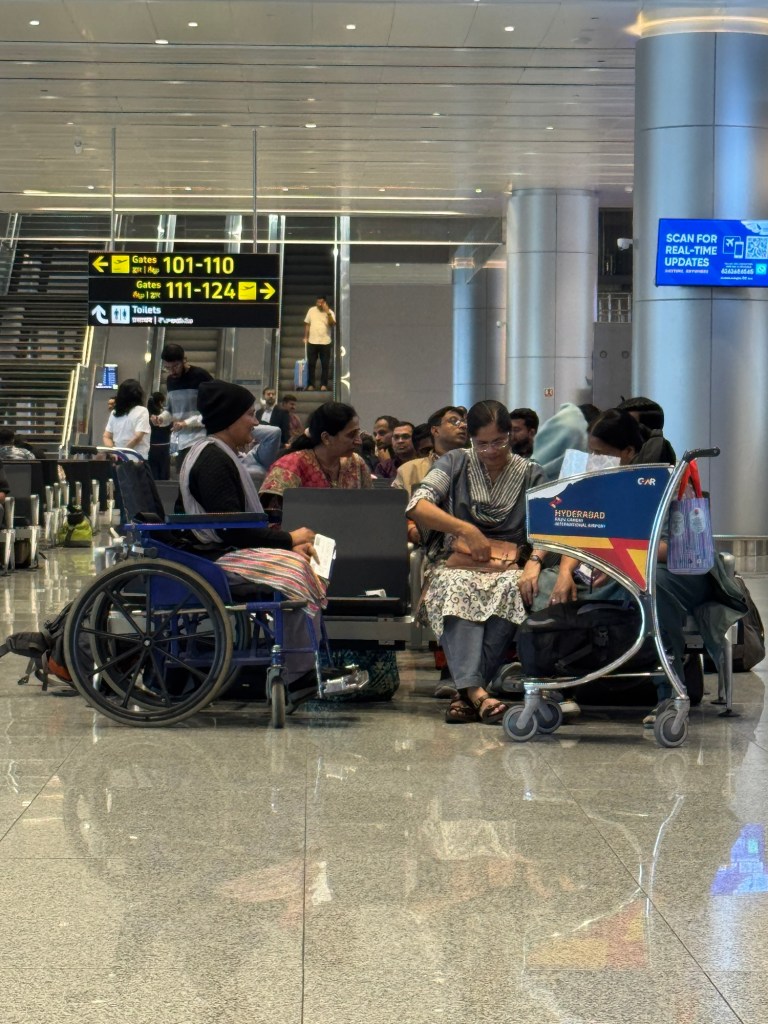
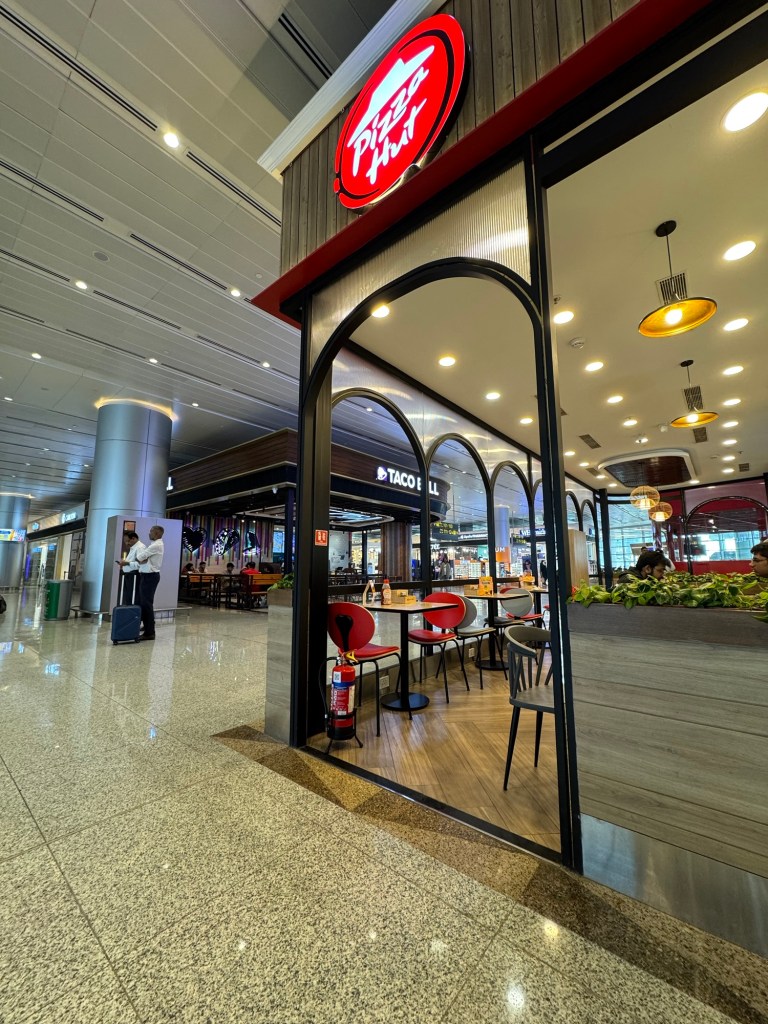
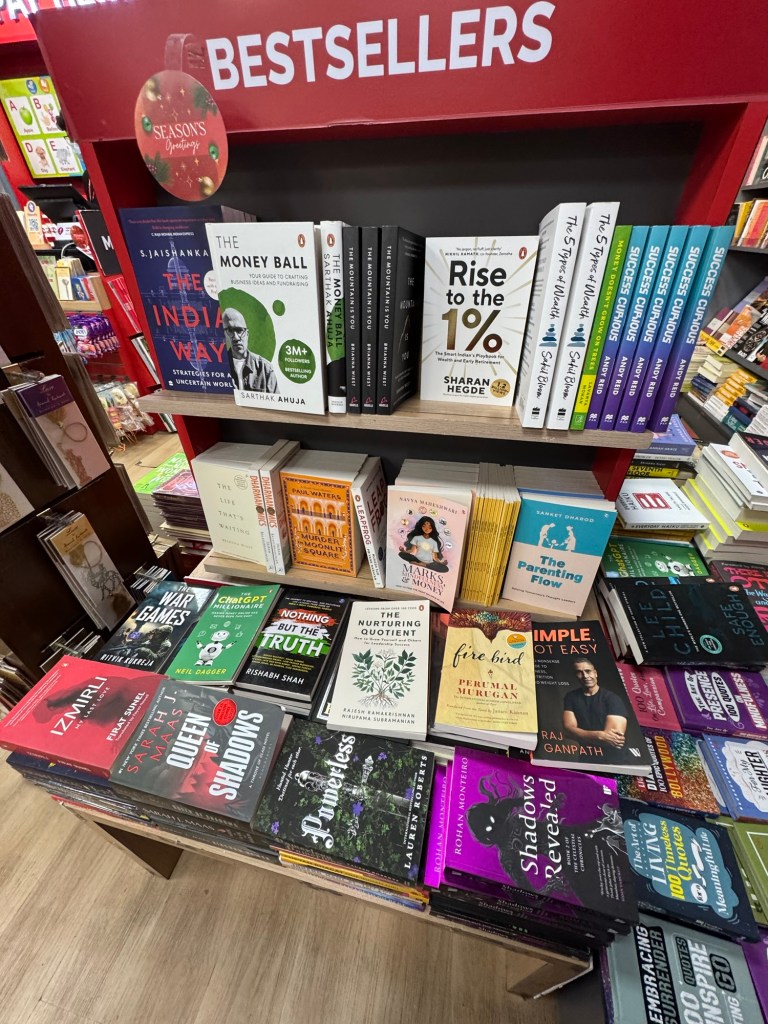
The changes wrought not only herald a maturing country but one that in some ways is leap frogging into a new age: key personnel are being paid enough that the cost of deceit in too high, and furthermore the speed at which the country has moved to a cashless society due to a remarkably competent identification and banking system has reduced the cash that once ‘paved the way’ past annoying gatekeepers of state enterprises. The combination of factors seems to have made age old practices less economically viable. The rate of change portends the emergence of a nation on the verge of entering a modern economy. Yet its march into modernity, it will preserve its distinct nature: businessmen and bare-footed pilgrims wander in pristine airport malls amongst Pizza Hut, Taco Bell and McDonald’s, and the teeming middle class will find bookshelves filled with Indian English book.

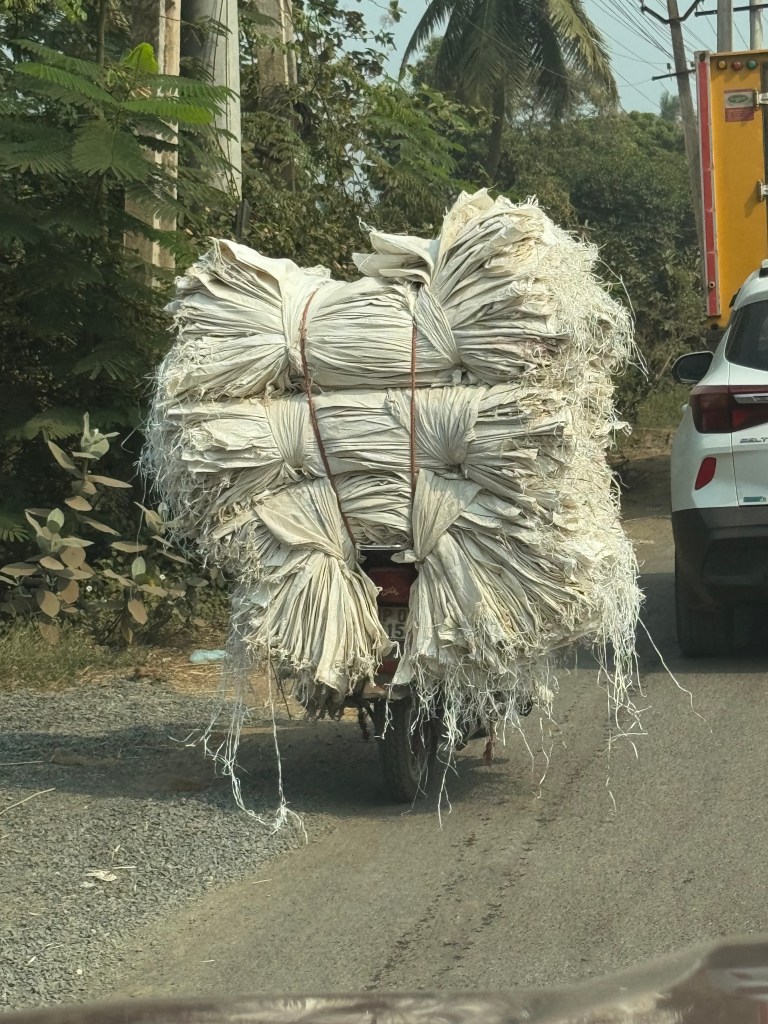
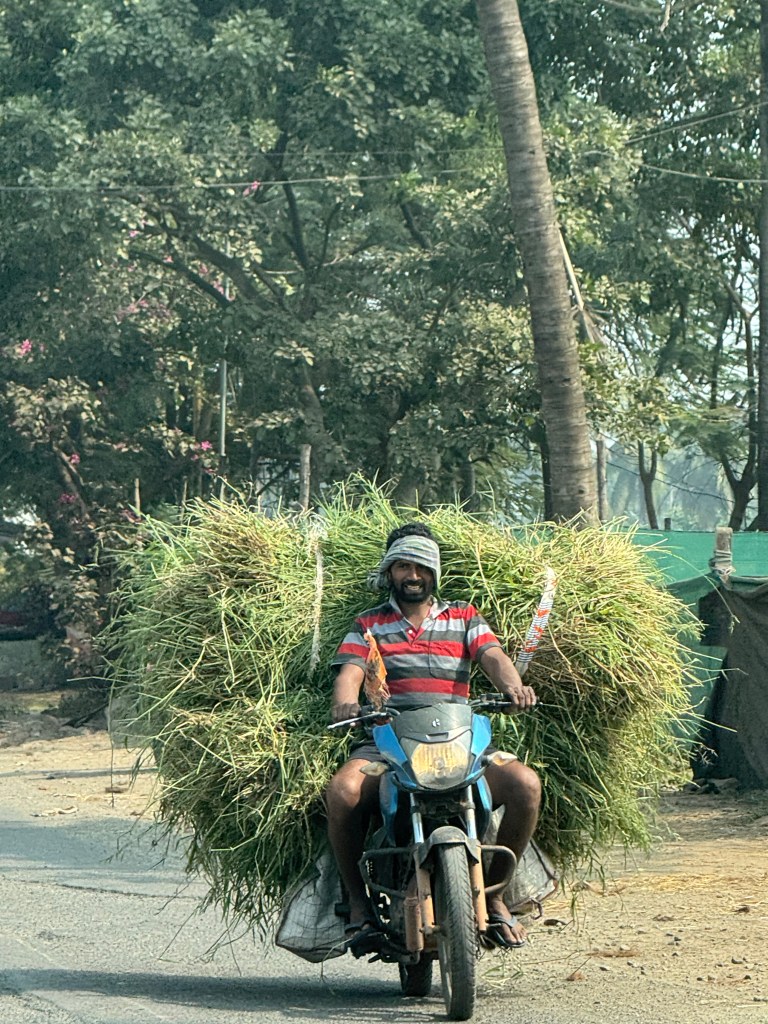
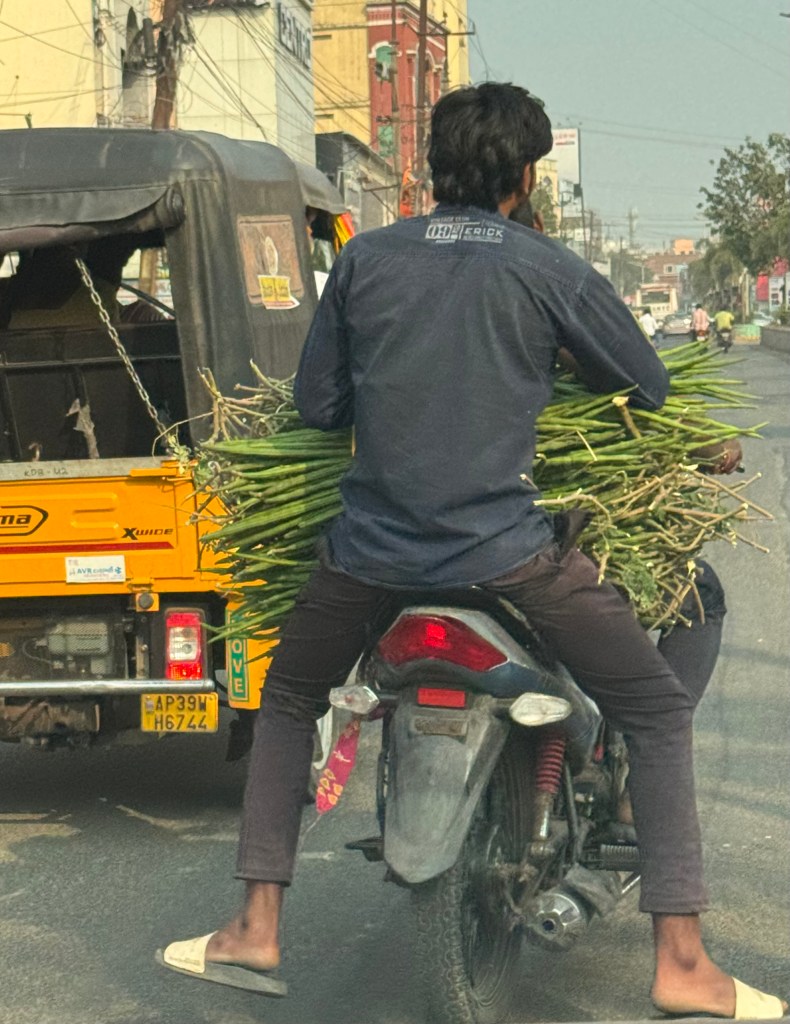
Carrying a load to Village Markets

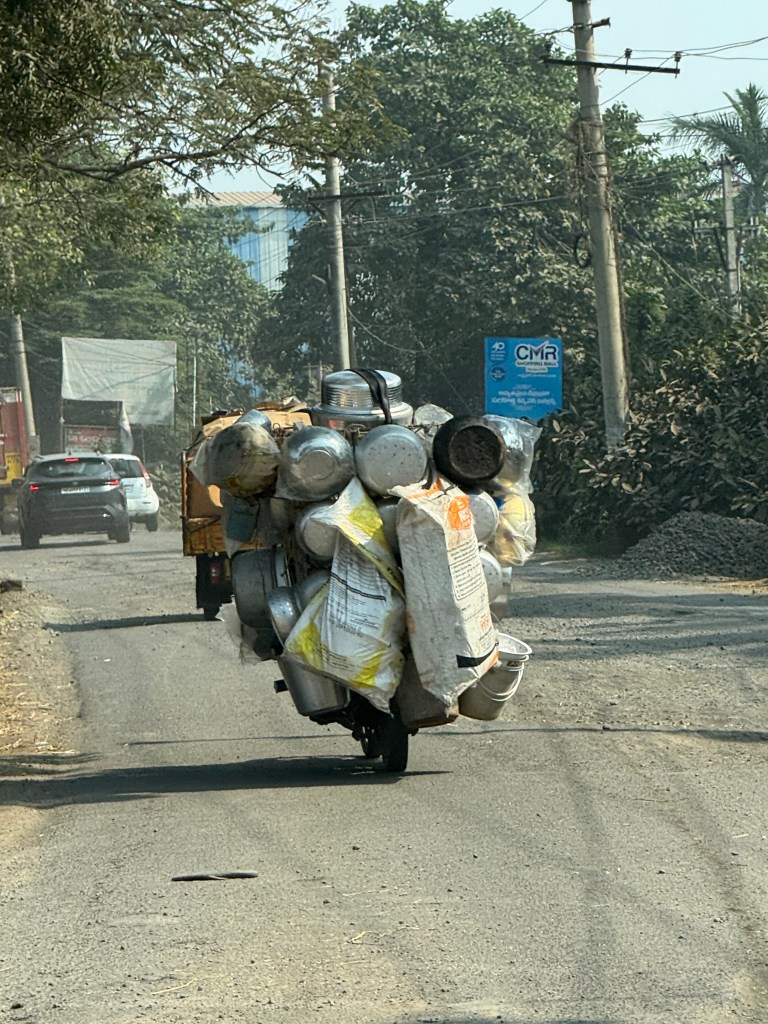
Motorcycles dominate the roads of India. In the millions of villages the domination is more pronounced since two wheelers can more easily navigate the crowded, narrow, severely uneven roads more readily than cars. These rural roads crowd into the very edges of the broad, high speed multilane federal highways on both sides – highways that do not allow three wheelers and two wheelers.

India is booming, and evidence of the remarkable economic growth pervades even the tiniest of villages – gone are the bullock carts, and the foot traffic that once took centre stage now stays along the curb-less edges. Even bicycles have given way to motorcycles as the lowest strata of the population has discovered the economic benefits of faster locomotion.

The riders display remarkable feats of traffic-weaving around four wheelers, pedestrians (many of them barefooted pilgrims to local deities), massive slow-moving lorries, occasional herds of water buffalo, with remarkable agility, even on some of deeply carved dirt roads. All this while carrying goods to market strewn over several towns or often transporting the entire family of five to schools, temples, and churches.

For servants and labourers once locked into caste professions rapid locomotion has opened avenues for entrepreneurship and side hustles never seen before. Ultimately, it is the expansion of the economy, and the pace (though slower in rural areas) of infrastructure development to support it that will create a new India of millions of entrepreneurs. Eventually it will be the speed of transportation that will enable new entrants into the an increasingly modern economy.

Little Time for Tears, Vietnam

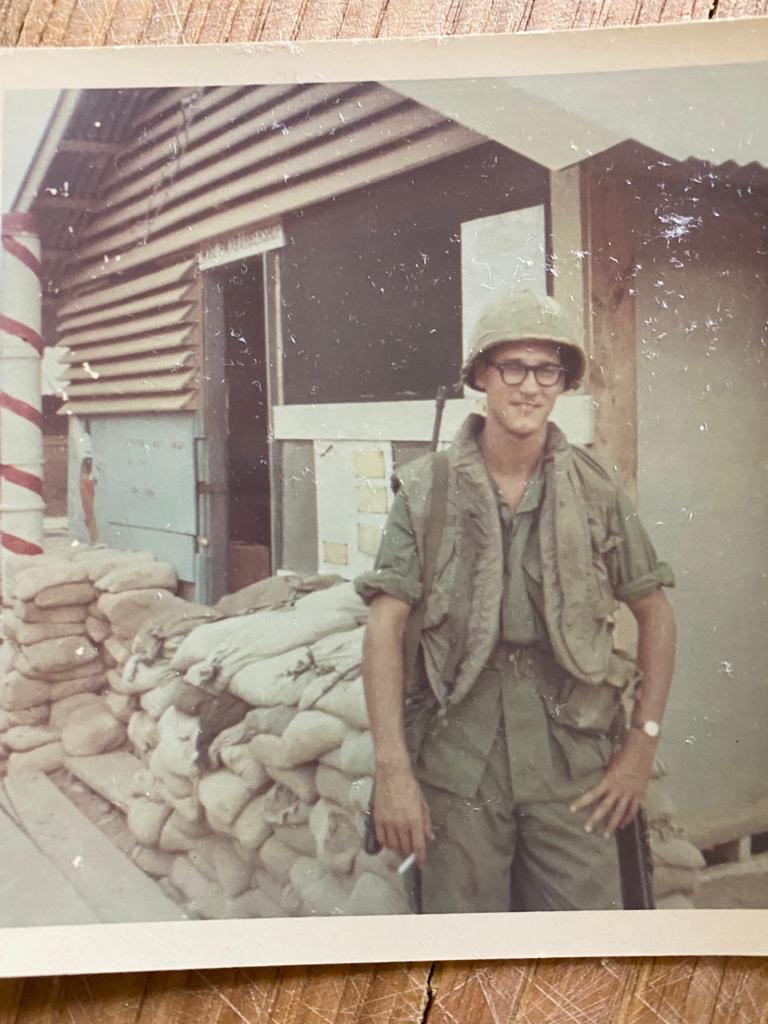
“Combat is so religious and spiritual! Get up each morning and go out to die!” Al Sever, and American Vietnam War veteran who served for five years as a helicopter gunner texted me. For the first time I viscerally encountered the truths I could only access in theory and speculation. Having been deeply moved, for much of life, by the dialogue between God/Krishna and the warrior/prince Arjuna in the heat of battle, in Kurushetra an inner shock reverberated in my spine.

“I served from 1968 to 1972.” Al texted me some time later,”and I died on September 10, 1970 in the Mekong Delta.” Certain he had succumbed to autocorrect, I asked, “you mean you almost died.””No,” he replied, “I died and went into the tunnel to the other side.”

Al Sever in 1968

Those of us living under the diverse influences of globalism, and immigration have searched exhaustively through the pages of the Bhagavad Gita and its many interpretations for solace. The man who assassinated Gandhi, and Gandhi himself quoted the great epic – one finding inspiration to kill and one for non-violence. That Robert Oppenheimer, the father of the atomic bomb, would quote the Gita when the first bomb exploded in Alamogordo, merely miles from the quaint homes of Los Alamos, New Mexico gives pause.

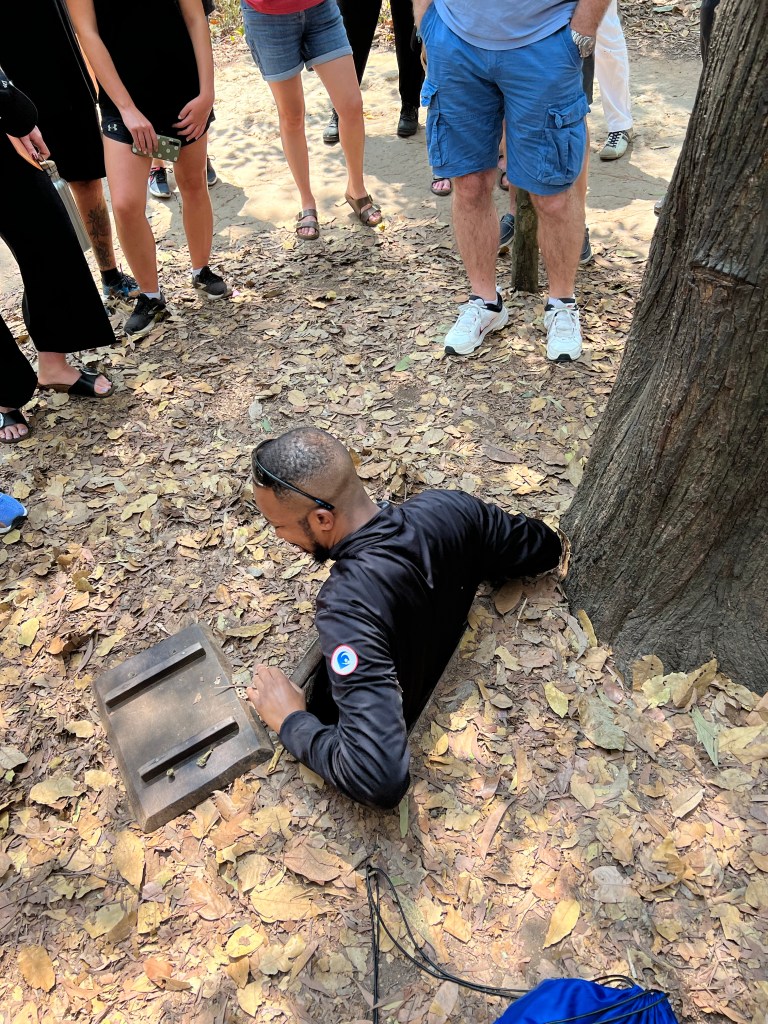
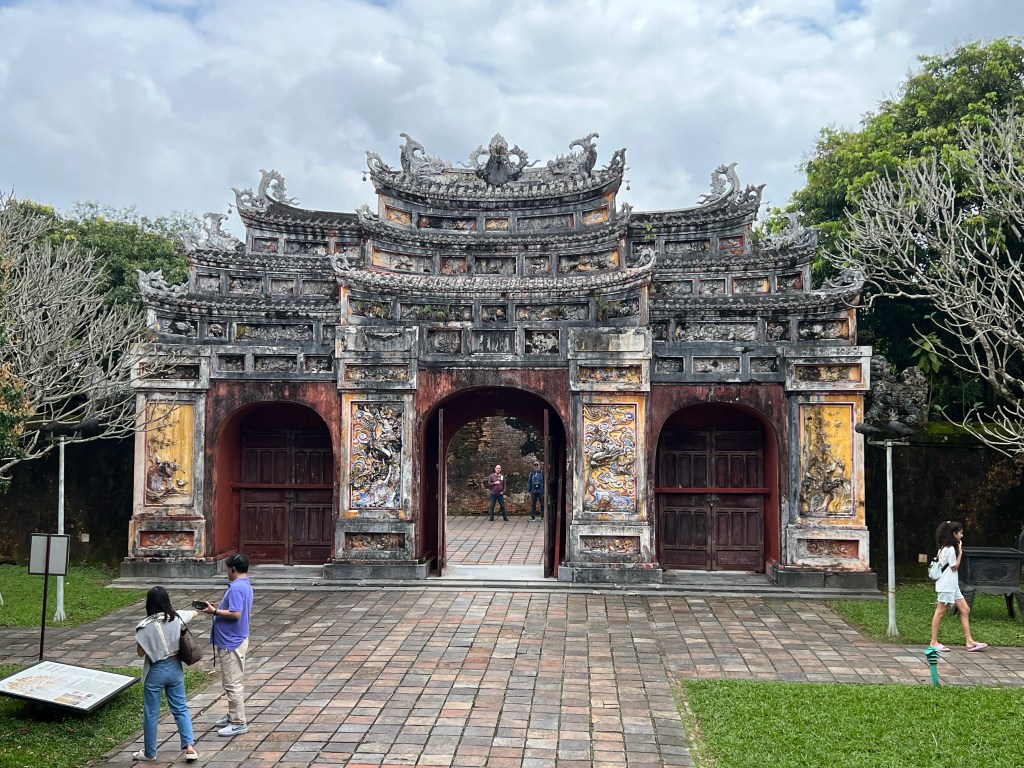
The simple truth of Al Sever, raised in small town Pennslyvania in the heart of a coal mining country with little luxury for great texts of the world is that the heightened sense of being that arises when one is tasting mortality with every breath holds within it spiritual truths. Now Alan – filled with painful wisdom wanders those battle grounds still pockmarked with bomb craters like the ancient capital, Hue – epic street battle that changed the course of the war, and Cu Chi tunnels where the Americans, their sniffer dogs, bombs, and tunnel rats could not destroy men who crawled through hundreds of miles of tunnel- some twenty meters deep and emerge long enough to kill and disappear again

Yet there is not a hint of malice for the enemy nor the enemy for him. Contrarily there is much respect between former adversaries and little trust in the conveyors of the war in his own country. It was duty. It was dharma. The scars have become grist for inner transformation to both him and the former enemy. Despite eschewing religion, Alan’s is a pilgrimage for meaning, whether in the rubble of the battle ground or in his multiple treks along Camino de Compostela.

Ironically, the capitalists fear of communism that drove the war has resulted in a nation racing to the highest growth rate in the world, fuelled by a powerful cocktail of one-party rule and unbridled entrepreneurism. Today Vietnam accrues the benefit of President Clinton – a draft exempt American –  normalizing the relationship between warring countries, and of Trump – another draft exempt American – whose ire toward China has meant opportunity for Vietnam.

Those of us who live lives anesthetized  by middle class comforts, secure in serving as cogs in faceless bureaucracies and corporations forever metered on quarterly statements are free to contemplate the philosophies with no risk. Those who have faced mortality in every breath do not shed any tears, and stand by in profound silence. To some a guilt ridden silence, to some a silence of ineffable pain, and to some a silence of hope. I wonder if this is what Krishna meant when he said to Arjuna, “Death is as sure for that which is born, as birth is for that which is dead. Therefore grieve not for what is inevitable.”


Ahn Lao: Vietnamese Village Life

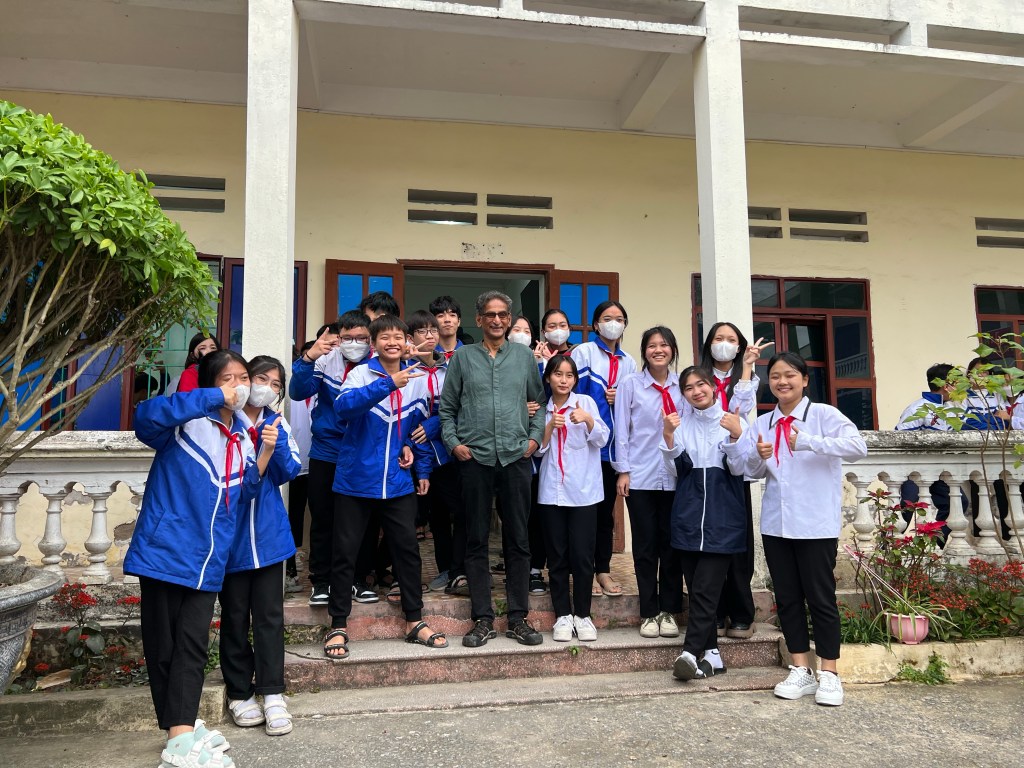
“We would be pleased if you would teach English to our classes.” The principal of the middle school said through the interpreter, Minh – my former street food guide in Hanoi, 100 kms to the west. Then as an afterthought, he added, “But please do not speak of religion or politics.”

Ahn Lao is between a Hanoi and Haiphong, the industrial city near Halong Bay. It has 1500 citizens scattered in handful of streets that all ended in small holdings of rice fields – some barely an acre. Minh was born in the village. It was to those fields that his family trudged for generations, while the males intermittently went to war – the French war, the American war, the Cambodia War, the Chinese war, and regional battles long forgotten. Here they eked out a living as massive industrial complexes moved into the area after the government invited foreign investment in 1986. Assembly plants edge within a few kilometers of this bucolic village – surrounded by condominiums for foreign executives. The youth are abandoning the rice fields and the narrow main street to the highway is jammed with motorbikes at all hours of the day.

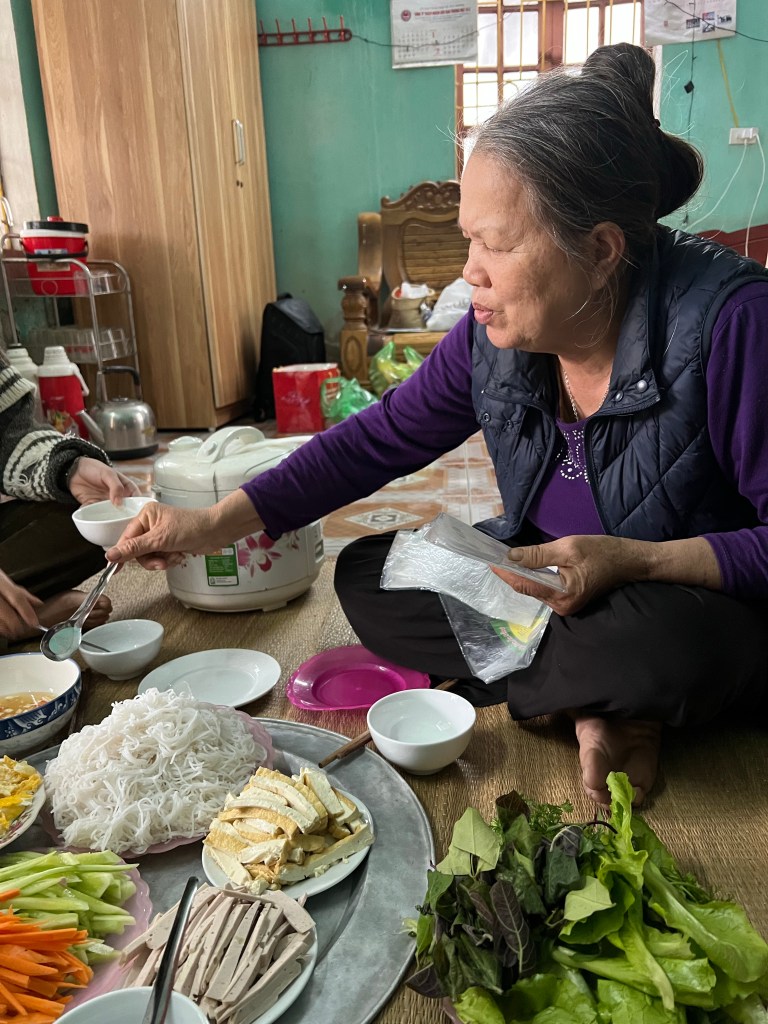
This is “Red” Minh’s (“Red” is his TikTok persona) family home – two bedrooms, the altar to ancestors, both kitchen and bathrooms outside, surrounded by trees- Jackfruit, Dragon fruit, Grapefruit, Peach, Persimmon, and Bananas, bordered with flowers – Roses, Chrysanthemum, and Orchid. Mrs. Minh – widowed when her husband could not be saved during a cardiac event – invited me graciously, her dog and two puppies by her side. I entered the home, leaving my shoes at the door and bent in prayer to acknowledge the ancestors. Over green tea Mrs. Minh told me that she was not an influential person in the village but has managed to arrange to meet the village head and the woman who looked after the Buddhist shrine at the edge of the village, and the man who maintains the Nyugen Val family mausoleum.

“Unfortunately,” she continued in Vietnamese, “The district manager will not see you. They are afraid you may be a spy.” and added with a soft imperceptible smile, “I think it is because they are all corrupt and afraid of strangers.” Minh interjected that his old teacher would like me to teach English to Grade 6 and Grade 9 students. “You will be a celebrity here.” He said, “the first foreigner to come to the village.” Just as he said these words, I looked out of the door to be greeted by several elderly women in the courtyard smiling and waving.

The most noticeable aspect of the kids in the middle school – a large, clean compound surrounded on three sides by rice field, and party flags prominently at the entrance – is that they are remarkably attentive and respectful to their elders. There is an air of acceptance of authority and willingness to comply with teachers. Minh and I had agreed that we would use global geography and sports – the least controversial of subjects – as vehicles to teach English and brought along bagful of treats to be given as rewards for participation – the excitement was boundless. Except for one or two eager students, the level of knowledge of English and geography was poor but there was great enthusiasm to learn.

It was not until evening descended with orange and purple clouds reflecting vividly on the rice fields the village erupted with vibrant life. Volleyball players rising from the ground and spiking balls and betting with each serve, the pragmatic yet striking woman in her bright red dress dipping her ladle into one of the row of local rice toady barrels to fill another order and the loud men in the only bar by the side of the road.

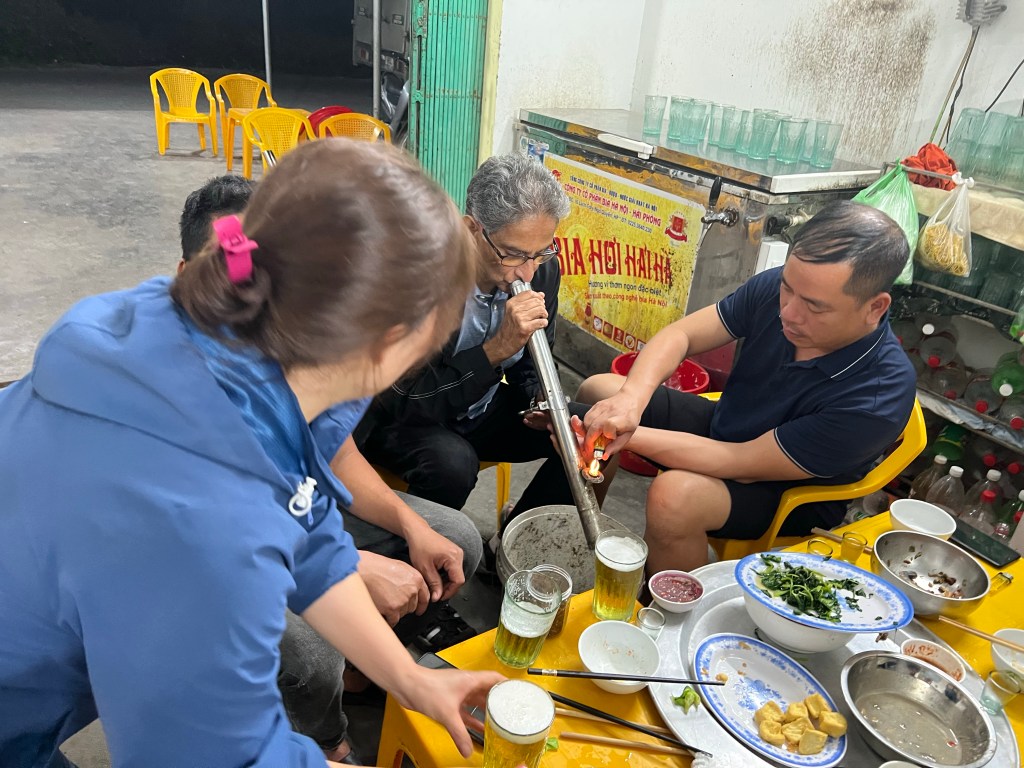
The owner of the bar – and also loudest most incoherent patron – erupted in glee when Minh and I walked in the door and immediately announced, “I could not meet you at the office, but now, we will drink together and I will answer every question you have.” And turned to Minh and said in Vietnamese, “you understand I could not talk to him at the office when you mother asked me.

Minh had warned me that this group and in particular, the district manager would be loud and say things they don’t mean. The district manger pointed to the female server and said, “this is the girl you want. She is soft. She is a catholic.” I laughed and said, “I am sure she is soft and she is beautiful but I am married.” She smiled broadly and shook my hand and scolded the owner. “I can tell by looking at you that you are an intelligent man.” He said, “so what can I tell you about our humble village.”

“I am curious how the village is managed. I just came from an Indian village. How do you resolve disputes? Crimes? I asked. “We have no crime here.” He said, before he handed me a hookah that they were sharing and held a long soliloquy to the others about the great work of the district committee.

That night Minh and I walked home to find his mother distort. One of the puppies had been stolen. Minh noticed my shock and said, “it’s okay. They will not eat it. It’s too young. They probably just raise it as pet.”
Walking the Streets of Old Hanoi

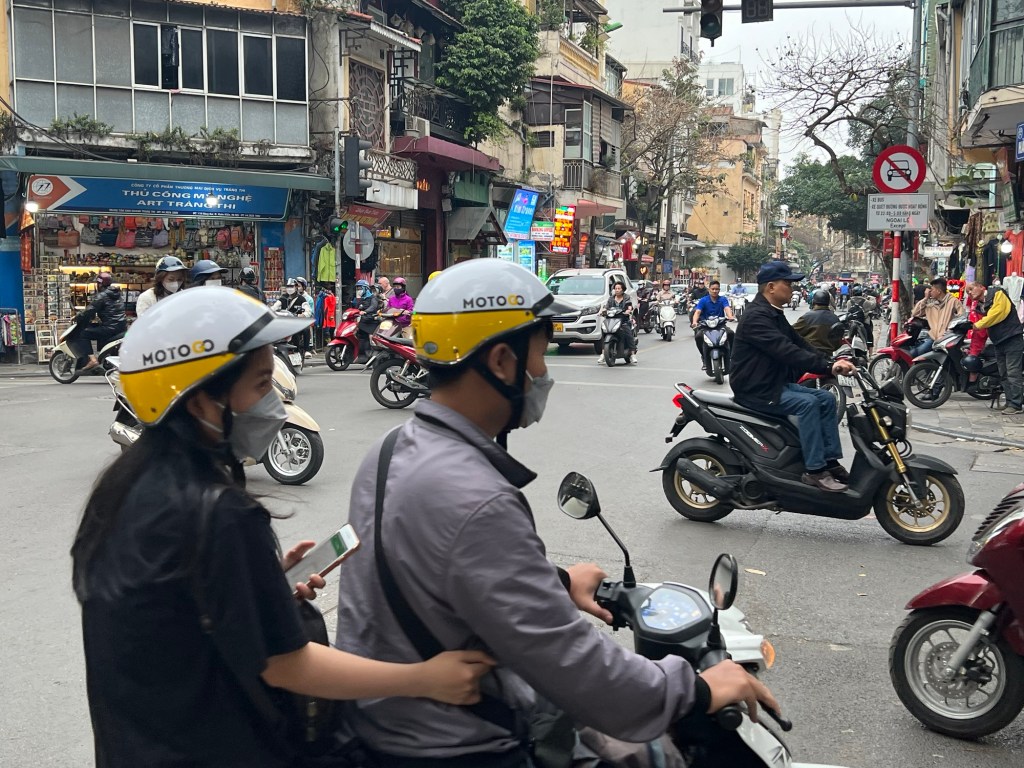
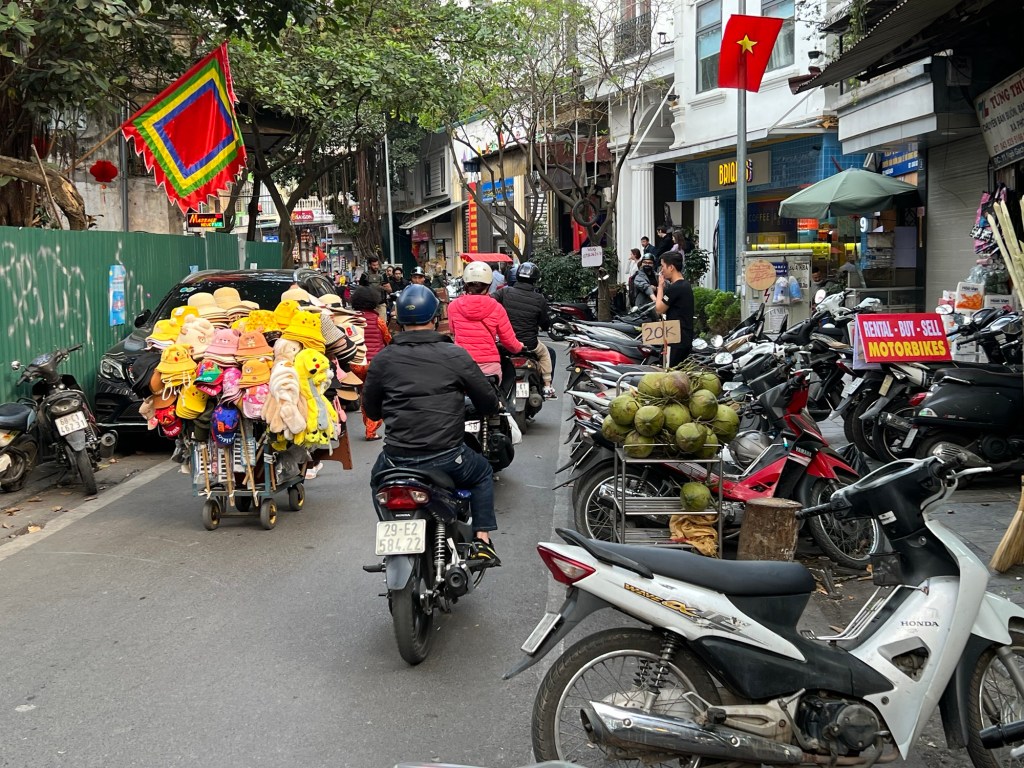
When walking in the streets of Old Quarter of Hanoi, known locally as Hoàn Kiếm, it is best to heed the word of the renowned Vietnamese Zen master, Thich Nhat Hanh, “Breathing in, I release the tension in my body. Breathing out, I smile.” That may be the best state of being with which to walk the streets of Old Hanoi. Almost certainly you will encounter countless street crossings and intersections along its narrow streets, their sidewalks spilling with street vendors and scores of people hunching over their green tea on tiny stools. A moving interlocking wall of traffic – pedestrians, bicycles, rickshaws, motorbikes, cars, trucks, carts, and an occasional giant tour bus weave around each other even through traffic lights like a perpetual square dance without a caller.

 It is not easy to escape this run through the gauntlet of traffic in Old Hanoi’s narrow streets and intersections. There are green lights for pedestrians and although there is some profit in waiting for them, it is important to not lose a moment of attention as the green lights serve merely as optional for the charging traffic. “Walk slowly, but confidently” my street food tour guide told me, “You will confuse them if you walk too fast or seem uncertain.” “I have crossed streets in India,” I told me, “and I even practiced back and forth to get it right but this in different.” “How?” he asked. “In India all the moving participants in the street never lose eye contact with each other. They even have subtle eye and hand gestures to signal each other. Here there is nothing.” “Everyone is in their own world here,” He said, “preoccupied with their own thoughts.”

Westerners are the most dangerous of street crossers for local traffic but most of the moving hoard adjust for that fact. However, it is very important that newcomers practice the street walk in areas of low traffic, wait an extra length of time, or raise their hand in the air to announce their every move. Confidence will build with some practice and the final stage is to arrive at the Zen-like state in which the pedestrian becomes one with the traffic. Such a state will help in walking the streets of Old Hanoi and this newfound freedom will go a long way in enjoying the many streets that stay true to their original trade: Shoe Street (Hang Dau), Silk Street (Hang Gal), Bamboo Street (Hang Vai), Silver Street (Hang Bac), and Traditional Medicine Street (Lan Ong).

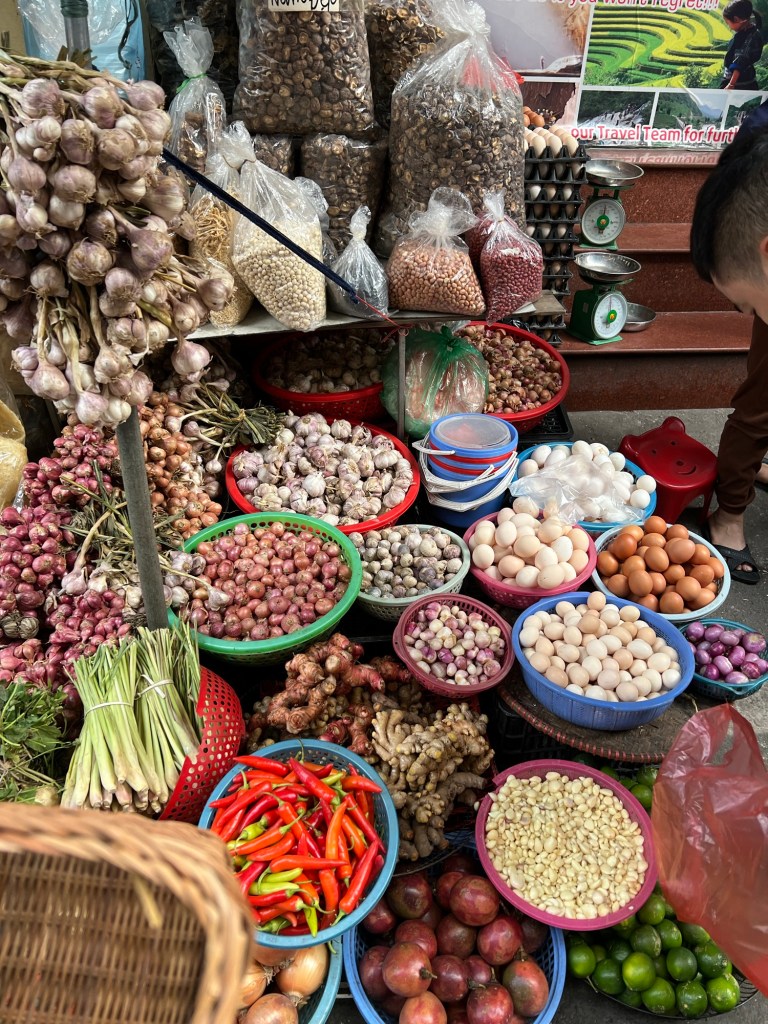
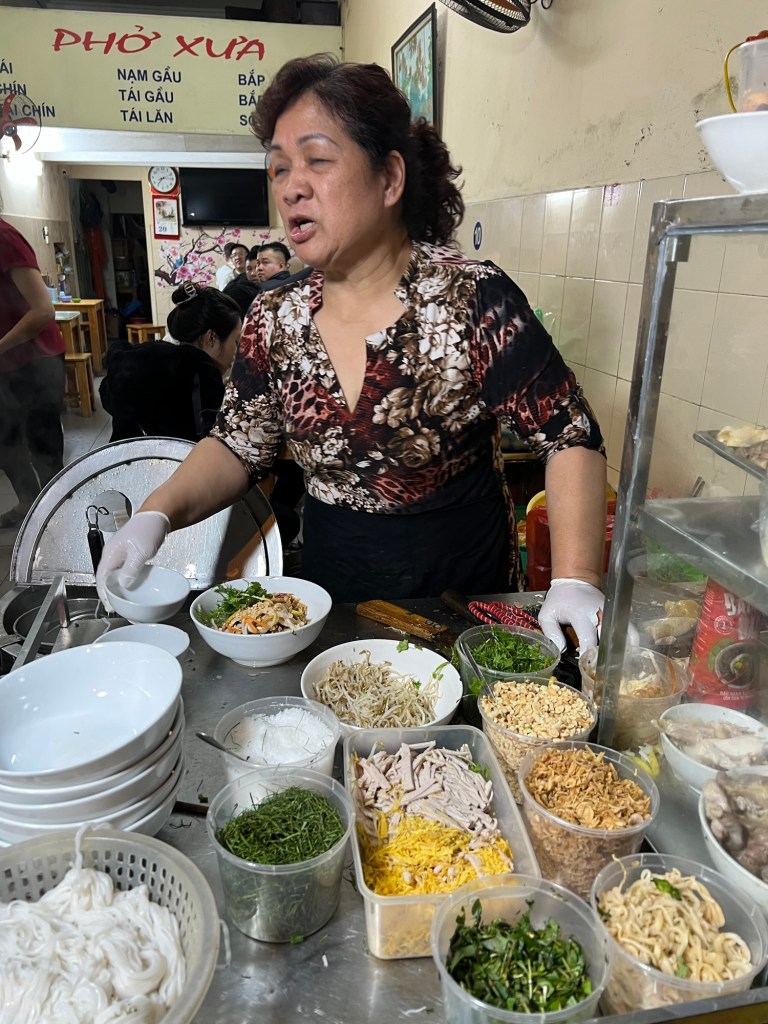
 There is some likelihood that you will see a phenomenon that I witnessed in which dozens of sidewalk food vendors suddenly, like well practiced stage hands, disappear in seconds – their customers hustled into alleys, the tiny stools disappearing, the lights turned off and sidewalk swept. The cause – someone had phoned ahead that authorities were in the neighbourhood to police unlicensed vendors. Licensed or not the street food is superb – the produce is fresh and natural and the process of cooking clearly visible.

 Also it is possible to encounter a “shoe repair” urchin that will point to your shoe and in one swift motion remove it from your foot, place the foot on a slipper – then adeptly sew up a nonexistent tear for an absorbent price. Almost certainly you will see someone burning play money – often $100 – in honour of ancestors. The various spa and foot massage services – all competent – are ready to help at a reasonable price to relieve feet from a day’s walk, and the omnipresent “Grab” motorbike-taxis are ready to offer a ride. Sadly, for males walking alone, the Grab drivers will boldly demonstrate their diverse offering of the most ancient of professions.

Globalization and Remote Village

Sir Arthur Cotton, Prawns, High Tech, Darwin, and Born-Again Christians

Andhra Pradesh, India.

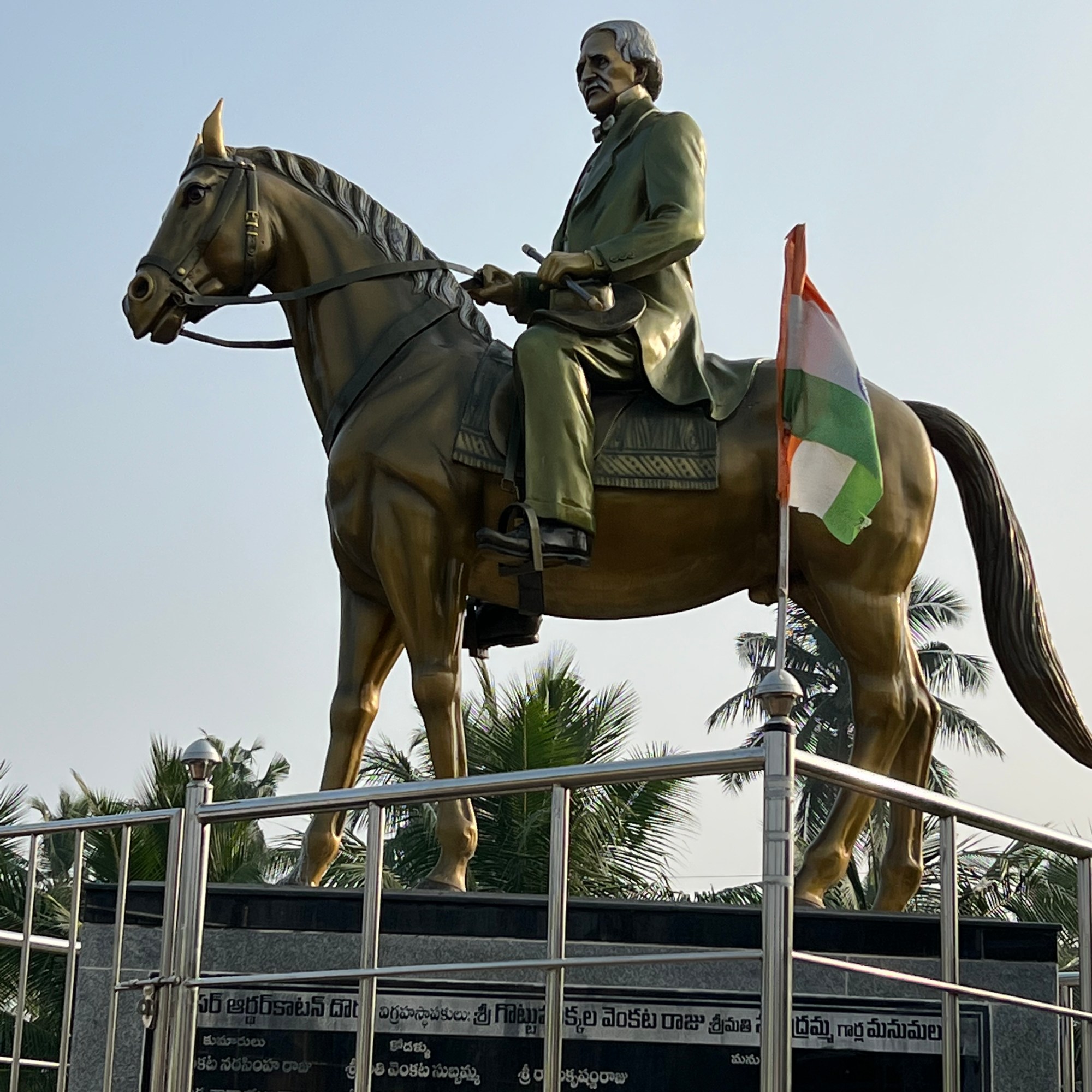
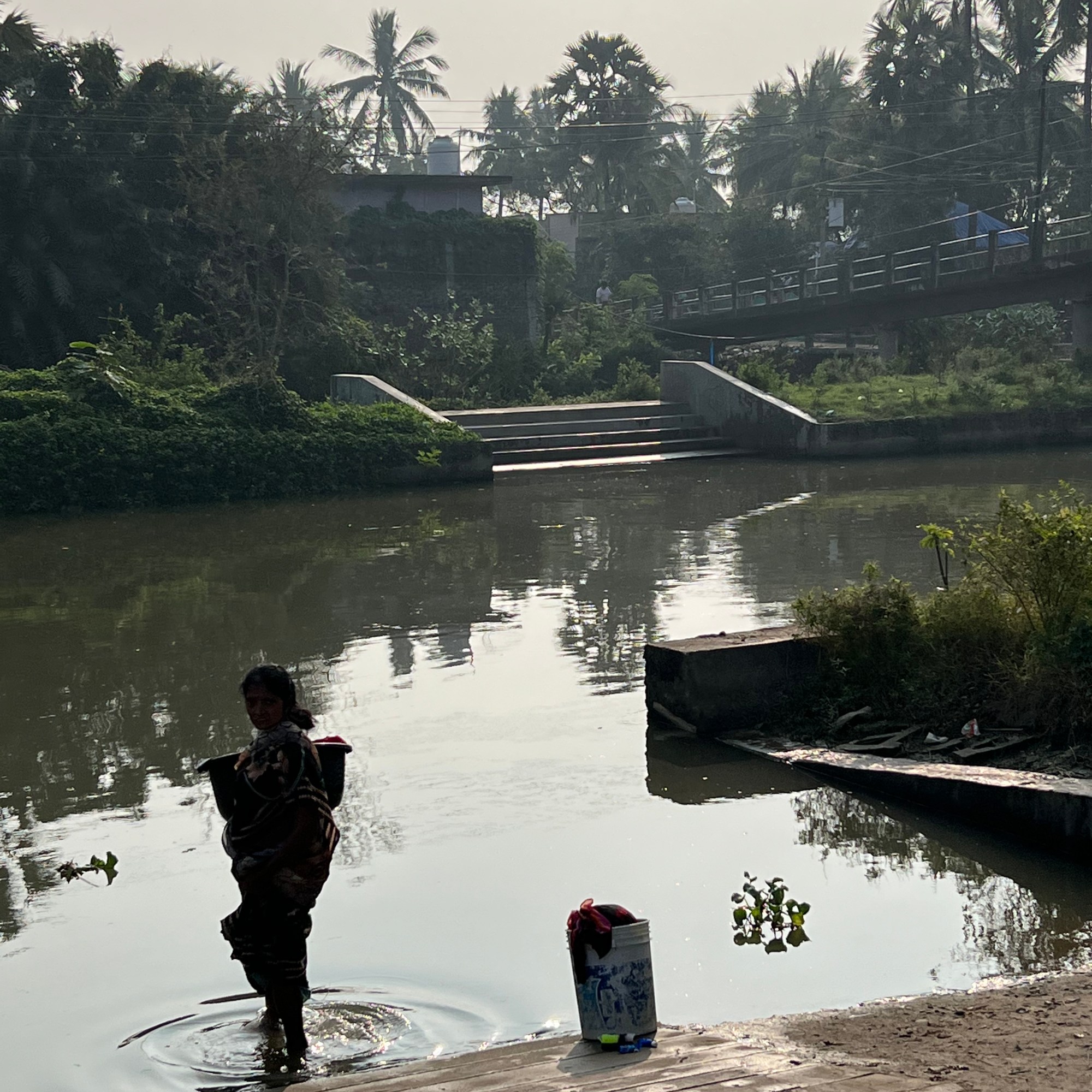
“He was not just a saint,” the farmer who lives in a stately mansion in a remote but wealthy village said to me, “He is like a god to us.” Then he waved his arm around him and added, “all of us in the state of Andhra owe everything to him. Even all of India.” His family had known wealth for three generations largely derived from farmlands transformed over decades from rice to fish and shrimp farms that stretch for miles along the canal. A canal first imagined by Sir Arthur Cotton whose statue, adorned each morning with fresh flowers, gleamed in the morning sun as women gathered to wash their clothes and men drove their waterbuffalo to lounge in its waters. He is seated regally on a horse, his back turned to the canal, and his face staring into the entrance of Aibhimavaram, one of the countless villages that made up the rice bowl of India for generations – entirely due to his vision and energy.

 Despite objections from his colleagues and overlords, even under threat of impeachment, he rode through this famine prone area a hundred and eighty years before and developed a plan to harness the waters of the majestic Godavari river – the second largest in India – and build a series of interconnected canals to bring life giving water to millions of acres. Moved by famines that plagued the region, he agitated against the British plan to build railways backed by investors, instead proposing navigable waterways for commerce and irrigation. “What we have before our eyes,” he once said, “the sad and humiliating scene of magnificent (rail) Works that have cost poor India 160 million pounds, which are so utterly worthless in the respect of the first want of India, that millions are dying by the side of them.”

The Godavari – known as the “Ganges of the South” holds a mystic place in the culture as she winds across the subcontinent from the hills around Mumbai to the west and empties into the Bay of Bengal, its delta inhabited by the second highest density of population in India. It is said that deities bathed in her banks five thousand years before and even now, masses gather every 144 years for a religious festival – the Maha Pushkaran. During the last such event in 2015, politicians offered a sacred mix of cooked rice, ghee and black sesame seeds in Sir Arthur Cotton’s honour – a ritual reserved for ancestors.

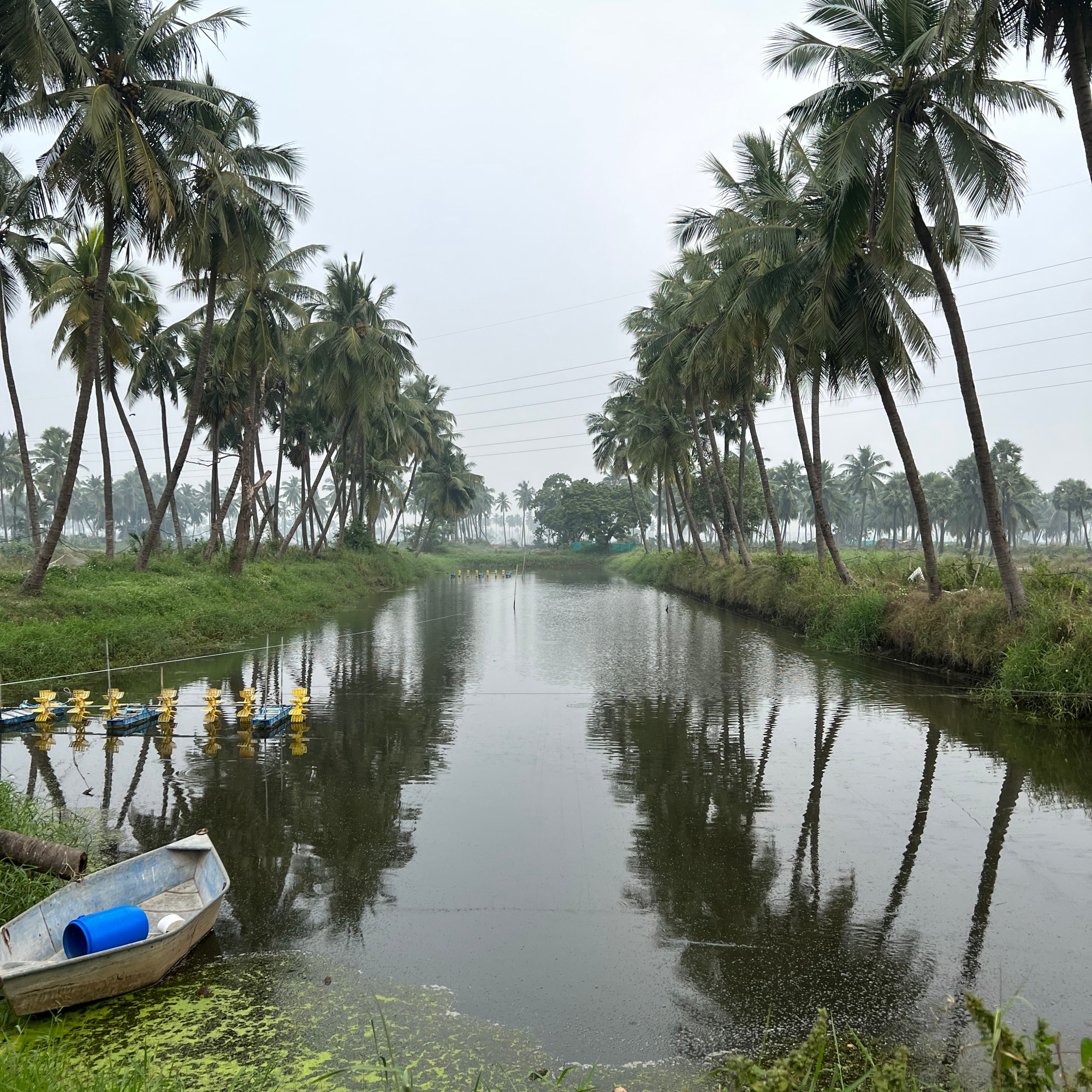
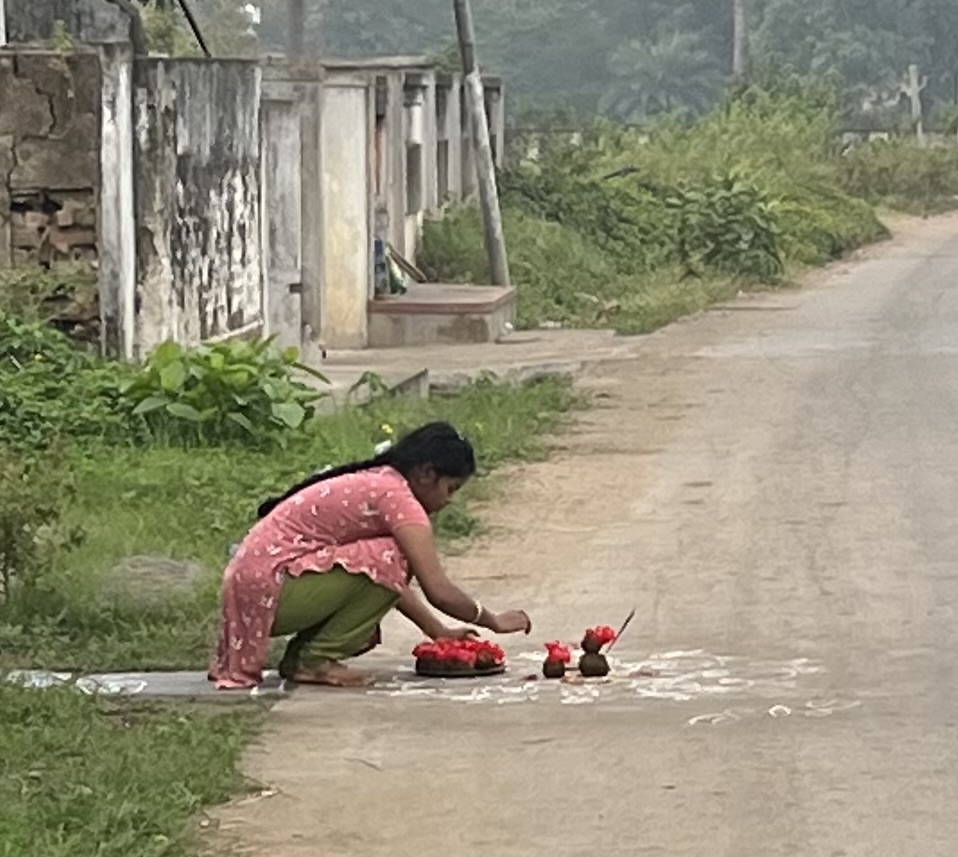
 Thus began the march of globalization that brings the produce of the region to dining tables all over the world. The water from the canal – unfortunately no longer as pristine as Cotton envisioned – feeds the many streams and gutters that leach through the fields into the Uppataru river that takes it back to Godavari. Instead of rice, the fields are now fish and shrimp farms producing giant prawns and Tilapia. The water also winds its way into a filtration system – setup as a non profit by a kind local businessman – that dispenses drinking water to villagers using a cashless e-comm system. Despite the hyper modern world seeping through broadband into each home, the villagers ritually invite the gods with mandalas on their doorsteps each morning.

The many mansions along the sides of the main road attest to the multigeneration wealth created, and the lush gardens, high technology penetration, and education system are testament to the vision and handiwork of one man. Vested with the capital generated, young men and women from the region flood universities and colleges worldwide and dominate the software industry globally – even producing CEOs like Satya Nadella of Microsoft, Arvind Krishna of IBM, and Santanu Narayen of Adobe Inc.

Alas there was an unintended global impact of Sir Cotton’s compassion when he retired in England in the late 1890s near Dorking, Kent, where Sir Charles Darwin would lay dying. His daughter, Lady Elizabeth Hope – a born again Christian deeply involved in the Temperance Movement – loudly proclaimed in America that she had visited Sir Charles Darwin in his death bed and he had privately recanted his theory of evolution. Although denied vehemently by Sir Darwin’s family she gave fuel to creationists – who retell her story on this day. These remote villages – an overnight train ride from the nearest international airport – where Sir Arthur Cotton is granted saint-like status has found its place to a global supply chain of rice, fish, prawns, and ideas.

Dangerous Seduction of New India

“You can trust me, saar” the bald driver said disingenuously, signalling for calm with his right hand in which he held a cell phone. His left hand was alternatively changing gears and holding the steering wheel. His eyes shifted nervously behind his thick glasses. The three of us were quiet and still. Not the calm stillness we had just experienced in a luxury Ayurvedic health retreat in Kerala from which we were returning. Instead, our hands were sweating. It was the quiet of one who had given up all hope – the stillness of the doomed. Traffic careened past us on the four-lane highway from the sparkling Rajiv Gandhi Airport in Hyderabad – designed by a famed Norwegian company and rated amongst the world’s best airports. The palm trees and manicured gardens left little room for a shoulder on the road. When we entered the highway a series of signs clearly blared out that bicycles and motorcycles were not allowed, that stopping on the shoulder was forbidden, and that all drivers should ensure they have gas in their cars when they enter – in all three local languages – Telugu, Hindi, and English.

The car we were in was clearly not an authorized taxi. Perhaps it was because of the two weeks of daily massages, yoga, and meditation in the resort on a pristine beach in Kerala, I had slipped away from caution and paranoia – the two required companions in years of traveling in India. I had broken one of a main tenets of travel all over the world – never use the cab from drivers who solicit you as you walk out of the arrivals area. We did. Worse still, we ignored each of the warning signs that announced loudly that we made a bad choice.

 At first look, the cab had several dents in the rear and side. There were no clear signs that it was an official taxi. The countless times we took taxis at this airport had lulled us into believing that the airport authorities closely monitored each car that came into the taxi lot. This experience combined with the luxurious and transformative Ayurvedic treatment had seduced us into a trusting state of bliss devoid of the basic survival tools for traveling in India. Perhaps I should have stopped the driver early, when I heard the driver ask the parking attendant – the one who controlled who came in the lot – if he could bring him dinner after this ride. Instead, I congratulated myself that my childhood Hindi was still good enough to understand their conversation. Ah, New India’s seduction is thorough and complete.

 Within ten minutes of entering the highway the car spluttered and spontaneously slowed down. Instead of showing concern the driver continued a tirade on his phone to his wife in Telugu. Perhaps unaware that my Telugu was far more functional, the driver told her that he had enough gas to get to the station. The engine sputtered again and the car slowed down to a crawl just as it would when running out of gas. Cars honked mercilessly – not the normal pleasant “beeps” drivers use to communicate with all moving items on Indian streets but sustained angry blares.

 I leaned over nervously to look at the dashboard – the gas light was on. “You have no gas.” I said in Telugu. Surprised to hear my Telugu he turned to me and moved his right palm up and down as if to signal calm, “I have been driving for years, saar” he said in English to reassure me in a language that signified confidence. The car suddenly began to accelerate. We began weaving in and out of traffic with the agility of a young antelope in a galloping herd and my fear was suspended. Then I noticed he straddled the line between lanes between overtaking adversaries as if he needed the extra room.

 Suddenly, the car coughed and sputtered again and the smell of engine oil seeped in. There was clearly no shoulder to turn to. The cars continued to careen around us and soon even the three wheeled tuk-tuks – some with robust truck-like horns to make up for their stature – began overtaking us on all sides. At one point, one lone bicyclist defied all the signs and rode past us in the little shoulder there was. It was then that I saw that even the engine light was lit.

“You have a problem with your engine.” I said, to which he shook his head, “You shouldn’t be driving while you are on the phone.” my wife interjected. “Can we now get off at the nearest exit and take an Uber?” my son said. But the exit ramps with no shoulders whatever led into each other before finally bringing us to a boulevard in Cyberabad – the exploding High Tech city with broad streets that narrowed in parts due to endless construction – massive residential compounds, office complexes, hundreds of telescopic cranes in all directions.

Our destination was one such complex – a walled mini city of ten thirty-five storey buildings with sixteen hundred apartments, perfectly groomed lawns and gardens, tennis courts, roller blade courts, cricket cages, gyms, groceries stores, pharmacy, a temple – a calm oasis. We were within a hundred yards of one of several gates, but he had entered a one-way street in the wrong end! He offered to drive around, and we all refused in unison despite having a lot of baggage. Soon as he stopped, we rushed out of the car. Unlike inside the immaculate compound where dog owners or their servants marched their pooches – pugs, beagles, rottweilers, German Shepherds and variety of designer variations of the poodle – and picked up their waste in bags and extension poop pickers the streets and sidewalks of India are the domain of packs of street dogs.

 Soon as I exited the car and muttered expletives in Telugu, Hindi and English, I realized that I had stepped on dog shit.  We would be navigating our luggage through an obstacle course of such droppings while the street dogs stretched on the sidewalk basking under the street lights paying us little heed. With the little anger left in me I raised my phone to take a photo of the cab as he drove away in the hopes that I could register a complaint only to notice the license plate was bruised and the number obscured.

Sunrise on Sunday in Kerala’s Backwaters

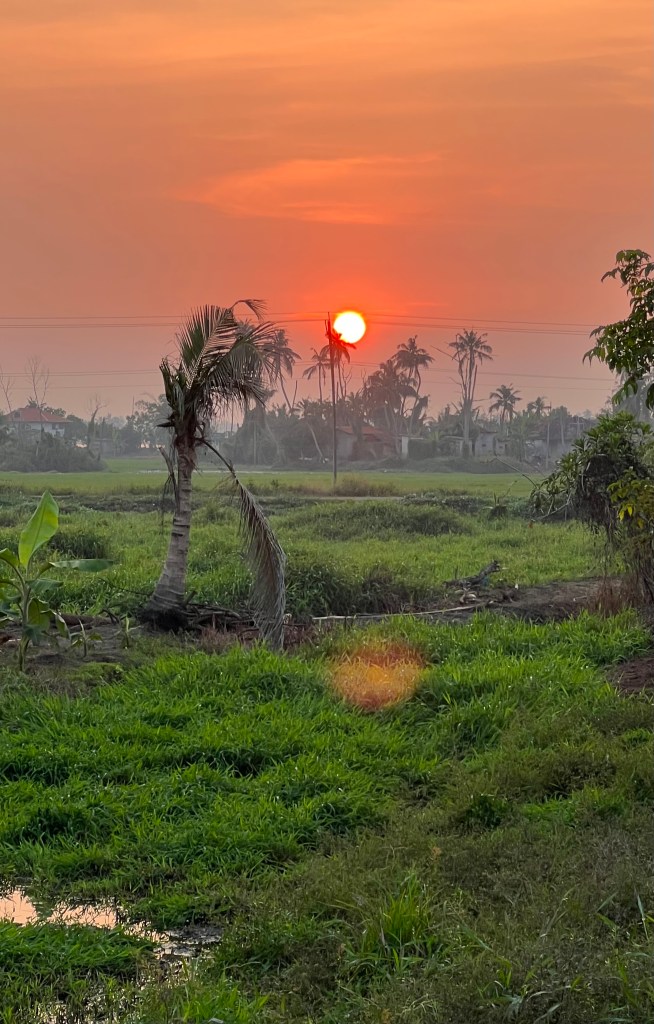
The sun rose to the piercing cry of a kochila khai, a large-beaked bird endangered in much of India. In the backwaters of Kerala, all life thrives, and dawn is greeted by the cries of a host of birds in one of the world’s most diverse environments. Fish break the surface of the water sending concentric circles in canals and lakes, that would soon be broken by passing boats carrying young boys and girls to Sunday school – girls dressed in blue frocks, hair tightly braided with marigold wound at the top of their heads, boys in blue shorts and white shirts. Occasionally, an elaborately dressed priest in white robes sailed behind with his retinue of nuns. The forty foot ferry stopped at the small docks along the stone walls of the canal and carries passengers through the network of canals and lakes all day.

Several Hindu men lined the wall at the break of day. The sun had barely risen above the rice paddies when they lifted their hands, lowered their heads and silently muttered their morning prayers before jumping into the water and swimming back and forth. They rubbed themselves dry with cotton towels before going to work in the houseboats as their guests awoke. A few well dressed men and women with stiffly ironed shirts and colourful saris walked along the dirt path toward a Devi temple – for the powerful female consort of the equally powerful Lord Shiva. The night before, on the occasion of the lunar new year, the temple was glittering with hundreds of candles and blaring prayers to Devi through its loudspeakers. Now it was silent, Brahmins murmuring prayers they would each day.

In the distance, a muezzin’s piercing cry called people to prayer at the earliest rays of the sun. Sunday morning’s cacophony of religious sights and sounds – the boats that plied children and clergy to school, Brahmins muttering beneath this breath, the muezzin’s cry – attest to Kerala’s motto, ‘Gods Own Country’ a motto that belies the state’s deeply communist roots. Yet it is the state that is admired for inter-religious harmony.

Well lit Devi temple on the night of the lunar New Year

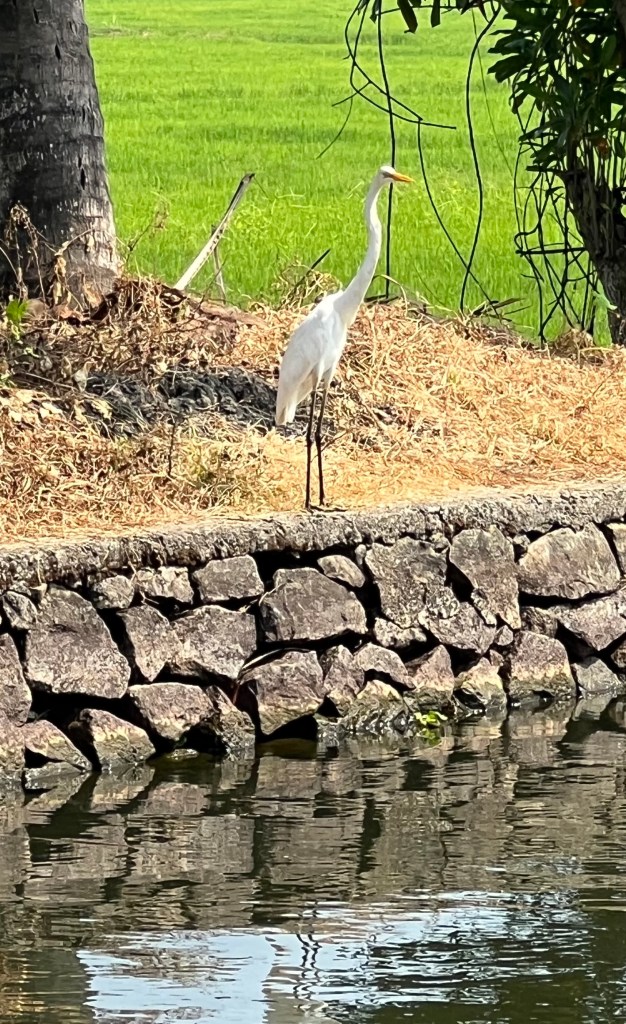
It is January, the cusp of winter when the backwaters are alive with the most diverse bird life in the world. Whiskered terns, egrets,and purple herons pirouette just above the water, giant cormorants and kingfishers line the shore, and above, kites, osprey, and hawks lazily petrol the skies. Black drongo with distinctive split tails, the sight of which, according to local legend, is a call to look deeply within yourself for gratitude and awareness, auspicious mynahs, and teals. Some like the stork would have migrated from far away Siberia.

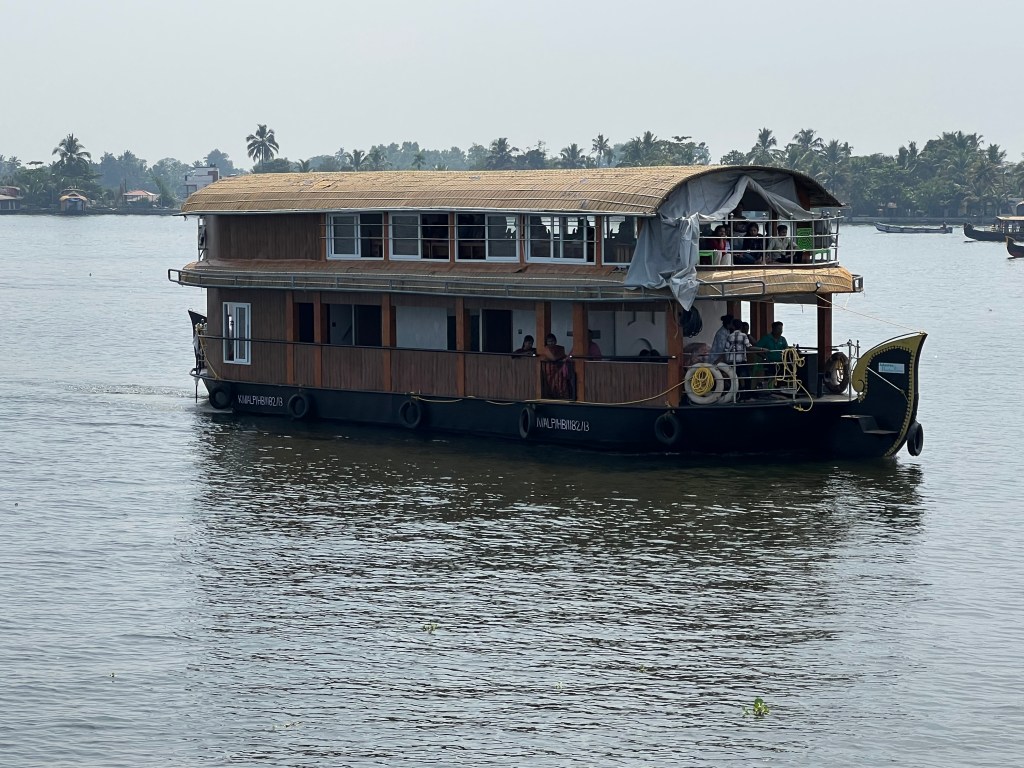
Houseboats, mandated by government to be made with natural material. Instead of metal nails they are tied together with jute.

On the journey along the canal in our houseboat, the mango trees can be seen weighted down with green mangos yet to be harvested, banana trees are fully laden as are the coconut trees, the custard apple trees, and palms. Morning Glory vines smother the fences of the small homes along the canal – almost all are single storey bungalows – and are surrounded by sacred Marigold, yellow and pink Hibiscus, Chrysanthemums.

Soon the backwaters would be filled with activity. A double decker boat called, the Vatican, with dozens of men, women and children, all with white dots on their foreheads and some men with orange robes plows by – probably on their way to church. A well dressed couple goes by in a small boat – she holding a purple umbrella over both of them, and few men and women quietly clean their laundry. Despite the noises there is never a sense of discordance, rather it seems sights and sounds play within the large silences as the sun rises and life slows with each hour as the sultry heat envelops each sound.

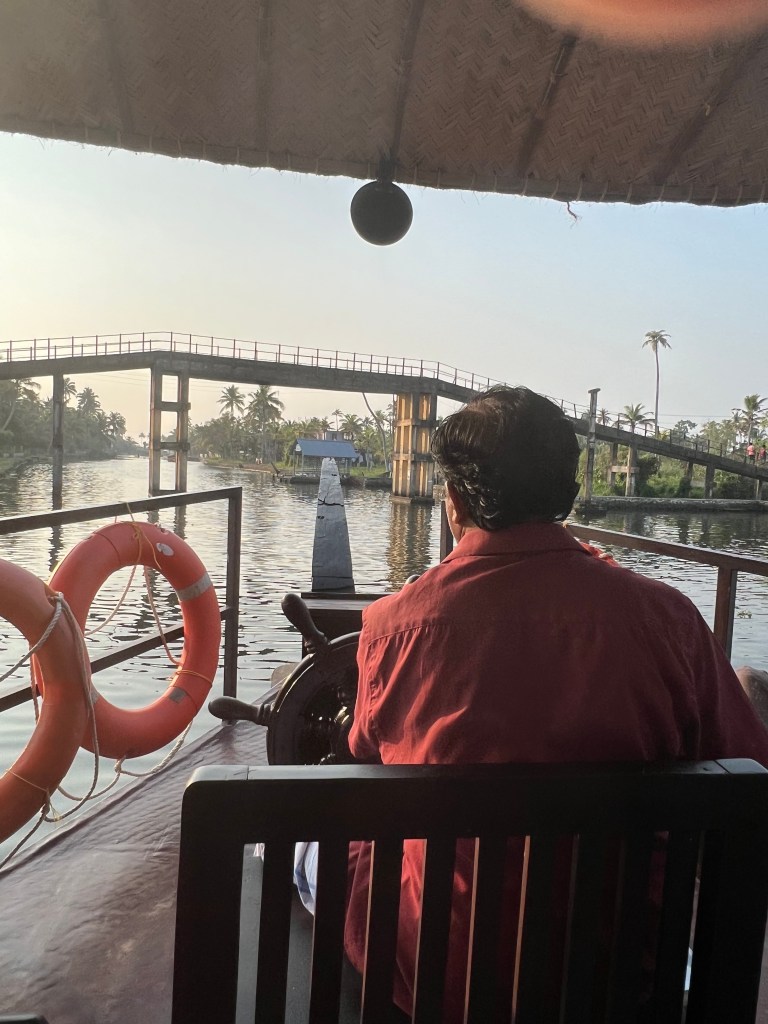
Captain navigating close quarters through a bridge

The sense of sacred is near at hand in Kerala. The deep commitment to communism along with a deeply inculcated sense of sacred will always make Kerala unique. With a superb education system (99% literacy for women and men in a country where 84% of men and 71% of women are literate.), and well organized health care network as may be expected in a communist state, Kerala’s largest income stream is foreign remittances. Three and half million of her citizens dominate health care, IT, and business in the middle eastern Gulf states where Malayam has become the second language.

Articles about Kerala:

https://www.washingtonpost.com/world/asia_pacific/the-place-where-communists-can-still-dream/2017/10/26/55747cbe-9c98-11e7-b2a7-bc70b6f98089_story.html

https://www.ndtv.com/india-news/new-york-times-names-kerala-in-its-list-of-52-places-to-visit-in-2023-3688909

Anusha

“You need to you take care of the young woman.” My 97 year old father said to me, “I will not live much longer” The snow curled and fell gently past his eleventh story apartment in Ottawa. The city was cloaked in grey, the streets below grey with snow, the buildings like grey sentinels.

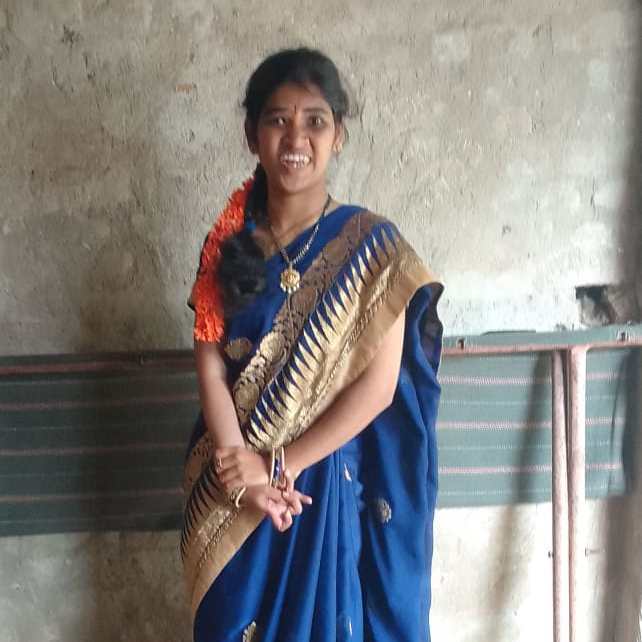
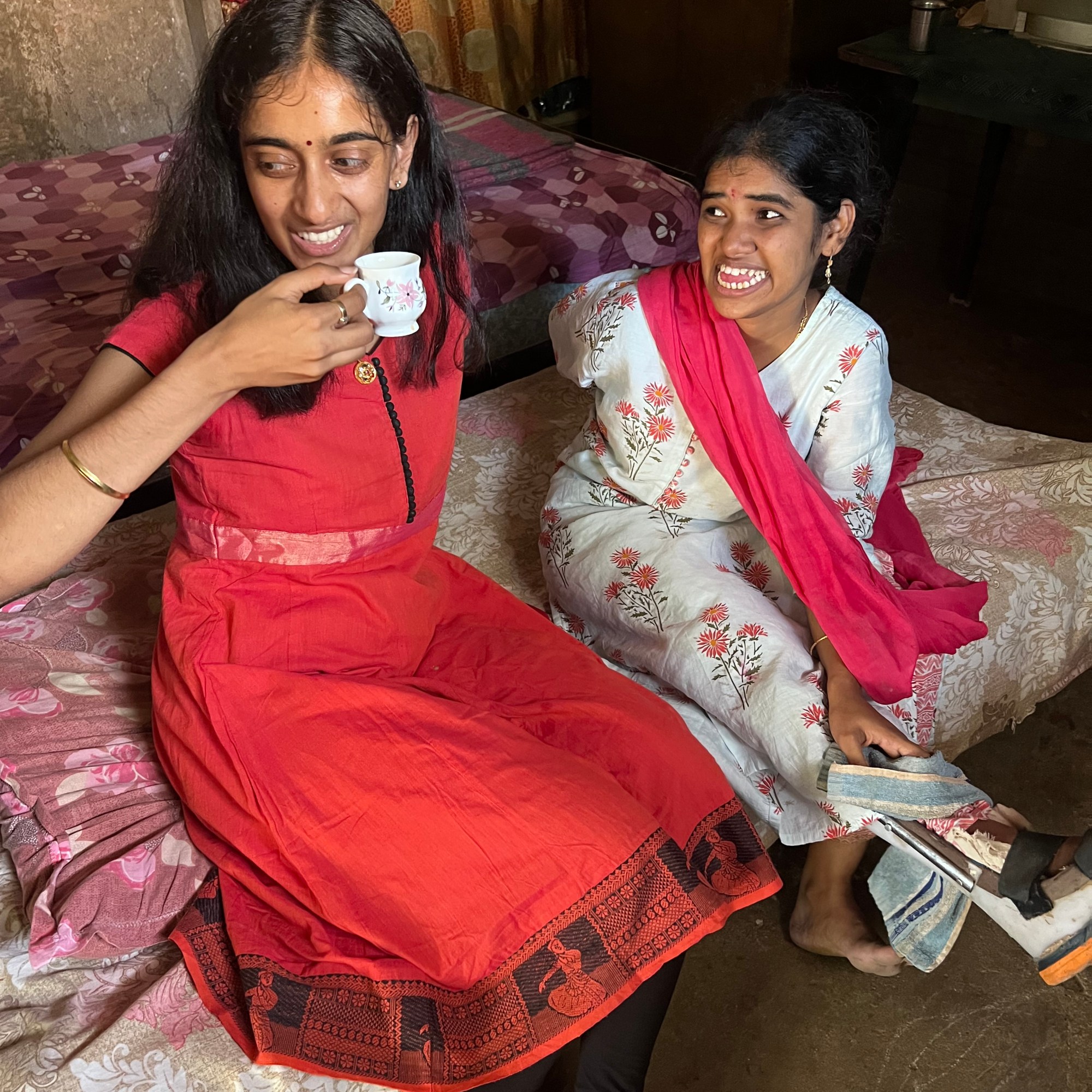
 I looked through the photos of the tiny woman – barely four feet tall, standing awkwardly on one leg while the other was wrapped past the knee in a metal brace. One arm was limp, and she held a phone with the other. Despite her overly large tongue which twisted outside her mouth, her eyes and mouth betrayed a broad smile. She wore a bright green half sari worn by unmarried women with white sash and had a big red dot in her forehead.

“I first saw her seven years ago.” My father said, “when I went to grandpa’s village to inaugurate the health clinic. She came with her parents on her hand and knees. She has knee pads on and a wooden clog on the left hand. I asked her father what was wrong with her. He told me she was born that way. She was eighteen at the time.”

Vandram is a tiny village that can only be reached by a five kilometre, rutty, dirt road that a car could barely navigate. The village is poor by local measure and clings to a canal that often overflowed and clawed away part of the road. Unlike prosperous villages nearby, Vandram could not enter into highly profitable fish and shrimp farming. Instead it would continue to grow rice in small holdings and often could only have one crop annually rather than two. The changing weather has made the rains more and more intense and inconsistent and the yields had been dropping for years.

Anusha’s family are extremely poor. They welcomed us into their tiny dark home which opened into their only bedroom. Anusha was in ecstasy to have us visit. “That’s all she talks about.” Her father said through a noticeable stutter, “and when your father died she could not stop crying for days. Your father gave her a life.” He said and tears formed in his eyes. “Look,” he said, “she can walk now without any help”

My father had her sent to Hyderabad six years before and arranged to have her seen by a leading orthopaedic surgeon. They operated on her legs at great expense – inserting metal rods through one leg, and casting a knee brace on the other. It was deemed too risky to operate on her tongue but the speed and accuracy of her texting on the phone was far more efficient than most tongues.

We had been texting each other since the day I called to tell her my father died. That was four months before. She walked out of the door and back to demonstrate and sat beside my daughter and held her arms. “I can’t text as fast as you.” I said in Telugu and she laughed, and she texted that she is slower in English. When we got up to leave, she clasped my knees and tried to speak. “She is saying that your father is her god.” Her mother said.

“Is she getting Rs. I 2000 a month from the trust my father setup?” I asked. “Yes. Yes.” Her father replied. “I am the trustee now,” I told him, “so if you have any problems let me know.”

Several villagers had gathered outside the house. Many stood and watched with hands folded. I greeted them one by one and asked about their health. They only smiled and nodded their heads. We went back to the car. The village was otherwise still. The mid afternoon sun bore down and all living beings sought out the shade. I looked back at Anusha as we drove away. She smiled broadly. As we drove down the narrow village road I looked at my phone: Anusha texted in Telugu, “It is because of your father and your family, my life is not awful.” and she added in English. “I love you all, pedananna (elder father).”