At the southernmost tip of India, where the land narrows to a fingertip and touches three vast waters—the Bay of Bengal, the Indian Ocean, and the Arabian Sea—lies Tamil Nadu, a state that holds both the weight of history and the pulse of tomorrow. With a population nearly as large as Germany’s, this is a place where religion, myth, and modernity coexist in breathtaking symmetry.
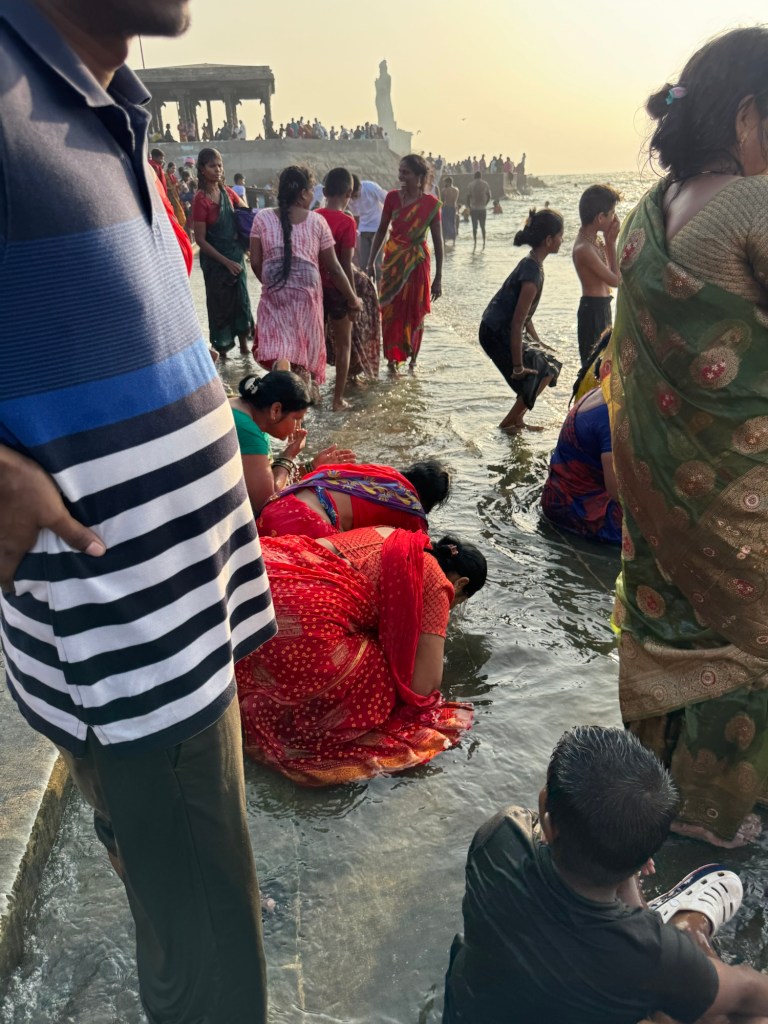
At dawn in Kanyakumari, thousands of pilgrims gleefully descend the stone steps toward the sea, clutching children and elderly as the waves crashed on the ancient stone steps. Beyond them rises the temple of the virgin goddess, Kanya Kumari – said to have forsaken marriage to Lord Shiva to save the world from a demon’s wrath. Inside, the crowd pushed against each other and the sanctum walls with a frightening sense of urgency.
Traveling northeast along the wind-swept coast, the symbols of modern Tamil Nadu turn with quiet precision—over twenty thousand wind turbines slice the horizon above palm groves along with ubiquitous power lines and cell towers.
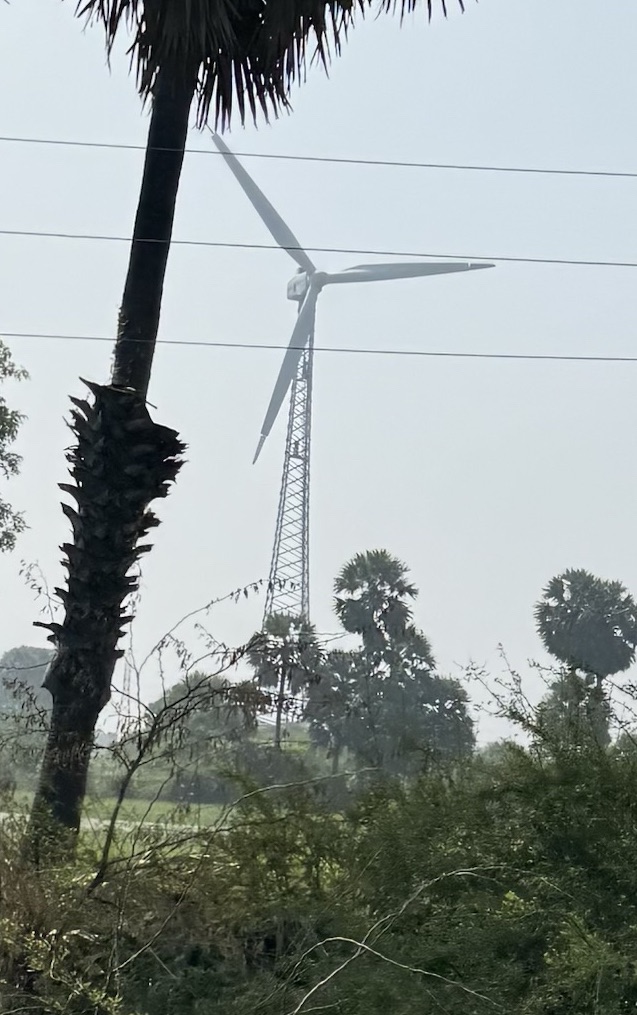
They provide a tenth of the state’s electricity. Solar farms, stretching across the sunbaked plains, contribute another ten percent. The goal: complete reliance on renewable energy by 2050 – a target that now feels less like ambition and more like destiny.
Yet this land has always drawn its energy as much from thought and myth as from the elements. Tamil Nadu has given the world some of its most luminous minds: Nobel laureates C.V. Raman (Raman effect), Subrahmanyan Chandrasekhar (Chandrasekhar limit), and Venkatraman Ramakrishnan (Chemistry) and even CEOs like Sunder Pachai of Google. Tamil Nadu’s most famous son is Ramanujan, one of world’s greatest mathematicians. Raised in a temple amongst myth and religion he famously remarked “An equation has no meaning for me unless it expresses a thought of God,” Tamil Nadu will forever be a land where logic and the divine deeply inform each other.
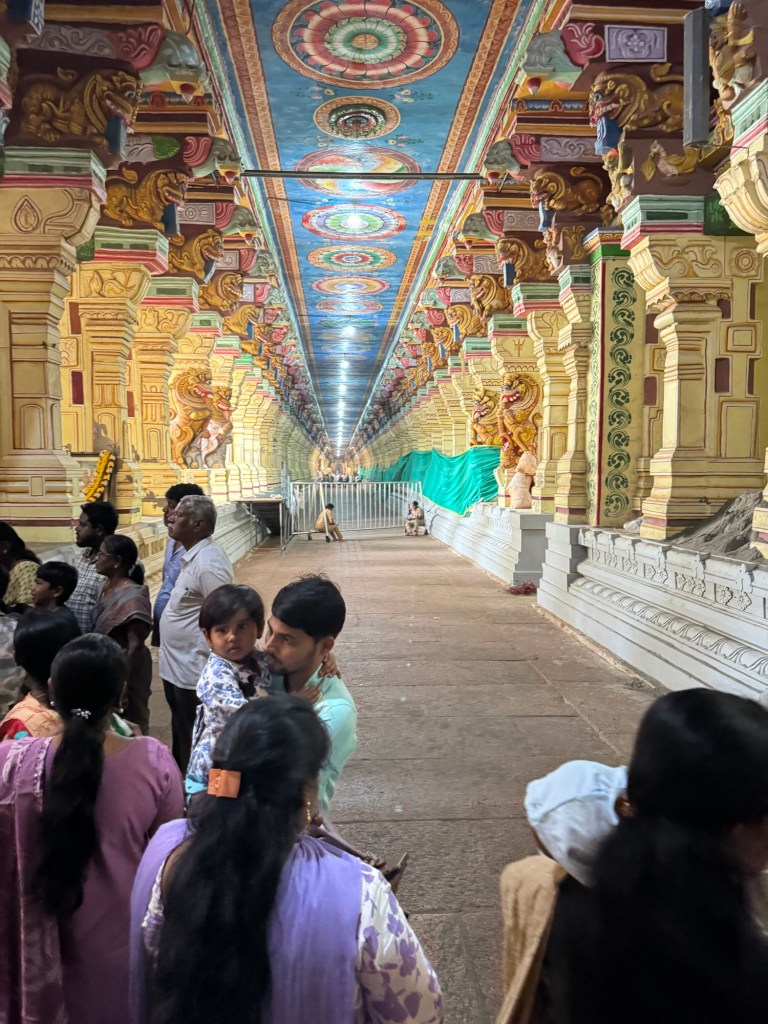
The state’s universities hum with young engineers and physicists, heirs to a legacy of learning that stretches back to ancient literature and exact mathematics of temple architecture with thousands of pillars.
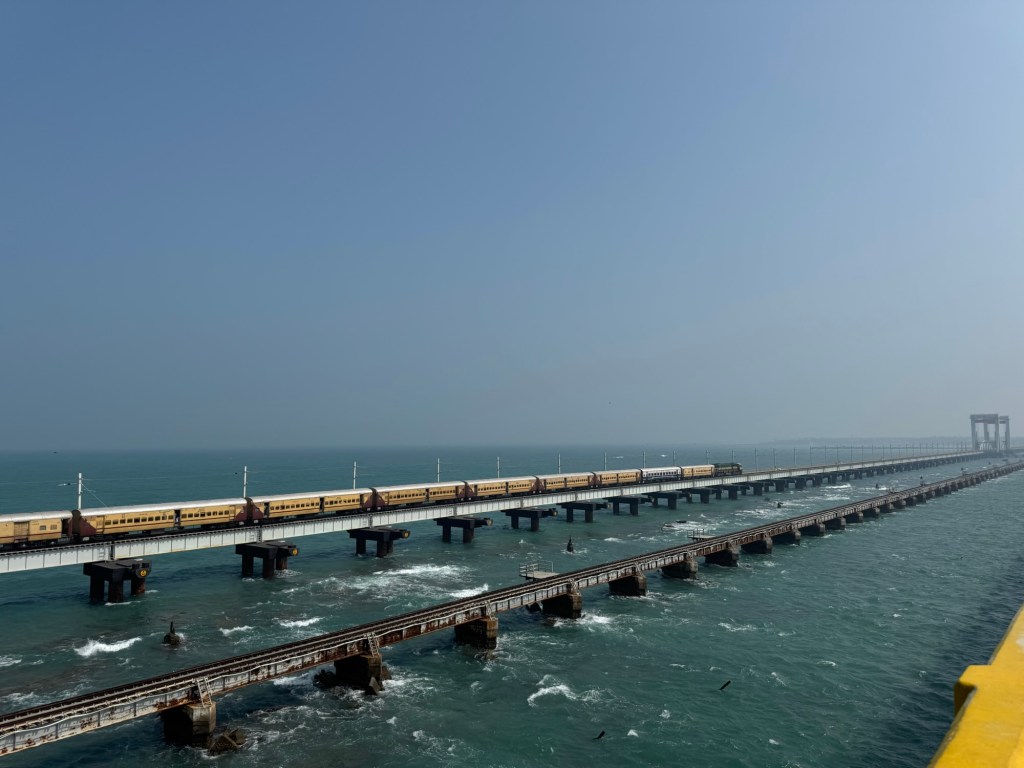
Farther east, the myths of Rameswaram unfold like an epic written in stone, coral and sand. Here, Lord Rama faithful companion, Hanuman is said to have built a bridge of stones to Shri Lanka. Pilgrims in red and saffron crowd the Ramanathaswamy Temple, its corridors cool and dim, echoing with chants of living and dead over the ages.
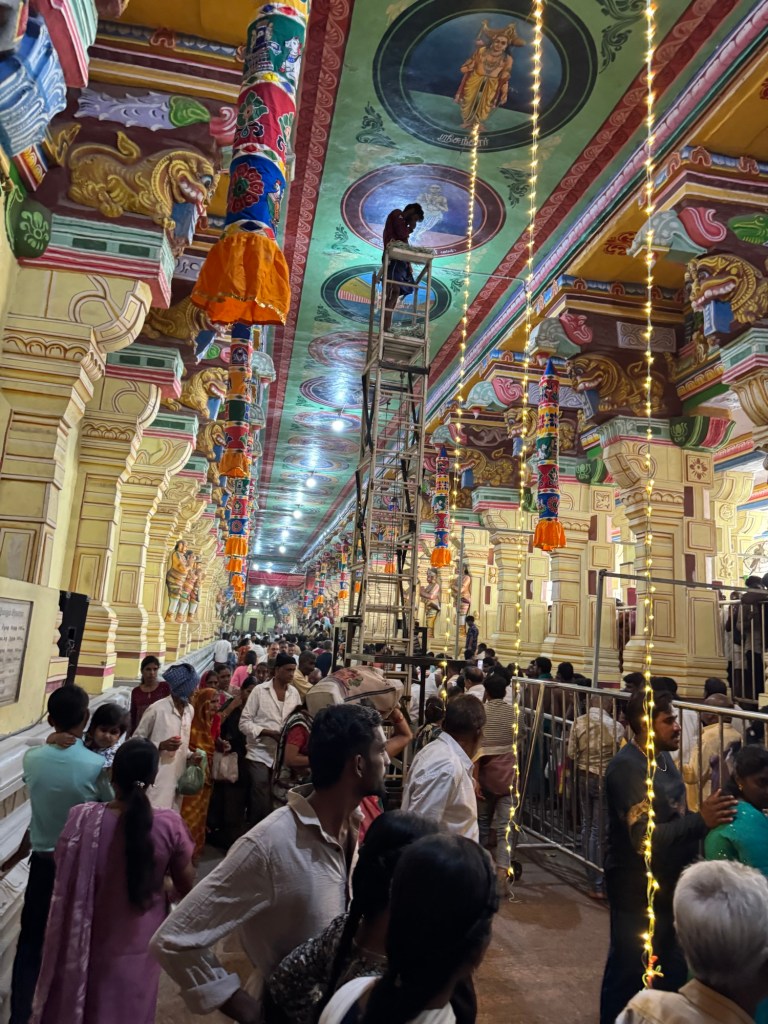
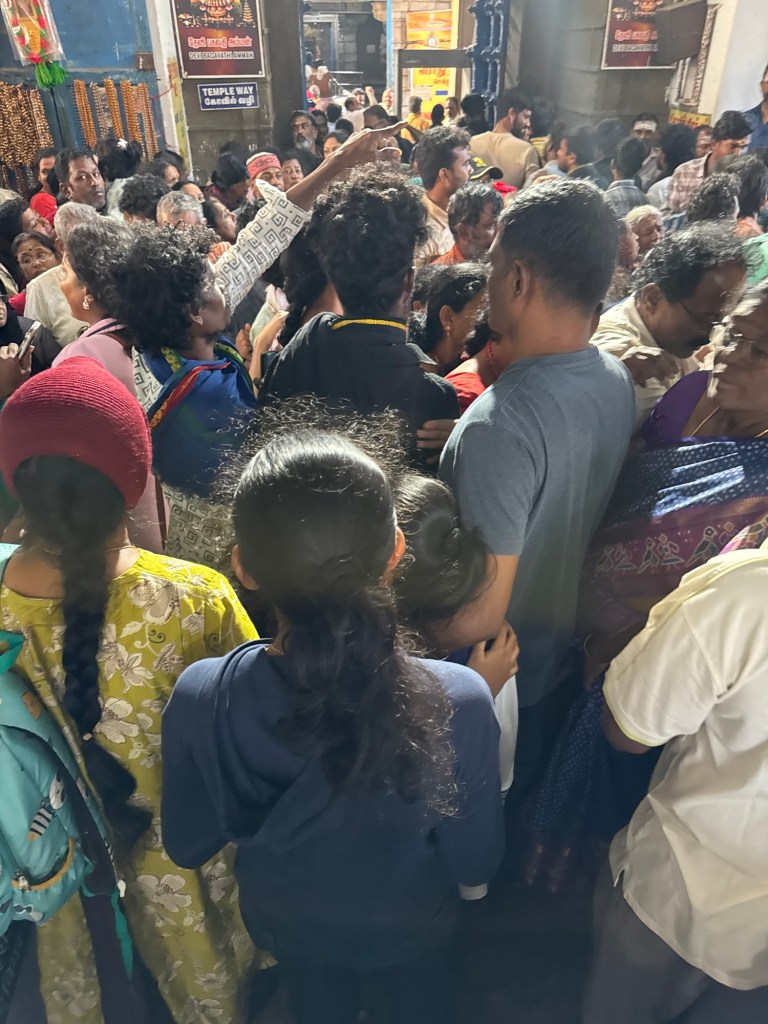
Yet, for all the prayers that millions pour into the temple nave, none will have even a second to reflect on the idol as priests marshal them through the line. The wealthy apparently have the privilege of paying thousands of rupees to go to the front of the line only to be hurried through as ignominiously. As one of four temples in the four corners of India that make up the required pilgrimage for Hindus in a lifetime, it is particularly busy in holiday season, with lines several hours long.
The sacred here is to be attained not granted. It is earned by being rooted in attention in the midst of chaos, not unlike the images of Hindu gods sitting on lotus leafs over troubled waters. Numerous pilgrims proclaim they sensed ‘a sacred vibration’ even in those split seconds. The sacred here cannot be approached in a blissful state from yoga and meditation, rather by sheer will to edge along narrow lanes and thousands of pilgrims, and crowding into tiny hallways with hands folded – some are blissful in this chaos, others weep from having arrived at the end of their arduous journeys.
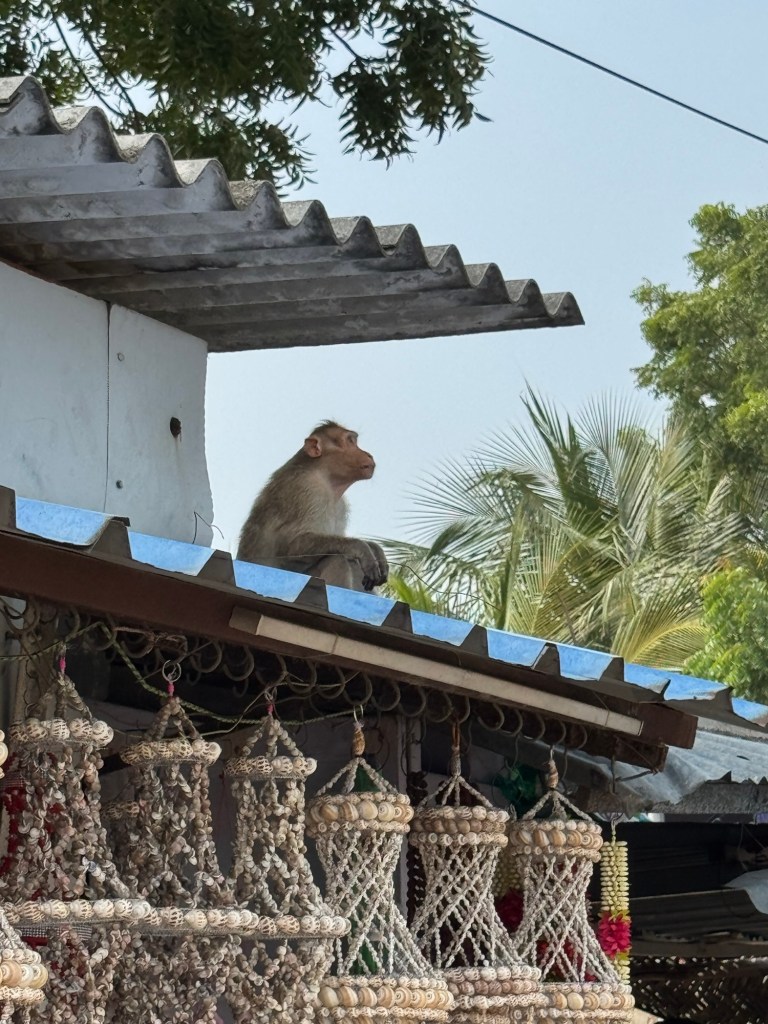
Buses, minibuses and cars which carried the pilgrims crowd the sides of each road. A twenty minute walk in any town in the world, is a 2.5 hour drive here. What appears as roads in google map are in truth tiny lanes – some of which may be blocked by construction. Most are effectively one way since the stream of cars and buses that fill the entire width of the street is never ending. The congestion and chaos of the road is remarkable.
Incoming cars from side streets gridlocked on the main street, neither side giving way even as several passersby spontaneously direct traffic while the policeman stands lost on his phone. Horns blaring, dogs barking and placid cows gracefully and nonchalantly weaving past man and machine, turning doleful eyes to shopkeepers for bananas and mango peels.
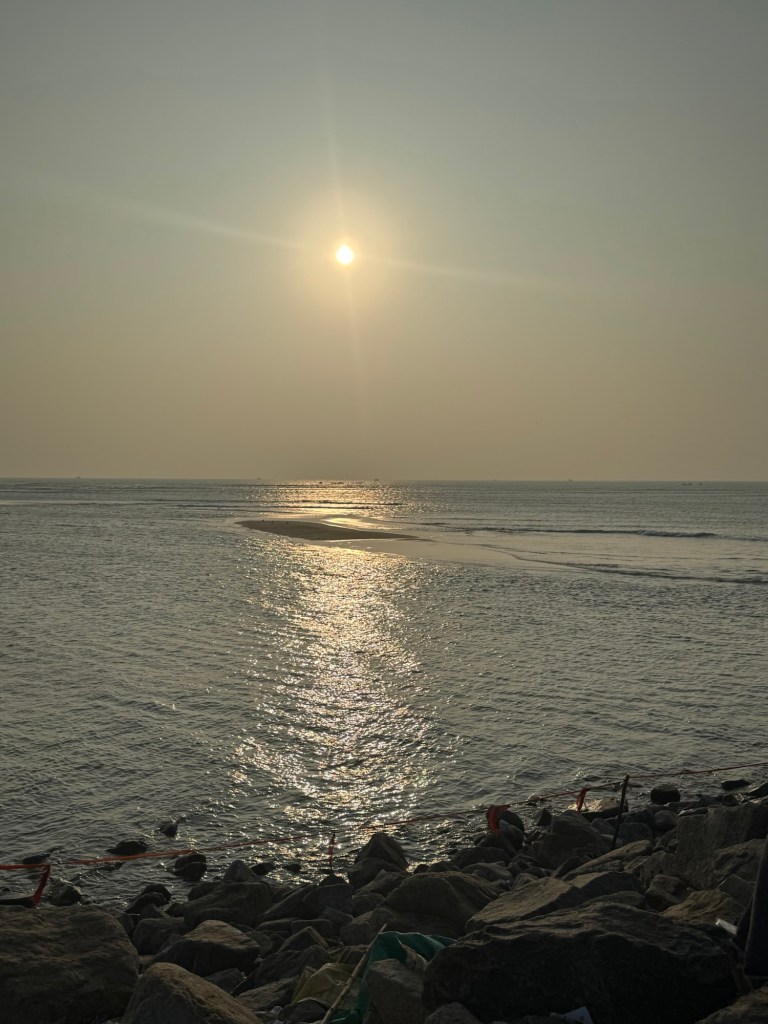
At the shore of Dhanushkodi – “Rama’s arrow”—the land ends abruptly. Only a few meters of foamy water separate India from Sri Lanka. As twilight deepens, thousands of visitors gather to watch the sun dissolve into the horizon, where legend and geography blur into one shimmering truth: Tamil Nadu is a place where the physical and the spiritual not only coexist, but depend on each other.
 Vidante