The mathematics of seeing in inexplicable, its laws indiscernible, its manifestation unpredictable. It is the mathematics in which to empty oneself is to be filled with hope, where to give of oneself is to receive immeasurably more. To come again to grandeur, knowing the work of our hands begins in failure, yet, in increments, the soul will stir and see itself.
Author: Ram Raju
Cathedral Patagonia
Patagonia, Argentina
Sweeping horizons of the Upsala Glacier and channel with rushing turquoise waters, mist covered mountains and racing clouds broken by beams of sunlight have the power to make the mind still and silence the travelers on the boat. The space is untouched by human works – save the lone low emission boat – preserving what is justly a human heritage. There are few thoughts, analogies, or words that could capture the sheer colossal artistry of this space. Perhaps the greatest poets of the world should be brought here to tell humanity of vast beauty and its power to transform and humble the human mind. If the body were a cathedral, the air as pure as the winds of Patagonia, and its blood as clean as the waters, and its being as still in the midst of movement as the sky, and soul as stirring as the deep blue icebergs and its limbs as profoundly quiet and strong as the glaciers, then mankind would count each of its days, its hours and seconds like deeply devote monks running beads through their fingers with love and care.
Glacier Bridge
Patagonia, Argentina
The massive glacier, merely a hundred yards away is still reverberating from the great collapse of the glacial bridge on two sides of the 50 foot divide of Lake Argentina. It had been breaking every 12 years for several decades but now breaks every 4 years as the waters from one side become higher and pressure the bridge to collapse. We arrived the morning of the greatly anticipated event. And the force of the break still shook the supported structure which continues to crumble.
Patagonia: Glacier bridge crash Every 4 years

Instrument
We can only clean the flute, care for it and prepare, and then wait. You, master flutist, may not come, yet, we begin and prepare and wait again and again. Perhaps you will come in an hour, a week, a year, or perhaps never. But what right have we but to prepare and wait. You have left us with little choice, other than to be a servant or slave. We strive to master the world only to surrender to a life of waiting for your breath.
Tilcare: Chicken Dish at La Carmela
Tilcara, Humahauca, Jujuy. Argentina
The restaurant, La Carmela, is nestled across the street from the main square where disinterested sellers man the native artisan stalls. The wind whips up the dust on the tiny main street that runs from the highway to the small cathedral. It is mid-afternoon, around 2 pm., and almost everything is closed except for La Cantina. Tilcara is an ancient native village on the Quebrada de Humahuaca, a narrow mountain valley of the Rio Grande.
Since the Quebrada had not been discovered by western tourists language is a significant barrier to communication. I had already mis-ordered -having received one cheese empanada for my wife but no chicken empanada for myself. The tamales I ordered with my mixed Hispanio-english-pig-latin for my wife was to be with corn and cheese but instead we got beef pureed into the corn, hardly appetizing for her vegetarian palette. The white wine thankfully arrived as ordered though it was unceremoniously dumped on the table in a small, chipped, deformed, glass jug along with an upside down drinking glass. The regional dish, Picenta Pollo (chicken) is bland and soupy with a yellow – golden hue. It is served with local rice and a mixture of vegetables that are largely indistinguishable and a boiled potato. It is not
unpleasant to the eye, and with each morsel, more of this dish became discernible. The vegetables seem to contain finely scrambled eggs, onions, small chunks of sweet potato, and green garnish – possibly parsley.
The occasional dog, omnipresent in Argentina, looked longingly through the open door and was driven away by the young waitress who should have probably been in school. A bareback horse rider galloped past followed by a cloud of dust and a retinue of dogs. The television is on but thankfully on mute so the mournful but pleasant sound of native flutes playing tunes from the Beatles and Simon and Garfunkel waft over the square. The chicken dish, though mis-represented by the term “picante”, was satisfying. The taste and presentation could be compared to that of a well-made curry in North London to which the cook had mistakenly forgotten to add salt and chili powder and possibly any spices whatsoever. In the end the saving grace was the fact that the chicken was fresh, as if it had just minutes before run past the door like the horse and the dogs. The empanada was fresh as was the corn in the tamale and the husk it was wrapped in. The white wine that was poured from a barrel seemed pleasant after the three hour drive from Salta though sweeter than I wished. The proprietor’s attempt to close the frail and aged double doors is futile against the wind.
There is no sign whatsoever that the proprietor had any intention to make this restaurant as rustic as it is – the lamp shades are made of thin pieces of animal skin which are torn or missing, the “specials” board with an image of Coca Cola hangs tilted and absent of any specials. The flies that seem to appreciate the cool, dark, interior to the bright sunny street are lazy, possibly because they seem well fed.
The Quebrada is in the province of Jujuy (pronounced who-whoee) in Northern Argentina, and it is the least visited by foreign tourists. The hotels and restaurants are aimed at Argentine sensibilities, or more notably, sophisticated Buenos Aires sensibilities. The few hotels and restaurants are small and in minimally refurbished old buildings and those that are new are artfully integrated into the adobe style buildings of the villages.
There is visible evidence in the form of walls and irrigation system that dates it well before the height of the Inca dynasties in nearby Bolivia and Peru to which they paid homage. It is also the home of Pulcara de Tilcara, an ancient stone and mud fortress. The presence of tourists, mostly young couples from Buenos Aires, does not seem to affect its daily life and charm, as in more developed destinations such as Patagonia, Iguazu Falls, Mendoza and Buenos Aires – all worthy destinations and more easily accessible.
Argentina
Strange bedfellows we make, Argentina
You speak in a tongue I barely know
You wish for things you cannot have
Your manicured brows and painted lips
Will always allure and hold my imagination.
Yet we are bedfellows because we’ve turned our hearts to common things.
All the while, vast rivers weave through rainforest,
Waters pour from the Andes to feed grapevines, and loamy soil.
Glaciers melt into massive lakes, and seas pound the endless coast.
And wherever one turns the soft footballs of the soul are left untended.
Perhaps we were meant to be bedfellows for I too forget.
My ears are stopped by pursuit of the ordinary,
My eyes no longer see, my touch has gone cold.
The movements of unseen truths, the beckoning of unrequited love,
the scent of subtle spirit elude me as much as you,
So cry for us, Argentina, for the power and wealth you seek passes by each living moment.
Sunset on a Sailboat

Mangrove in the Estuary
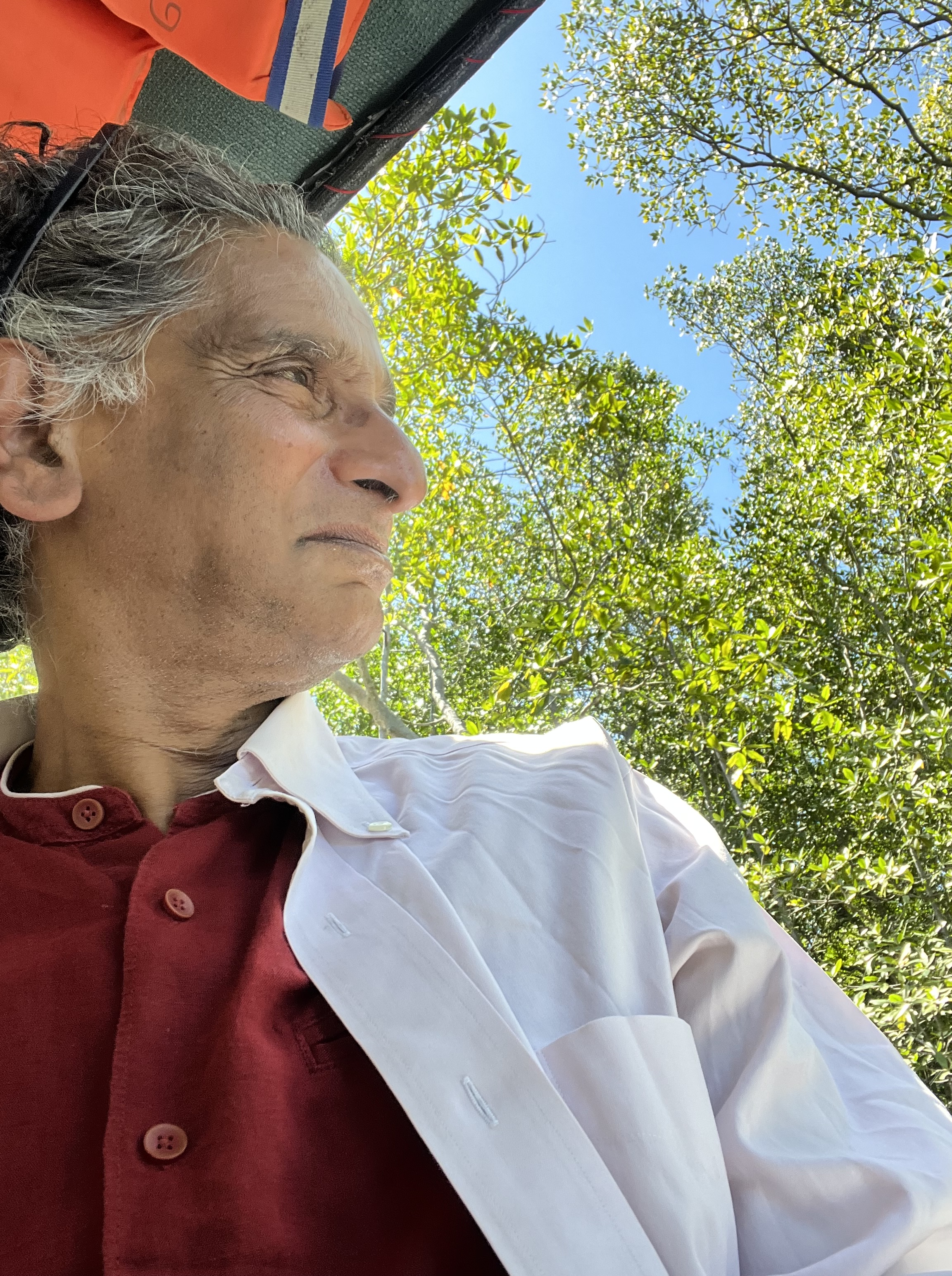
The deep silence of the mangrove at midday saturates sensations with transcendental attention

Abandoned Temple in Katmandu
 Vidante