Late in the afternoon, the road approaching Chennai’s airport had settled into its usual state of anarchy. What should have been three lanes behaved more like a migrating herd, forever splitting and merging, vehicles nosing into any open space with the persistence of thirsty animals at a shrinking waterhole. The tuk-tuks pierced the din with nervous, high-pitched beeps; scooters whined in protest; and trucks thundered in deep bellows. Some two-wheelers, equipped with truck horns, seemed more able to clear the way in front of them.
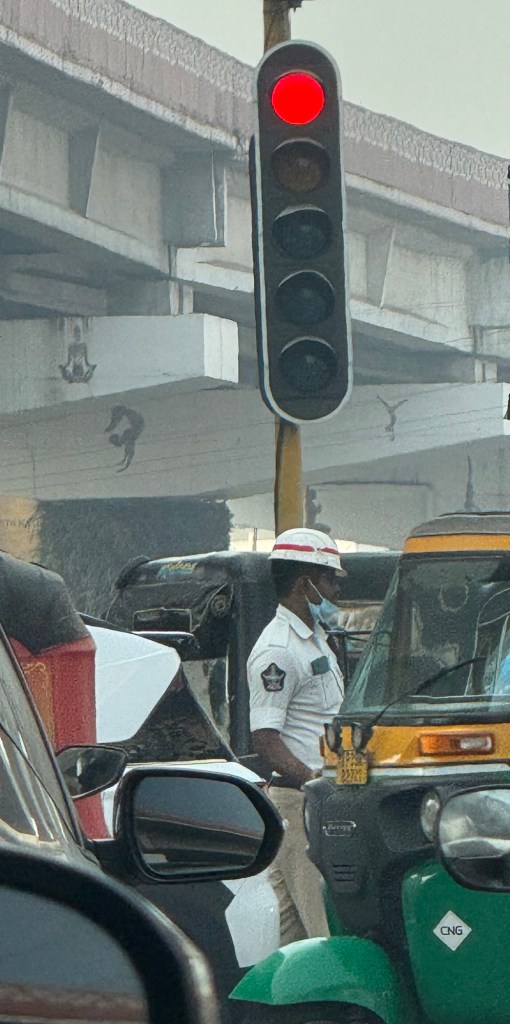
Just as the traffic light ahead turned orange, our car slipped through. A few metres on, two khaki-clad policemen ushered several cars to the curb – ours among them. We joined a silent procession of vehicles: a line of drivers standing by their cars, staring ahead with calm, distant, somewhat resigned looks.
Our driver walked over to a policeman, exchanged a few quiet words, and then returned, shoulders slightly lower. “Saar,” he said, leaning in through the window, “one thousand rupees.”
“For what?”
“For a bribe, Saar.”
There are moments in travel when a place introduces itself not with a monument or a meal, but with a single, perfectly honest sentence. This was one of them.
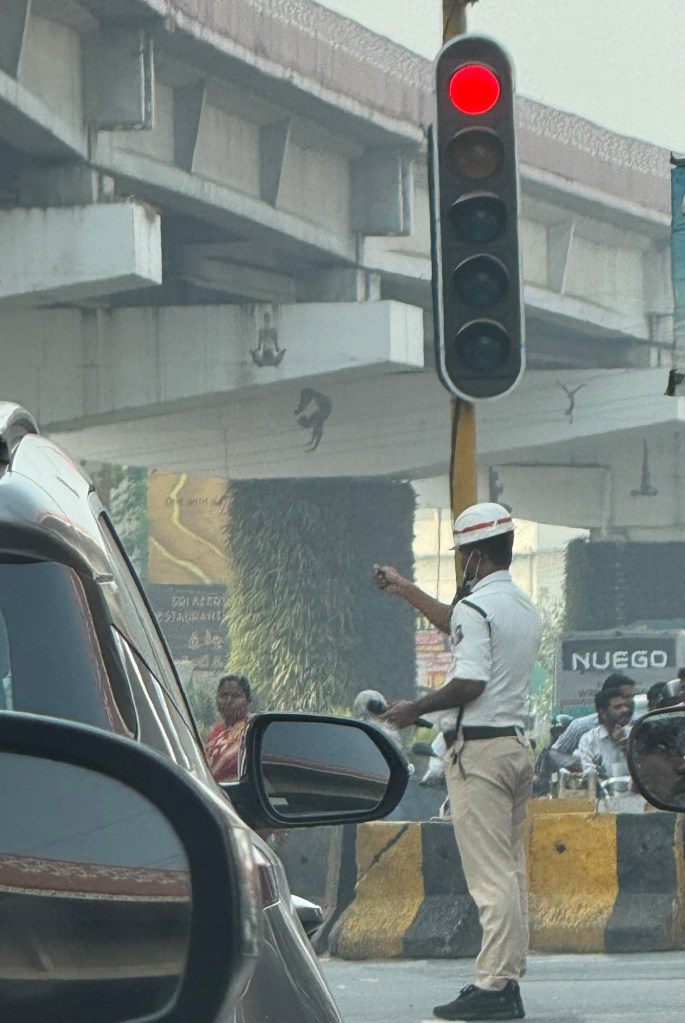
“What did we do wrong?”
“He says we crossed on red,” the driver replied.
“But you didn’t,” I said. “It was yellow. Does he have a photo?”
The driver’s eyes did a brief tour of the heavens, then returned to mine. “Saar, it is not worth arguing. He asked for two thousand. I agreed for one thousand. It is better this way.”
Somewhere behind us, a horn performed a long, operatic solo, perhaps in sympathy.
“Why not pay him with Google Pay?” I muttered, ‘like you pay for everything else.’
He turned, scandalized by my naïveté. “This is why they are going cashless, Saar. These people do not take Google Pay. You cannot bribe in e-comm.” He shook his head slowly, as though disappointed by my fundamental misunderstanding of it. Money changed hands with quiet efficiency. A nod from the policeman, and we were released back into the stream, the traffic folding around us as if we had never left.
“So how much is the actual fine for going through a red light?” I asked.
“Two hundred and fifty rupees,” he said.
“And he asked for two thousand?”
“Yes. I settled for one thousand.”
Outside, the vehicles resumed their restless ballet, slipping across lanes.
“What would he have done if you refused?”
The driver did not hesitate. “They only stop cars from outside Chennai. Those with Out-of-state, out-of-town license plates. They know which ones are going to the airport. They can keep you here six, seven hours, slowly raising the price.”
He nodded towards the lorries thundering past. “Those trucks are not going to the airport. Local cars, maybe. Auto-rickshaws, no money. You, Saar…” He tilted his head at me with a faint smile, “…you are airport.”
He let that sink in for a moment, then added, almost kindly, “Think of it as airport tax.” He laughed then, a short, helpless laugh before I laughed with him — at the system, at the day, at the way a simple traffic stop could lay bare an entire ecosystem of opportunism and adaptation. All the while, I silently admired the business acumen and teamwork of the policemen – where to operate, how to target your customer, and how to price appropriately. The cacophony of dissonant horns rose again around us. It seems Old India is still lurking, albeit in its last throes.
 Vidante