San Pedro, Belize
Pancho Patas has a commanding presence. He moves slowly, each step deliberate. His smile exuding warmth and his eyes the assurance of a self-actualized man radiating a paternalistic aura. The legion of young men around him was his ‘crew’ and each of them seemed congenial and light-hearted – exchanging complex handshakes, shoulder, and fist bumps. The camaraderie and joviality were shared with each new patron that walked in the tiny pub named, ‘Rehab: For Failed Addicts’’ in San Pedro, Belize. Even the three policemen on duty, while still in uniform, went through the gauntlet of greetings, ambled over to the bar, grabbed a beer each and stood outside like sentinels at ease. Perhaps more like relaxed tourists. The small playground was filled with children and mothers. Around the sidewalk, street food vendors cooked on open fires – jerk chicken, jerk fish with rice, kidney beans and coleslaw – all for five US dollars. The sea lapped at the edge of the beach, the moon shimmered on the water while in the distance white water crashed into what is the second largest barrier reef in the world.
The disk jockeys and their friends revved up the rap and reggae, swayed, rocked, threw out their arms with sharp gestures and moved their heads around their necks which seemed made of rubber. The signs on the ceiling, walls, and pillars loudly pronounced, ‘we don’t serve women here, you have to bring your own’, ‘drink triple, see double, act single’, or ‘alcohol may actually cause pregnancy’.
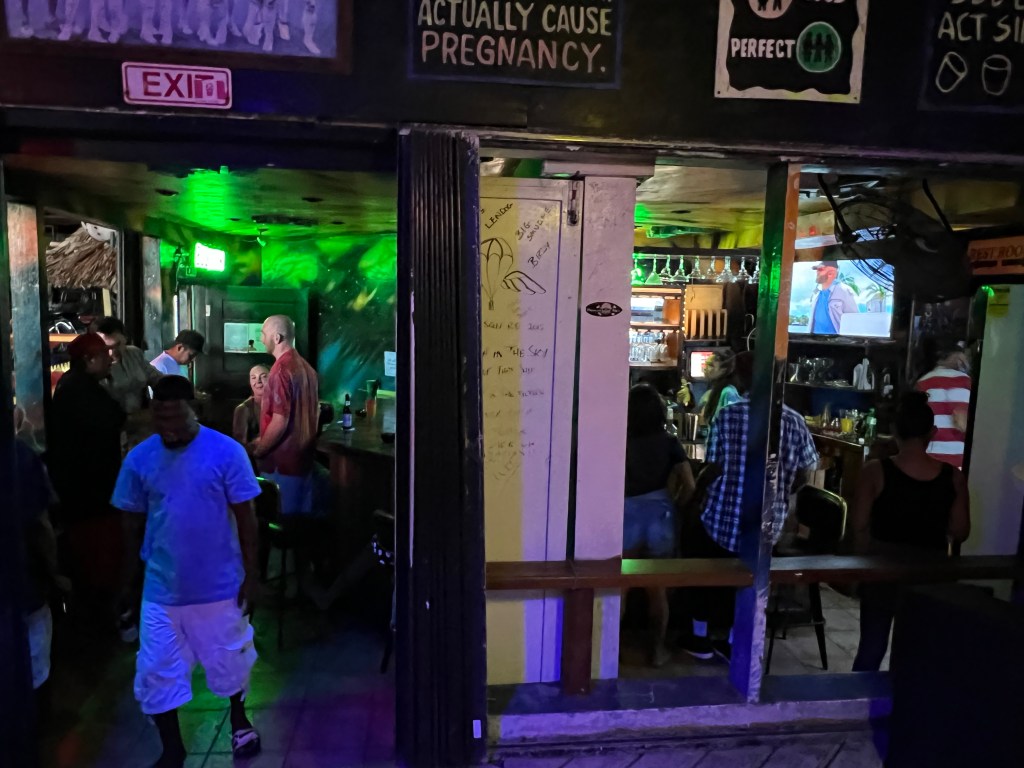
Before long, Pancho Patas came out to the verandah and I noticed for the first time that his t-shirt had Tupac Shakur emblazoned across the front. My son, a digital nomad, who had recently moved to Belize had once cured me of my harsh view of rap music by making me sit through a one-hour drive listening to Tupac. I had bought his collected works since. Pancho Patas walked directly to me and with a broad smile put a large cube wrapped in tin foil in my hand and said something in local Creole I couldn’t understand. I accepted gracefully and followed my thanks with a string of fist bumps, shoulder bumps, and the one complex handshake I knew since college – thumb to thumb, moving to full handshake, withdrawing into a snap of the middle finger and thumb, and ending with a fist bump. Pancho Patas added the shoulder bump while clasping my hand and pointed to my son, “He good man, Mr. Dad” he said and threw his arms in the air and gingerly, with a grace of a dancing bear, leaned into his slow stride to dance, two steps in each direction.
It was only when he turned his back that I looked at the tin foil wrapped cube and helplessly turned to my companions. “He likes you man” the American woman that I met at the hostel said and whispered, “its hash and mushrooms”. “But…” said I, “I don’t smoke this stuff.” She smiled and slipped it into her purse, “We want to take it,” she said and added, “he is a kingpin in this town.”
 Vidante